
Accelerating Discovery: How ML Surrogates Unlock Emergent Dynamics in Complex Systems
Surrogate Modelling for Efficient Discovery of Emergent Population Dynamics
The paper introduces a hybrid discovery framework that combines Genetic Algorithms (GAs) with Artificial Neural Network (ANN) surrogate models to find emergent population dynamics in complex Agent-Based Models (ABM). By utilizing the FLAME GPU framework and HPC environments, the method replaces expensive simulations with low-latency ML predictions, achieving equivalent solution quality at significantly higher discovery speeds.
TL;DR
Discovering emergent behaviors in complex systems (like stable predator-prey oscillations) usually requires thousands of slow, expensive simulations. Researchers from the University of Sheffield have demonstrated a hybrid GA-ML approach that uses GPU-accelerated batch simulations to train Neural Network surrogates. This "pre-search" strategy slashes discovery latency by 50% and allows for virtually instantaneous evaluation of candidate solutions.
The Bottleneck of Emergence
In Agent-Based Modeling (ABM), the "whole" is often greater than the sum of its parts. Individual rules for predators and prey lead to macro-level patterns—like population oscillations—that are impossible to predict analytically. To find the "sweet spot" of parameters that generate these patterns, we typically use Genetic Algorithms (GAs).
However, there is a fundamental mismatch in hardware utilization:
- Simulation: Can be massively parallel (GPUs).
- GA Search: Is inherently sequential (Generation 2 depends on Generation 1).
- The Pain Point: Evaluating each generation through a full simulation creates a massive bottleneck, leaving expensive HPC resources underutilized between generations.
The Strategy: Front-Loading the Computation
The authors' core insight is to decouple the simulation from the search. Instead of running simulations "on-the-fly" during the GA, they perform a massive batch of 50,000 simulations upfront.
1. The Architecture
Using FLAME GPU, they generate a massive response landscape. This data is fed into an Artificial Neural Network (ANN) with two hidden layers.
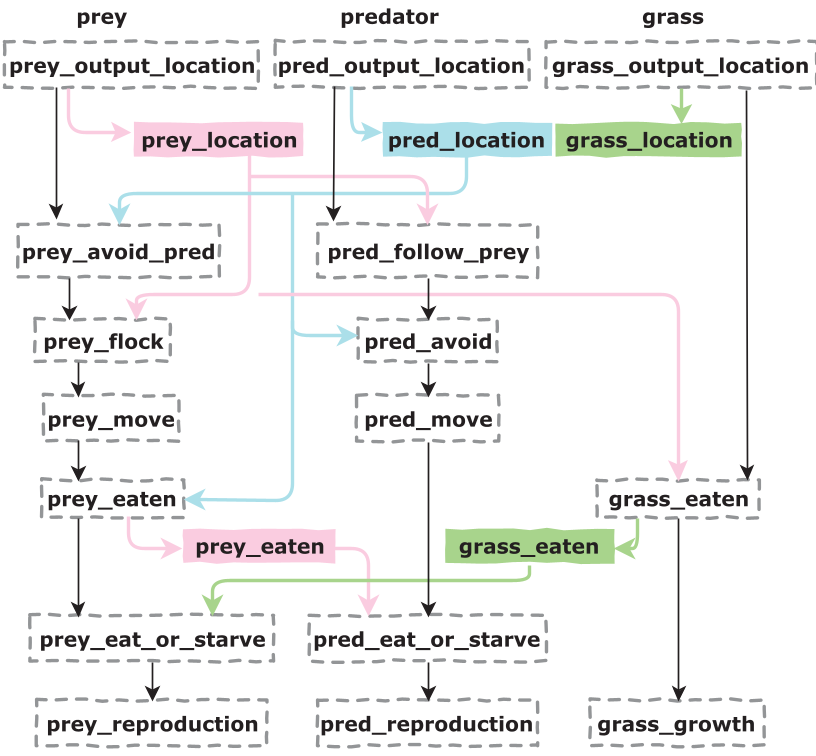 Fig 1: The workflow shifts cost to a highly parallel pre-search step.
2. Regression vs. Classification
The paper explores two ways to define "success" (Fitness):
- Discrete (Classifier): Did the population survive? (Easy to define, but creates a "sparse" landscape that is hard for ML to learn).
- Continuous (Regressor): How long did it survive? (Provides a "gradient" for the ML to follow).
Experimental Showdown: Simulation vs. Surrogate
The study compared a traditional simulation-guided GA against their hybrid surrogate-guided GA.
Key Findings:
- Latency: Training the surrogate + running 10 GAs took ~560 minutes, whereas the simulation-guided baseline took ~1034-1363 minutes.
- Scalability: While the simulation GA is limited by sequential steps, the surrogate training scales linearly with the number of GPUs.
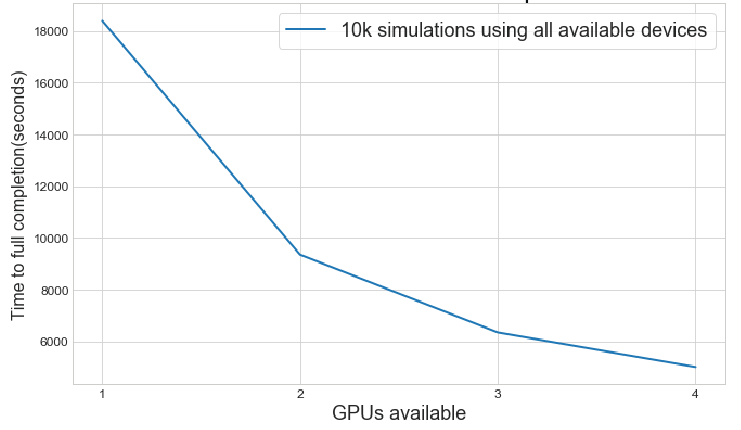 Fig 2: Adding more GPU devices provides near-linear performance gains for data generation.
The "Rare Event" Problem
One critical insight was that the Discrete Classifier struggled with overfitting. Because stable oscillations are rare, the model "memorized" the few successful training examples rather than learning the underlying dynamics. The Continuous Regressor was much more robust, providing a more accurate fitness landscape for the GA to navigate.
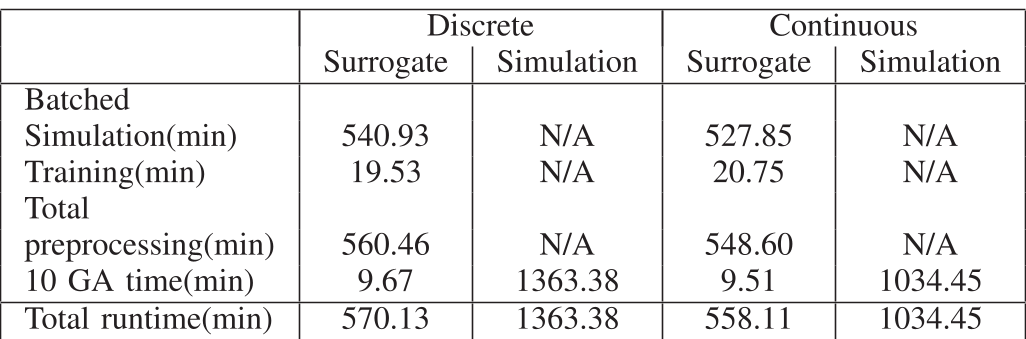 Table 1: Relative efficiency comparison shows significant total runtime savings for the hybrid approach.
Critical Insight: When to use Surrogates?
The authors are intellectually honest: if you only need one solution, just run the simulation-guided GA. The "overhead" of training a surrogate isn't worth it for a single run.
However, for large-scale discovery—where you want to map the entire parameter space or find hundreds of diverse high-quality solutions—the surrogate approach is the undisputed winner. It converts a "High Latency" expert task into a "Low Latency" exploration tool.
Conclusion & Future Directions
This work proves that even relatively "simple" ANNs can act as powerful surrogates for complex ABMs if the fitness function is designed correctly (favoring continuous gradients over discrete flags).
The next frontier? Evolution Control. By selectively updating the surrogate with real simulations during the GA (Active Learning), researchers could potentially achieve high accuracy with even less initial training data.