
Decoding Robot Empathy: A Survey on the Evolution of Speech Emotion Recognition
A survey on the development of intelligent robots in speech emotion recognition
This paper provides a comprehensive survey of Speech Emotion Recognition (SER) for intelligent robots, contrasting traditional machine learning (SVM, GMM) with modern deep learning architectures (CNN, RNN, LSTM). It evaluates leading methodologies across standard datasets like IEMOCAP and EMODB, highlighting the paradigm shift toward end-to-end learning.
TL;DR
This survey maps the technological trajectory of Speech Emotion Recognition (SER), a cornerstone of Affective Computing. It explores the transition from hand-crafted acoustic features and Support Vector Machines (SVM) to sophisticated End-to-End Deep Learning models (CNN-LSTMs with Attention). The goal is to bridge the "empathy gap" in intelligent robots, allowing them to perceive not just what is said, but how it is felt.
The "Empathy Gap" in Robotics
While modern service robots excel at precision tasks in medicine and home service, their interactions remain "mechanistic." The primary hurdle is that human emotion is both abstract and multidimensional. Researchers generally tackle this using two frameworks:
- Categorical Theory: Classifying speech into discrete buckets (Happy, Sad, Angry, etc.).
- Dimensional Theory: Mapping emotions onto a continuous Valence-Arousal coordinate system.
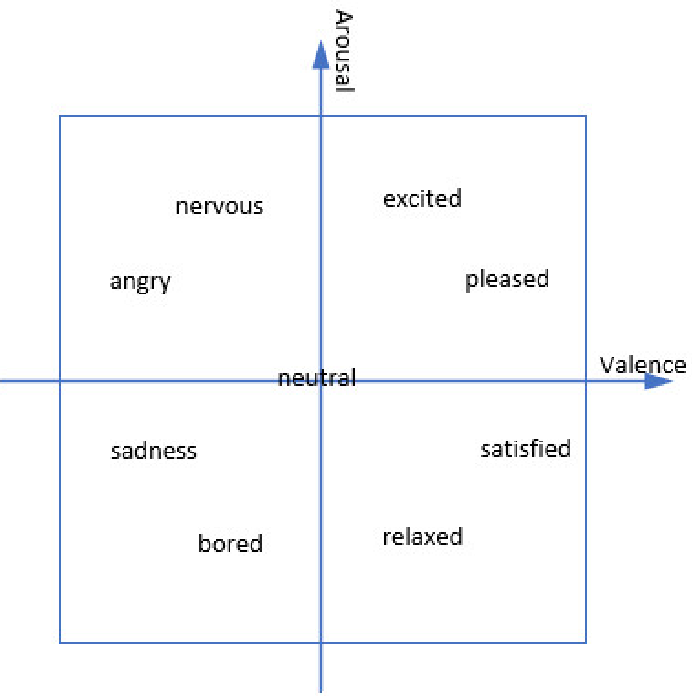 Fig 1: The Valence-Arousal space used to model subtle emotional nuances.
Methodology: From Kernels to Context
1. The Traditional Guard: Support Vector Machines (SVM)
For decades, SVMs were the gold standard due to their effectiveness with small datasets. By using Kernel Functions (Gaussian or Linear), they map low-dimensional acoustic features into high-dimensional space to find the "optimal hyperplane" for emotion separation.
- Pros: Solid theoretical foundation, works well with limited samples.
- Cons: Highly dependent on manual feature extraction (MFCCs, pitch, energy).
2. The Deep Learning Revolution: RNNs and LSTMs
Speech is inherently sequential. Recurrent Neural Networks (RNNs) revolutionized SER by extracting contextual information across time. However, to solve the "vanishing gradient" problem, Long Short-Term Memory (LSTM) units became the preferred variant.
The introduction of the Attention Mechanism was a game-changer. It allows the model to "focus" on specific segments of an utterance that carry the highest emotional weight (e.g., an aspirated sob or a sharp rise in pitch), mirroring human auditory perception.
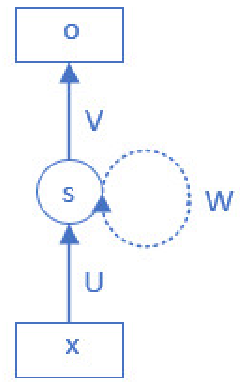 Fig 2: The standard RNN architecture for processing temporal speech sequences.
Battle of the Models: Traditional vs. Deep Learning
The survey highlights several critical experimental findings:
- End-to-End Advantage: Modern models (like CNN-LSTMs) can process raw audio or spectrograms directly, removing the bias of manual feature selection.
- Hybrid Power: Combining CNNs (for spatial features in spectrograms) with LSTMs (for temporal dynamics) leads to state-of-the-art results.
- The "Happiness" Paradox: Multiple studies (Wang et al., Ghosh et al.) noted that "Happy" segments are frequently misclassified as "Angry" because both exhibit high arousal.
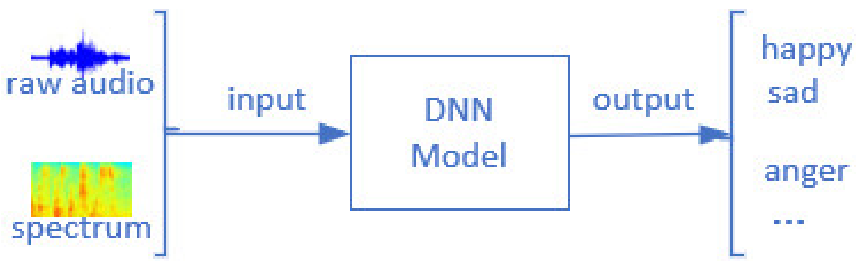 Fig 3: The End-to-End Deep Learning pipeline for automated feature discovery.
Critical Analysis & Future Outlook
Despite the progress, the field faces three "Grand Challenges":
- Data Scarcity: Emotional labeling is subjective and expensive. Future work must leverage Semi-supervised learning and Data Augmentation (e.g., using the Retinal Imaging Principle for spectrograms).
- Explainability: Deep learning models are often "black boxes." For a robot to be trusted in a medical setting, we need to understand why it perceived a specific emotion.
- Complexity: Most current research focuses on "Basic Emotions." Recognizing complex states like anxiety, disgust, or sarcasm remains an open frontier.
Takeaway: The transition from feature engineering to representation learning marks a milestone in HRI. As robots become more emotionally perceptive, the boundary between "calculating machines" and "social companions" will continue to blur.