
Architecting Connection: A Deep Dive into Social Link Recommendation
15176_A Survey of Link Recommendation for Social Networks Methods, Theoretical Foundations, and Future Research Directions.
This paper provides a comprehensive survey of link recommendation in social networks, categorizing methods into learning-based and proximity-based approaches. It uniquely synthesizes technical methods with foundational social and economic theories, such as Homophily and Social Interaction Theory, to explain the "why" behind recommendation efficacy.
Executive Summary
Link recommendation—the "People You May Know" engine—is the heartbeat of modern social platforms. This survey paper by Li et al. transcends the typical algorithmic review by bridging the gap between machine learning methodology and socio-economic theory. It categorizes the field into learning-based and proximity-based models while challenging the industry to look beyond pure accuracy toward "Utility" and "Diversity."
The Problem: The "Why" vs. the "What"
Current link recommendation systems are often treated as black-box optimization problems. We know that if two users share 10 friends, they are likely to connect. But why? Is it because they share a social "focus" (workplace/school), or is it a psychological drive for "cognitive balance"? Most existing research fails to map these social intuitions to the math, leading to models that might optimize for clicks but fail at building healthy, diverse, or high-value networks.
Methodology: The Two Pillars of Recommendation
The authors categorize the state-of-the-art into two primary schools of thought:
1. Learning-Based Methods
These treat link formation as a supervised learning task.
- Classification: Using SVMs or Decision Trees to predict a binary label (0 or 1) based on features like node attributes or path lengths.
- Probabilistic Models: Systems like Supervised Random Walks that estimate the likelihood of a link by simulating movements across the graph.
- Relational Learning: Using the dependency structure of the data itself (e.g., the "Area" of a paper depending on the "Journal") to infer missing links.
2. Proximity-Based Methods
These are the industry workhorses due to their computational efficiency.
- Nodal Proximity: "Birds of a feather flock together." Measures similarity in age, location, or interests (Cosine Similarity, Jaccard Coefficient).
- Structural Proximity: Highlighting the importance of the graph's topology. This includes Neighborhood-based metrics (Common Neighbors, Adamic/Adar) and Path-based metrics (Katz Index, PageRank).
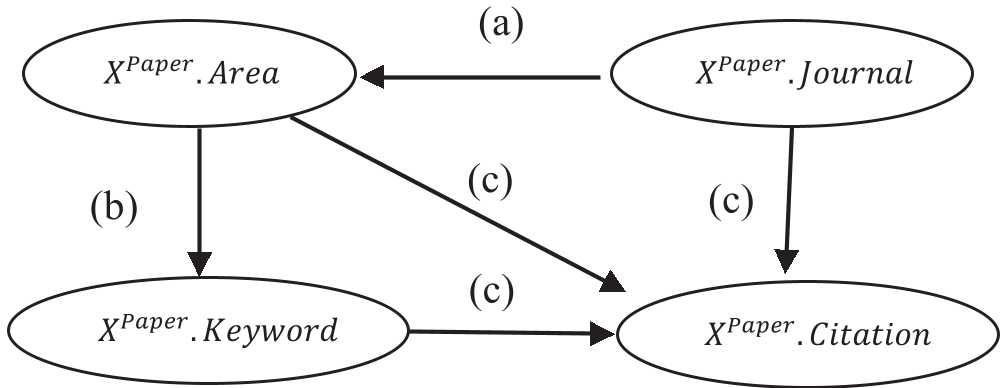 Figure 1: A Relational Dependency Model showing how attributes and linkage relationships interact.
The Theoretical Bridge
This is the paper's most significant contribution. It maps algorithms to established social theories:
- Homophily Theory: Justifies Nodal Proximity—similar entities connect at higher rates.
- Social Interaction Theory: Explains why your utility depends on your neighbors' decisions—the basis for probabilistic neighborhood models.
- Cognitive Balance Theory: Explains "Network Transitivity" (the friend of my friend is my friend)—the logic behind path-based measures like the Katz Index.
Critical Insight: Beyond Accuracy
The authors argue that the industry is hitting a "plateau of accuracy" that ignores three critical frontiers:
- Utility-Based Recommendation: Not just will they link, but what is the value of that link? (e.g., does it increase ad revenue or platform stickiness?).
- Diversity: Recommending only similar people creates echo chambers. True network value often comes from "long-range links" that bridge disparate communities.
- Incomplete Data: Most models assume we see all relevant features. In reality, extrinsic factors (unobserved "focuses") drive many connections.
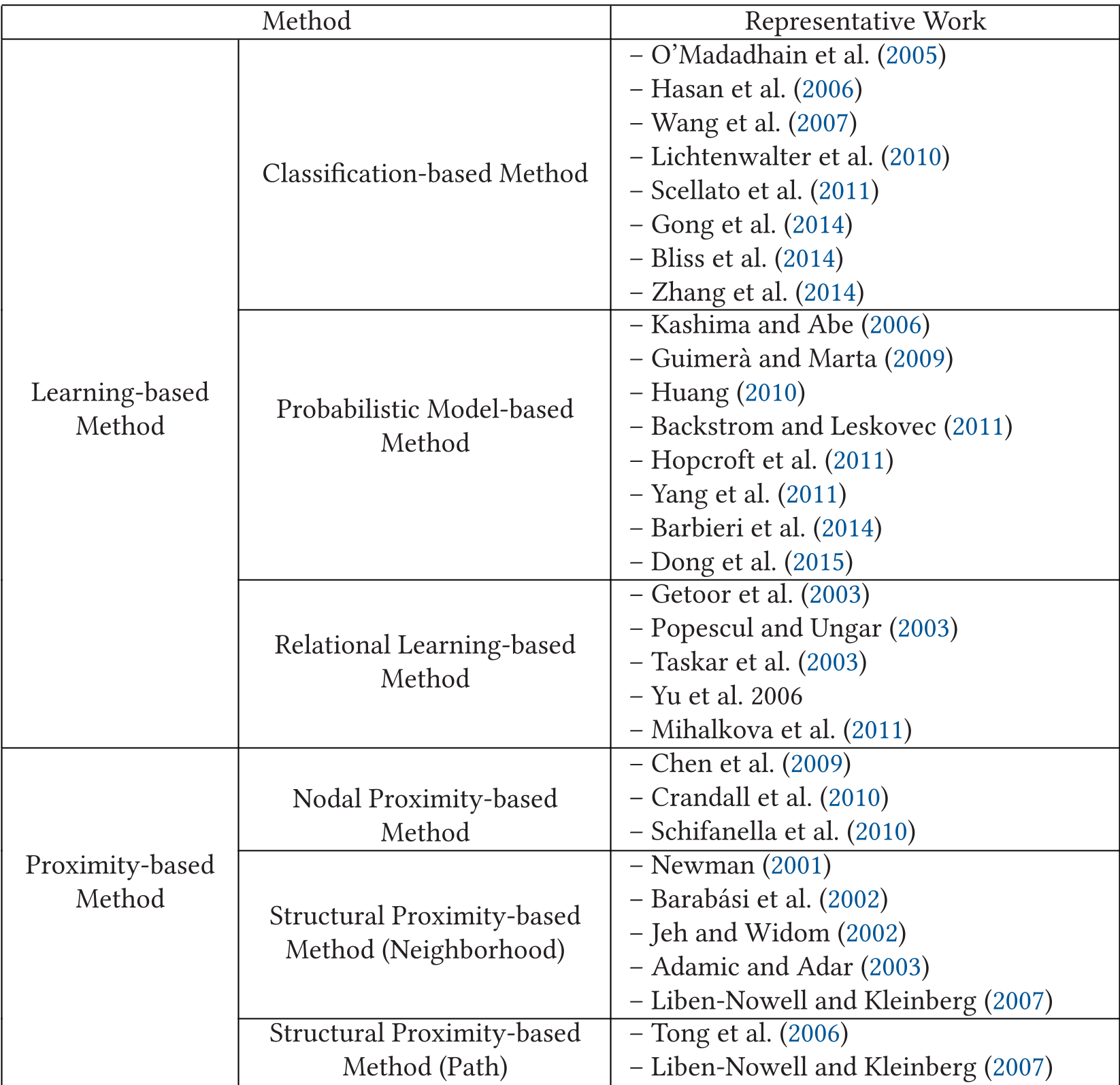 Table 1: Classification of Representative Link Recommendation Works.
Conclusion and Future Outlook
The paper concludes that we must move toward Experimental Study. Archival data (historical logs) cannot distinguish between organic growth and the influence of the recommendation engine itself. Future research must utilize A/B testing and field experiments to understand the causal impact of link suggestions on network health. For the next generation of social AI, pure prediction is no longer enough; we need models with a social conscience and economic foresight.