
The Architecture of Trust: A Survey on Governing User-Generated Content
Survey on governance of user-generated content in web communities
This research provides a systematic survey of governance mechanisms for user-generated content (UGC) across 21 prominent web communities. Categorizing platforms into Social Media, News, Social Reviewing, and Social Networking, it identifies "Abuse Reporting" and specific "Comment Moderation" workflows as the most prevalent industry best practices.
TL;DR
A healthy digital community isn't built by accident; it's engineered through Governance. This classic survey by Schwagereit et al. deconstructs how giants like YouTube, Wikipedia, and Amazon use interface design to steer millions of users toward high-quality content without relying solely on paid moderators.
Context: Published during the peak of the Web 2.0 boom, this paper establishes the fundamental "toolbox" that still dictates how modern social platforms operate today.
The Scaling Paradox: Why Governance Matters
The success of a web community is often its greatest threat. As more users join, the influx of content—ranging from high-value insights to spam and vitriol—expands exponentially.
The authors argue that Governance (the task of steering collective actions) must be participatory to scale. If a platform relies solely on staff moderators, it fails. If it has no rules, it decays. The solution lies in "distributed moderation" where the UI enables users to act as sensors and filters.
Methodology: Categorizing the Digital Wild West
To find the industry gold standards, the researchers audited 21 platforms across four archetypes:
- Social Media: Content is the core (YouTube, Flickr, Twitter).
- Editorial News: Professional content with user-led discussions (Yahoo! News, CNN).
- Social Networking: Relationship-focused interaction (Facebook, LinkedIn).
- Social Reviewing: Opinion-driven e-commerce (Amazon, eBay).
Analyzed Governance Dimensions
The researchers didn't just look at "Delete" buttons. They analyzed three layers of content control:
- Assessment: How do we judge it? (Ratings, Bookmarks, Abuse Reports).
- Selection: How do we see it? (Ranking by time, popularity, or "Relevance").
- Modification: Who can change it? (Owner deletion rights vs. Collaborative editing).
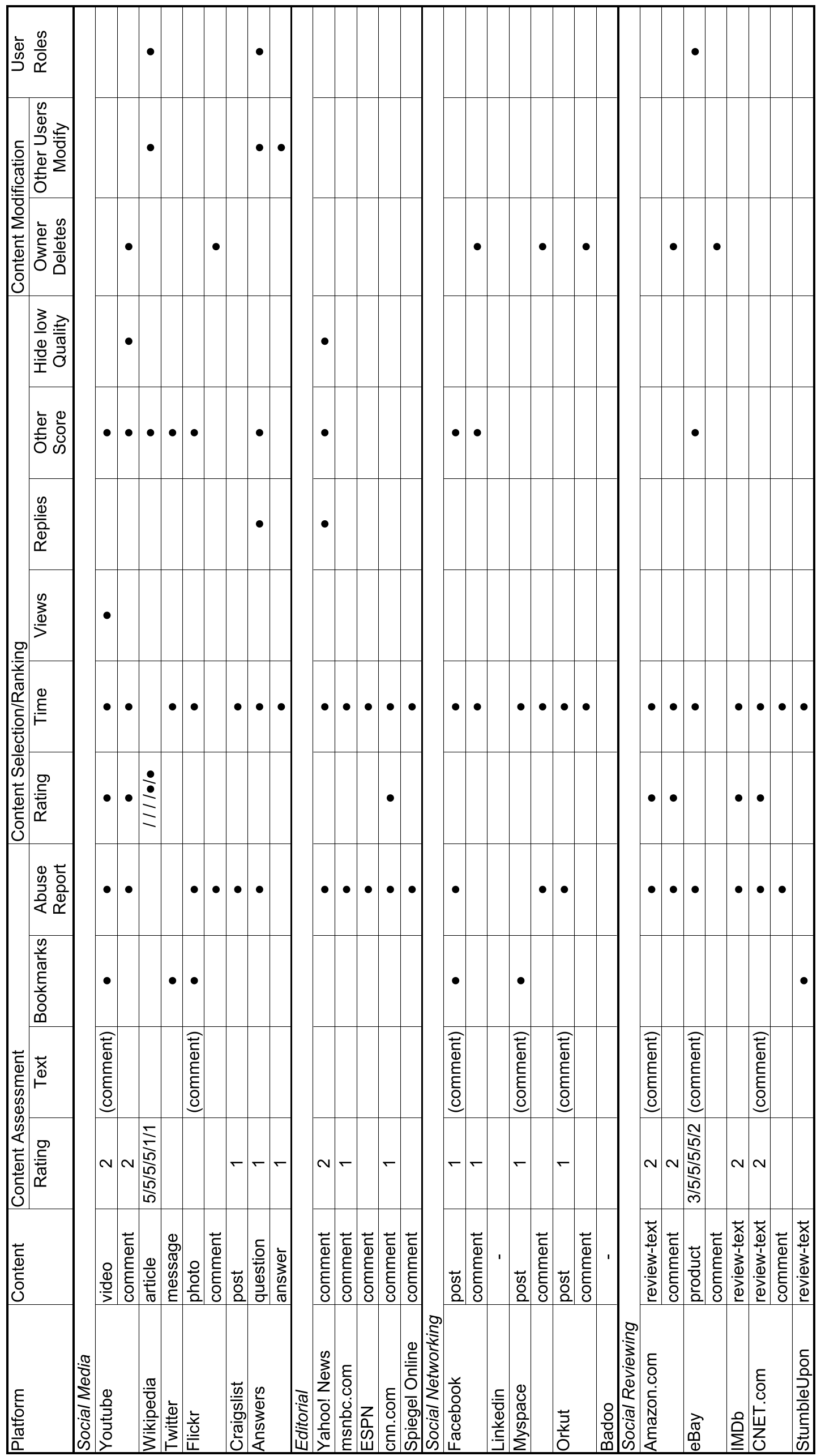
Key Insights: The Three "Best Practices"
1. The Global "Abuse Report" Standard
The paper found that regardless of whether a site hosts videos or sports news, the Abuse Report is the universal safety valve. It serves as an asynchronous signal to administrators, allowing millions of "eyeballs" to act as a security perimeter.
2. Rating Complexity follows Content Complexity
- Micro-content (Twitter/Facebook Statuses): Thrives on "1-ratings" (the 'Like'). It reduces friction and focuses on engagement.
- Collaborative Content (Wikipedia): Requires "Multi-dimensional ratings" (Trustworthiness, Objectivity, Completion). These platforms also necessitate a Role Multiplier—where users earn "sysop" or "supervisor" status through proven expertise.
3. The "Creator-as-Judge" Paradox
In Social Networking and Non-collaborative Media, the "Owner-Deletes-Comment" model is standard. If you post a photo on Flickr, you are the monarch of your own comment section. This empowers users but also creates "echo chambers" where dissenting opinions can be erased.
Critical Analysis: The 2011 View vs. Today
While this paper brilliantly maps the UI mechanisms of governance, it predates the era of Algorithmic Governance. Today, "Other Scores" (mentioned in the paper as "hidden scores") have become the primary drivers of what we see, often prioritizing engagement over quality—a nuance the authors hinted at as a "non-transparent" area.
Takeaway for Product Designers: If you are building a collaborative platform, invest in Role Models (super-users). If you are building a low-friction feed, prioritize 1-click Abuse Reporting and Engagement-weighted Rankings.
Limitations & Future Work
The authors correctly identify that "absence of activity" (forgetting) is a form of governance. In modern platforms like Snapchat or ephemeral Stories, "forgetting" is now a programmed feature, proving that time itself is a governing force in web communities.
Summary Checklist for Community Governance:
- Feedback Loop: Are users able to report abuse easily?
- Authority: Do creators have the power to moderate their own threads?
- Signal vs. Noise: Does the ranking algorithm account for quality-based ratings?
- Scalability: Can users earn the right to moderate others (e.g., Reddit moderators)?