
From VANET to VSN: The Evolution of the "Social Car"
A Survey on Vehicular Social Networks
This paper provides a comprehensive survey of Vehicular Social Networks (VSNs), a paradigm integrating Social Network Analysis (SNA) into Vehicular Ad-hoc Networks (VANETs). It defines the architectural transition from standard V2V/V2I communications to socially-aware "Social Driving" ecosystems that leverage human behavior and interests to optimize data dissemination and safety services.
TL;DR
The future of driving isn't just about autonomous sensors; it's about vehicles that "socialize." This paper explores Vehicular Social Networks (VSNs), where the hardware-centric architecture of VANETs is upgraded with a social intelligence layer. By understanding driver behavior and community interests, VSNs solve the chronic connectivity issues of traditional vehicular networks, turning every car into a node in a dynamic, interest-based social ecosystem.
The Missing Link: Why Traditional VANETs Fall Short
For decades, Vehicular Ad-hoc Networks (VANETs) focused on the "how" of communication—standardizing IEEE 802.11p or DSRC protocols. However, these networks are notoriously unstable due to high node mobility and hostile propagation environments.
The authors argue that the missing ingredient is the Human Factor. Humans aren't random particles; we have routines (commuting at 8 AM), social circles (colleagues), and specific interests (finding cheap gas). VSNs bridge this gap by treating vehicles not just as radio towers, but as social entities.
Methodology: Engineering Sociability into Silicon
The core of VSN methodology lies in Social Network Analysis (SNA). Instead of sending data to the geographically closest car, a VSN selects relays based on their "social standing" within the network.
The Four Pillars of Centrality
To identify the best data carriers, the paper highlights four critical metrics:
- Degree Centrality: Popularity. A vehicle with many connections can spread safety warnings faster.
- Betweenness Centrality (BC): The "Bridge." Cars with high BC connect isolated clusters of vehicles (e.g., a car at a crossroad).
- Closeness Centrality: Efficiency. How "near" a vehicle is to all others in the social graph.
- Bridging Centrality: Locating the gatekeepers between highly connected regions.
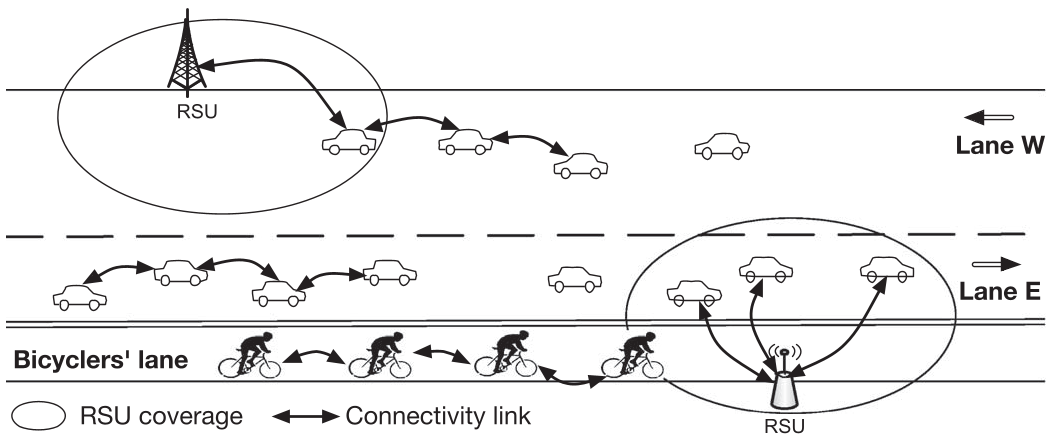 Fig 1: The two-layered approach of Socially-Aware Networking (SAN), mapping stable social ties onto volatile electronic links.
Biomimetic Forwarding: The BEEINFO Concept
One of the most intuitive methods discussed is BEEINFO, inspired by bee colonies. Just as bees scout flowers, vehicles record "community densities" (e.g., many students near a school). If a message is destined for the "School Community," the system picks a carrier that frequently "visits" that social spot, drastically increasing delivery efficiency.
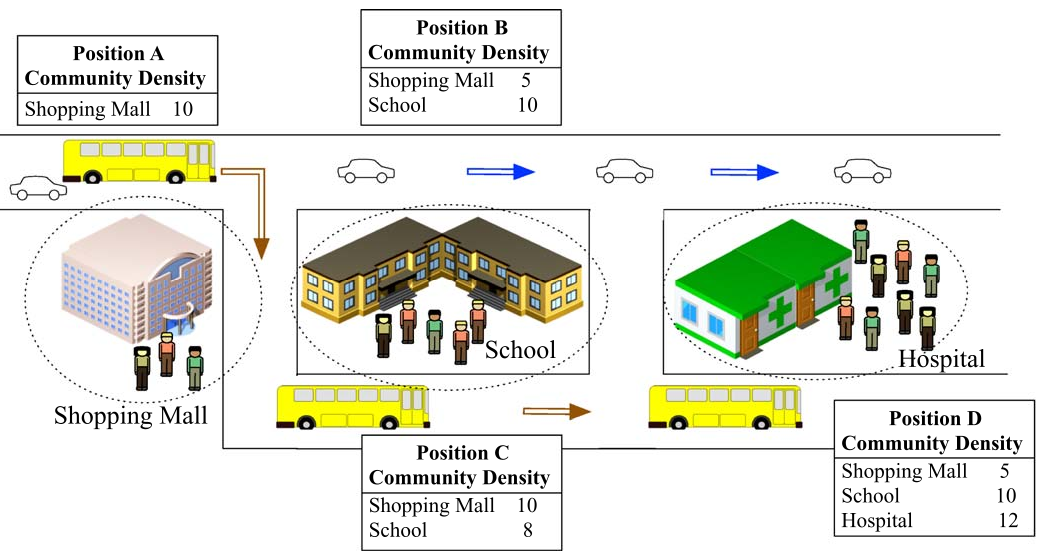 Fig 2: Intuitive density-based forwarding where different vehicles are chosen based on their frequent "social spots" like malls or schools.
Experiments and Collective Intelligence
The paper reviews several SOTA breakthroughs:
- LASS (Local Activity & Social Similarity): Improves delivery ratios by accounting for how often nodes actually interact.
- Crowdsourcing Success: Applications like Waze and Moovit are early-stage VSNs. They prove that "the wisdom of the crowd" can reduce traffic congestion by 30% simply by sharing real-time social data.
- Privacy Preservation: Protocols like SPRING use RSUs (Road Side Units) at social intersections to store-and-forward packets, providing anonymity while maintaining high reliability.
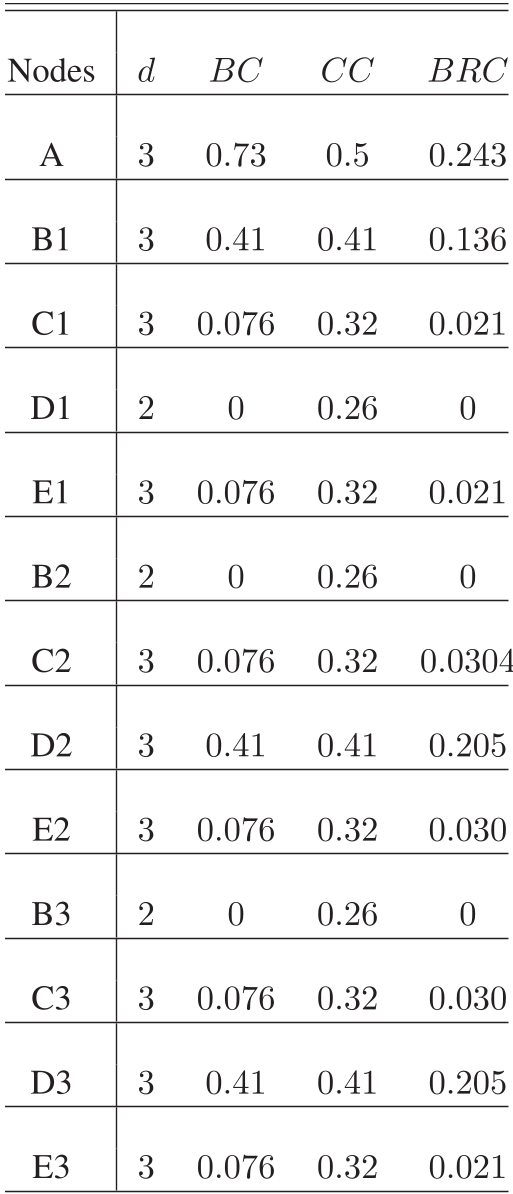 Table 1: Quantitative analysis showing how node 'A' (the relay) dominates the network's connectivity through high Betweenness and Bridging centrality.
Critical Insight: The "Sporadic" Nature of VSNs
Unlike Facebook (which is static and permanent), VSNs are sporadic. They are born when cars cluster at a red light and die when the light turns green. This creates a radical engineering challenge: How do you establish trust in 3 seconds?
The authors conclude that future research must move from centralized cloud-based social apps to fully distributed, edge-computing architectures. The car of 2026 must be capable of autonomous "friendship" selection to ensure that the data it receives—be it a hazard warning or a movie stream—is both relevant and verified.
Conclusion
Vehicular Social Networks are transitioning from a conceptual "vision" to a technical necessity. By leveraging human behavior as a routing heuristic, we can turn the chaos of urban traffic into a structured, efficient, and safer social machine.
Takeaway: The next time you're stuck in traffic, remember: you're not in a jam; you're in a high-density social cluster waiting for a better routing algorithm.