
Survival Analysis: Predicting the "Lifespan" of Communities in Dynamic Social Networks
Survival analysis for modeling critical events that communities may undergo in dynamic social networks
This paper introduces a formal risk model based on Survival Analysis to predict critical events (split, merge, shrink, expand) in dynamic social networks. By leveraging a parametric hazard rate approach, the method achieves high prediction accuracy (F-measure ~87%) on DBLP and Yelp datasets, significantly outperforming traditional methods in long-range event forecasting.
TL;DR
Communities in social networks are not static; they merge, split, and shrink over time. This paper moves beyond traditional "next-step" classification by introducing Survival Analysis to social network mining. This allows researchers to model the probability of critical structural changes at any future point in time, even when data is missing or communities disappear temporarily.
The "Next-Step" Trap: Why Current Models Fail
The study of dynamic community evolution typically follows a supervised learning paradigm: extract features at time and predict the class of event at . However, this presents three major bottlenecks:
- Temporal Myopia: Traditional classifiers are "short-sighted," unable to predict events two or three steps ahead.
- Continuity Bias: They assume a community must exist at every single timestamp, failing in real-world scenarios where data is "interrupted."
- Feature Redundancy: Many topological features (density, cohesion, size) are highly correlated, leading to sub-optimal classification performance.
Methodology: The Physics of Social Risk
The core innovation is treating a "Split" or "Merge" not just as a label, but as a risk event with an associated hazard rate.
1. Hazard Function and Intensity
The authors define the instantaneous risk (hazard rate) using a parametric model: Where:
- is the general hazard (the background baseline of the event).
- represents how the specific topological features of a community increase or decrease that baseline risk.
2. Handling Missing Data (Censoring)
Survival analysis naturally handles "censoring"—when a community is not observed for a period. By using the cumulative intensity process, the model can calculate the probability of survival even through unobservable time gaps.
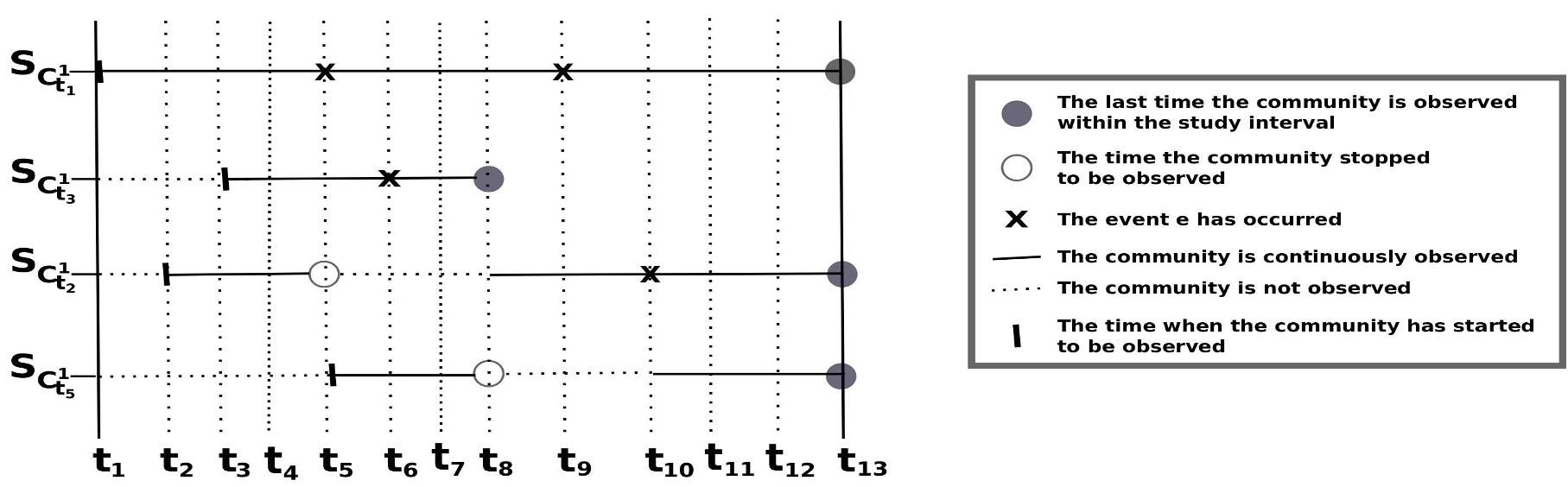 Figure 1: Illustration of the study interval showing communities surviving and disappearing across timestamps.
Experiments and Key Findings
The model was validated on the DBLP (citation network) and Yelp (friendship network) datasets.
Distribution Selection
One key insight is that different events follow different statistical "tempos." For DBLP, the 'Split' event fits an Exponential distribution, while 'Merge' and 'Shrink' follow a Log-Normal distribution. In contrast, Yelp events consistently follow a Weibull distribution, suggesting that social dynamics are heavily dependent on the specific platform context.
Long-Term Accuracy
Unlike traditional models that degrade over time, this survival model showed a unique trend: for events like 'split' and 'expand', prediction accuracy actually improved as the target time became more distant.
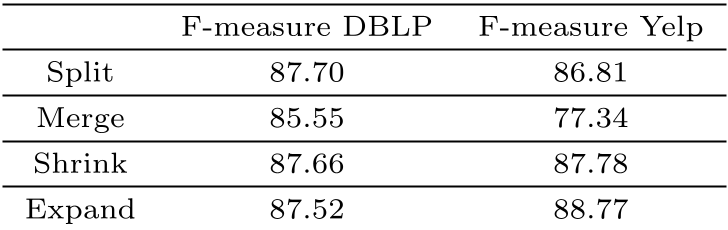 Table 1: High F-measure scores across all event types demonstrate the robustness of the hazard-based approach.
Critical Insight & Future Outlook
The beauty of this approach is its inductive bias. By assuming that community change follows a continuous probabilistic process rather than discrete jumps, the authors capture the underlying "pressure" within a network structure.
Limitations: The current model assumes the influence of features () is constant over time. In highly volatile networks, the weight of "density" or "conductance" might change as the network matures.
The Takeaway: For AI researchers working on Dynamic Graphs or Temporal GNNs, integrating Survival Analysis could be the key to moving from reactive "now-casting" to proactive "forecasting" of structural collapses or expansions in massive social systems.