
The Sustainability Game: Rewiring Human Cooperation Through AI Simulation
The Sustainability Game: AI Technology as an Intervention for Public Understanding of Cooperative Investment
The paper introduces the "Sustainability Game" (SG), an AI-driven serious game intervention based on agent-based modeling designed to enhance public understanding of cooperative investment. It evaluates how direct experience with complex resource dynamics affects altruistic behavior in economic games like the Prisoner's Dilemma.
TL;DR
Can a 20-minute video game change how you invest in society? Researchers from Umeå University and the University of Bath have developed The Sustainability Game (SG)—an AI-driven intervention that replaces dry economic theory with a lived experience of resource management. The study finds that while players become significantly more cooperative in anonymous "public good" scenarios, they paradoxically become more competitive when facing identifiable opponents.
Motivation: Why Don't We Cooperate?
In behavioral economics, "Public Goods" tasks are the gold standard for measuring cooperation. Even when participants explicitly understand the math—that everyone benefits if everyone contributes—many still choose to "free-ride."
The authors argue that the problem is a lack of implicit understanding. Static instructions don't capture the volatility of a real ecosystem. They posit that by allowing users to manage a virtual society, they can internalize the "why" behind cooperation, moving beyond rote knowledge to intuitive strategy.
Methodology: The Spiriduşi Ecosystem
The core of the intervention is a sophisticated ecological simulation. Players interact with a society of agents called Spiriduşi across a 2D world divided by a river.
The Mechanics of Survival
Players don't control agents directly; instead, they manage Time Allocation Sliders (a form of high-level policy intervention):
- Private Goods: Harvesting and eating apples for stamina.
- Semi-Private Goods: Building houses and procreating.
- Public Goods: Building bridges to access secondary food sources.
Systemic Complexity
The AI agents follow rules of aging, starvation, and reproduction. The environment introduces "shocks" like:
- Floods: Periodically destroying bridges (devaluing public investment).
- Immigration: Increasing the workforce but also competitive pressure on food.
- Decay: Infrastructure collapses over time without maintenance.
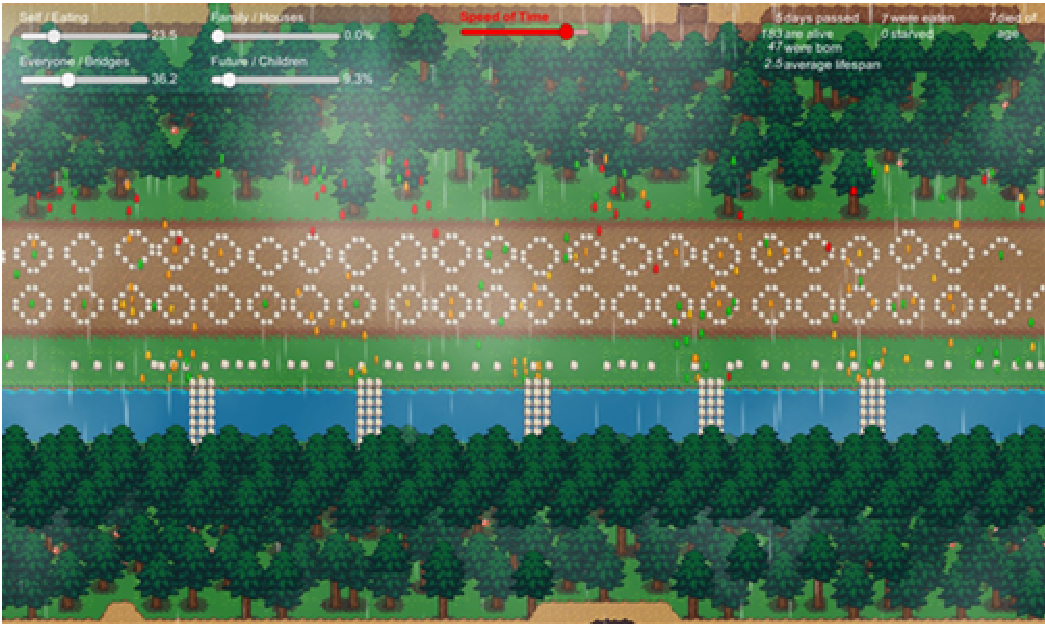 Fig 1: The SG Interface. Players must balance the sliders (top-left) to keep the population from going extinct while managing environmental warnings like rain.
Experiments and Behavioral Shifts
The researchers conducted a controlled 2x2 study (n=72) comparing the SG against a control (Tetris), subdivided by partner status (Anonymous vs. Identifiable).
Key Result 1: Anonymity Breeds Cooperation
In the Iterated Prisoner's Dilemma (IPD), those who played the Sustainability Game showed a massive spike in cooperation when the partner was anonymous.
- SG Group Cooperation: ~80%
- Control Group (Tetris) Cooperation: ~41%
Key Result 2: The Competition Paradox
Curiously, when participants were "identifiable" (sitting face-to-face), the SG actually decreased cooperation compared to the control. The game made them better strategists, and in a one-on-one "Head-to-Head" context, better strategy often means winning at the expense of the other.
| Condition | Tetris (Control) | Sustainability Game |
|---|---|---|
| Anonymous合作率 | 0.41 | 0.80 |
| Identifiable合作率 | 0.80 | 0.60 |
| Performance metrics suggesting the SG mitigates the "anonymous selfishness" often seen in digital interactions. |
Critical Insight: Transparency is a Double-Edged Sword
The study’s success lies in its ability to make the systemic consequences of individual actions transparent. By experiencing the fragility of a society where no one builds bridges, players learn that altruism is a survival strategy.
However, the shift toward competition in face-to-face settings suggests that the SG didn't just make people "nicer"—it made them more aware of the context. They learned to cooperate when it benefited the system, but also to recognize when they were in a zero-sum game with a visible rival.
Conclusion & Future Outlook
The Sustainability Game demonstrates that AI-based serious games are potent "behavioral interventions." As we face global public goods challenges—like climate change—tools that bridge the gap between "knowing" the math and "feeling" the ecosystem are essential.
Limitations: The study is limited by its short duration (20 minutes) and specific university demographics. Future work should investigate whether these shifts in behavior persist over weeks or months and if they translate to real-world financial or environmental choices.
Editor's Note: This research highlights a shift in AI role-play from simple chatbots to complex system simulators that act as "cognitive mirrors" for human behavioral traits.