
Sweets: Reclaiming Privacy in Social Networking via Mobile Data Sync
Sweets: A Decentralized Social Networking Service Application Using Data Synchronization on Mobile Devices
This paper introduces Sweets, a decentralized social networking service (DSNS) designed specifically for mobile devices. It utilizes Couchbase Lite for peer-to-peer data synchronization over Social VPNs, enabling users to maintain full data ownership and privacy without centralized servers.
TL;DR
Sweets (Sync Tweets) is a decentralized SNS application that runs entirely on mobile devices, removing the need for a central "Big Brother" server. By leveraging peer-to-peer data synchronization and advanced attribute-based encryption, it allows users to share tweets, photos, and comments directly with friends while maintaining strict ownership of their digital footprint.
The "Centralization" Trap
Modern Social Networking Services (SNS) operate on a simple but invasive trade-off: you get a free platform, and they get your data. This centralization leads to three major pain points:
- Privacy Eradication: Providers track behavior for targeted advertising.
- Data Sovereignty: Users cannot truly "delete" or "own" what they post.
- Service Fragility: If the provider shuts down, your digital history vanishes.
While decentralized SNS (DSNS) projects exist, they typically struggle with Mobile Compatibility. Using DHTs (Distributed Hash Tables) kills phone batteries, and requiring nodes to be "always-on" is unrealistic for smartphone users.
Methodology: How Sweets Decentralizes Social Data
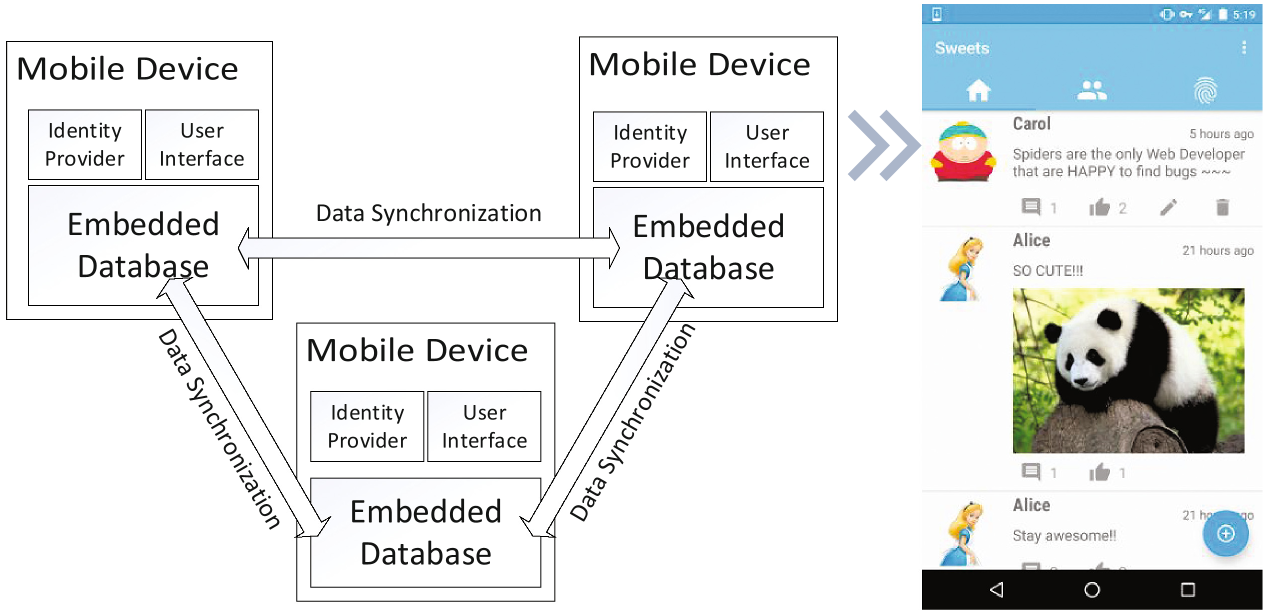
The core innovation of Sweets lies in its use of Data Synchronization as the primary networking primitive rather than simple API calls.
1. The Sync Engine: Couchbase Lite
Sweets uses Couchbase Lite, an embedded DBMS that supports Multi-version Concurrency Control (MVCC). When you post a "tweet," it is first saved to your local database. The app then triggers an asynchronous background task to sync these changes with friends over a Social VPN.
2. Solving the Availability Gap: Indirect Replication
In a P2P world, what happens if your friend is offline? Sweets introduces Indirect Replication.
- Encrypted Relay: Your data can be relayed through a mutual friend.
- ABE Access Control: Using Attribute-Based Encryption (ABE), you can encrypt a tweet such that only people with specific attributes (e.g., "Family" or "Close Friends") can decrypt it. The relaying friend (the "Mirror") stores the encrypted blob without ever being able to see the content.
3. Decentralized Identity
Instead of a central login, Sweets uses OpenID Connect with self-issued identity providers running on the device. Users exchange identities face-to-face via QR codes or NFC, establishing a "web of trust" without a third party.
Performance Under Pressure
The researchers tested Sweets on 4G cellular networks to simulate real-world conditions.
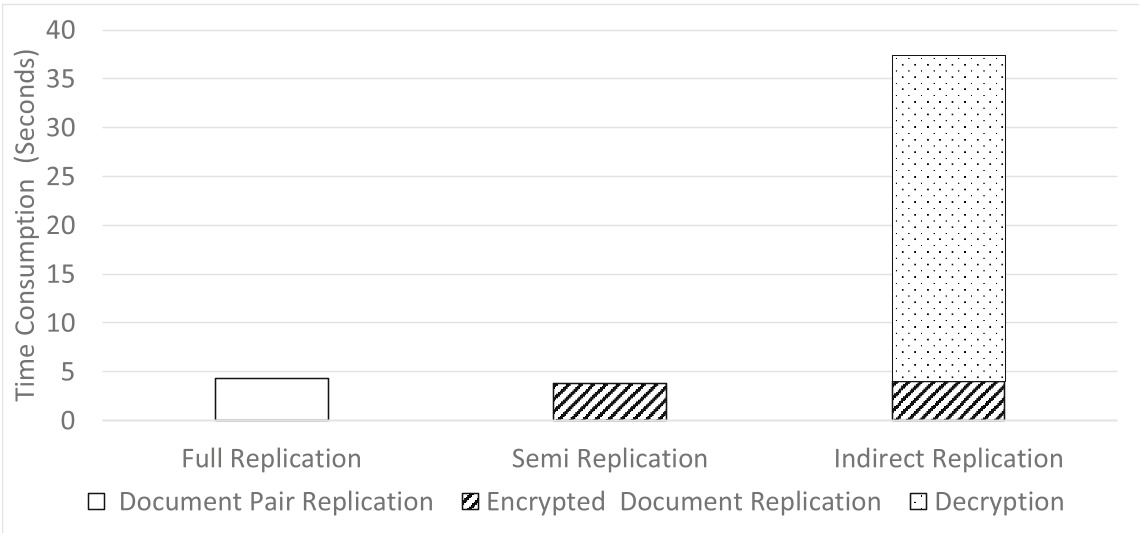
- Direct Sync: 50 tweets in ~4 seconds.
- Indirect Sync: ~35 seconds (slowed primarily by the intensive ABE decryption process).
While 35 seconds for 50 tweets is slower than a centralized server, the authors argue this is acceptable because all sync happens in the background. Users interact with their local database immediately, making the app feel snappy even if the "latest" data is still propagating through the network.
Critical Analysis & The Road Ahead
Sweets successfully demonstrates that we don't need a central server to have a functional social network on our phones. However, the system has a few hurdles:
- The "Bootstrap" Problem: Users must trust the Social VPN server (SoftEther), which acts as the underlying pipe.
- Search Limitations: In a decentralized world, "searching everything" is hard because no single node sees the whole graph.
- Computational Bottleneck: ABE decryption is heavy for mobile CPUs. Future work on reusing AES keys could potentially slash these sync times significantly.
Conclusion
Sweets is a significant step toward a truly private social web. It proves that by combining local storage, smart synchronization, and modern cryptography, we can build social platforms that respect user autonomy without sacrificing the mobile-first convenience we've come to expect.