
iTag: Beyond the Average—Synthesizing Multi-Faceted Opinions in Social Web
Synthesis of Collective Tag-Based Opinions in the Social Web
This paper introduces iTag, an enhanced tagging framework designed to synthesize complex, tag-based opinions in social networks. By enriching tags with structure (facets, polarity, and relevance), it moves beyond simple tag clouds to provide a multi-faceted and personalized summary of collective user sentiment.
TL;DR
The iTag framework transforms simple tags into structured "informed opinions" by adding dimensions like relevance (size) and scope (facets). Unlike traditional tag clouds that flatten data, iTag uses semantic interpretation and social trust to provide a personalized, multi-faceted synthesis that highlights both majority consensus and significant niche disagreements.
The Problem: The "Flatness" of Modern Tagging
In the Social Web, we usually choose between two extremes:
- Ratings (1-5 stars): Easy to aggregate but lack context. Why did they hate the restaurant? Was it the food or the service?
- Free-Text Comments: Rich in detail but computationally expensive to summarize at scale for thousands of users.
Traditional Tag Clouds sit in the middle but suffer from a "majority bias." If 70% of people say a place is "cheap" and 30% say "expensive," an average might suggest "moderately priced," which is technically a lie. Neither group thinks it's moderate. Furthermore, these clouds don't account for who you actually trust—a food critic’s tag should carry more weight than a random bot.
Methodology: The iTag Framework
The authors propose a structured tuple for a tag: .
- Facet (F): The specific part of the object (e.g., "Food" or "Service").
- Label (L): The adjective (e.g., "Tasty").
- Polarity (p): Whether the user liked/disliked that trait.
- Size (S): Relative importance to the overall experience.
1. Semantic Interpretation via WordNet
To synthesize tags, the system must understand that "quiet" and "calm" refer to the same property (Quietness). Using WordNet's bipolar adjective clusters, iTag maps diverse user adjectives to a set of underlying properties without requiring heavy Natural Language Processing (NLP).
2. The Four Aspects of Synthesis
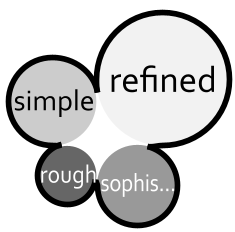
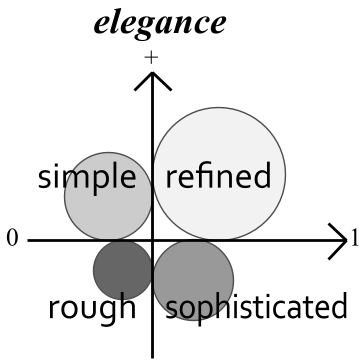
One of the most brilliant insights of iTag is the division of opinions into four quadrants based on the relationship between reality (the property) and preference (the polarity):
- Positive/Confirming: "It's elegant and I love it." (Chic)
- Negative/Confirming: "It's elegant, but it's too much/stuffy." (Sophisticated)
- Positive/Opposing: "It's not elegant (simple), and I like that." (Simple)
- Negative/Opposing: "It's not elegant, and it looks cheap." (Shabby)
Personalized Integration
The synthesis is not global; it is target-user specific.
- Trust Weighting: If you trust your "Expert" group more than "Friends," their iTags will appear larger or more prominent in your synthesis view.
- Facet Filtering: If your user model shows you don't care about "Price," the synthesis can hide the price-related iTags to reduce cognitive load.
Visualization: The "Flower" Approach
Instead of a messy cloud, iTag uses a "flower" visualization. Each facet of a resource (e.g., a restaurant) can have up to four "petals," representing the four quadrants of opinion mentioned above. This allows a user to see, at a glance, if a restaurant is polarizing or if there is a strong consensus.
Experimental Evidence
The authors conducted a two-part study. The results were telling:
- Transparency: Users correctly interpreted the "size" of the tags as relevance 87% of the time, proving the visual metaphor is intuitive.
- Information Density: 71% of users found iTag synthesis more informative than traditional clouds.
- Niche Preservation: 82% of users specifically appreciated seeing the "niche" opinions, which are usually buried in other systems.
Critical Insight & Future Outlook
The true value of iTag lies in its Inductive Bias: it assumes that "truth" in social contexts is multi-dimensional. By forcing a small amount of structure at the point of data entry (choosing a facet), it solves the massive problem of ambiguity that plagues free-text sentiment analysis.
Limitations: The reliance on WordNet feels dated in the era of LLMs. Modern embeddings could likely handle the semantic mapping more robustly, especially with slang or context-specific adjectives. However, the core logic of iTag—personalizing the synthesis of opinions based on trust—remains a highly relevant blueprint for building healthier, less "echo-chamber" prone social recommendation engines.
Takeaway: For developers and researchers, iTag suggests that the future of social UI isn't just "more data," but "better-structured aggregation" that preserves the diversity of human experience.