
Mapping the Latent Talent Graph: Synthetic Social Networks in HR
Synthetic Social Network Based on Competency-Based Description of Human Resources
This paper introduces a formal methodology for constructing Synthetic Social Networks from human resource competency data. By applying graph theory metrics like Betweenness Centrality and the Left-Right Spectral Clustering algorithm, the authors successfully map latent professional relations and identify "bridge" employees who facilitate cross-departmental collaboration.
TL;DR
In modern software development, who you know is often as important as what you know. This paper proposes a way to bridge that gap by building Synthetic Social Networks—graphs where nodes are employees and edges represent the similarity of their skills. Using spectral clustering and centrality measures, the authors identify hidden "technical bridges" that can optimize team formation and knowledge transfer.
Background & Positioning
Most HR systems treat employees like rows in a spreadsheet. While the industry has moved toward Competency Models (like SFIA), these models usually fail to capture the interconnectedness of a workforce. This work positions itself at the intersection of Graph Theory and Knowledge Management, transforming static competency profiles into a complex network to reveal the organizational "skeleton" that usually remains invisible.
Problem: The "Silo" Trap
Why is it so hard to staff a new project?
- Invisible Expertise: Just because a worker is labeled a "Developer" doesn't reveal their latent "Communication" or "UML" skills that might assist a Project Manager.
- Interaction Blindness: In large companies, we don't always know who actually talks to whom. We need a proxy for "potential" interaction.
- Rigid Roles: Analysts and Designers are often kept separate, even though their skill sets (and thus their ability to collaborate) may overlap significantly.
Methodology: From Vectors to Graphs
The core innovation lies in the transition from Competency Levels to Graph Nodes.
1. The Vector Space Model
The authors represent each worker as a vector in a 19-dimensional competency space (e.g., Java, C#, Communication). By calculating the cosine similarity between these vectors, they create a similarity matrix.
2. Graph Construction & Thresholding
To prevent the network from becoming a "hairball" of weak connections, a threshold is applied. Only strong skill-similarities become edges.
3. Spectral Clustering (Community Detection)
The paper uses the Left-Right Algorithm (based on the Fiedler vector and Laplacian matrix) to divide the network. This isn't just group-finding; it’s identifying "Ecological Niches" of expertise within the company.
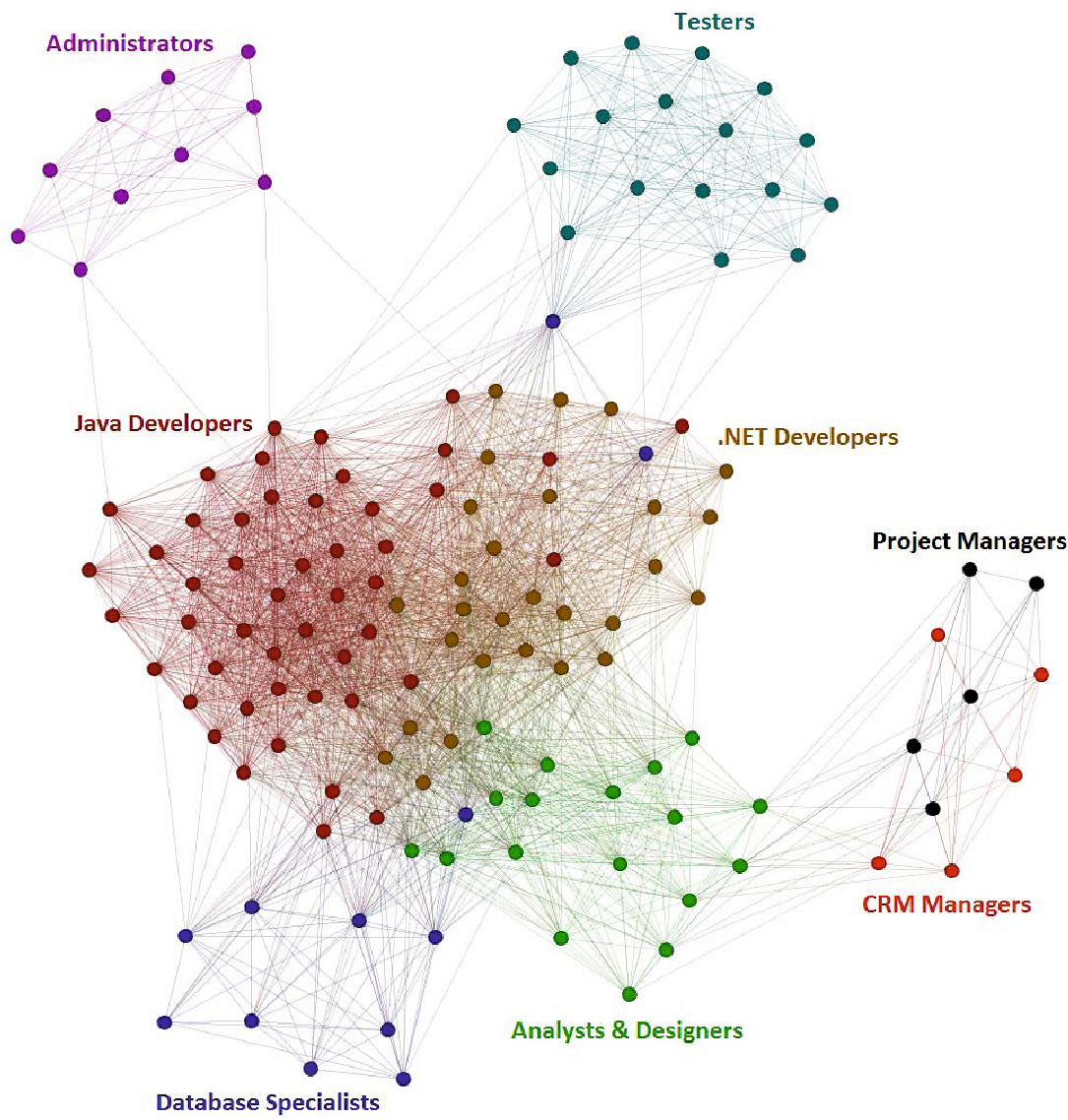 Figure 1: The resulting network automatically discovered roles like ".NET Developers" and "CRM Managers" without manual labeling.
Experiments: Finding the "Bridges"
One of the most striking results involves Betweenness Centrality. In academic terms, this measures how many "shortest paths" go through a node. In HR terms, this discovers your Bilingual Experts.
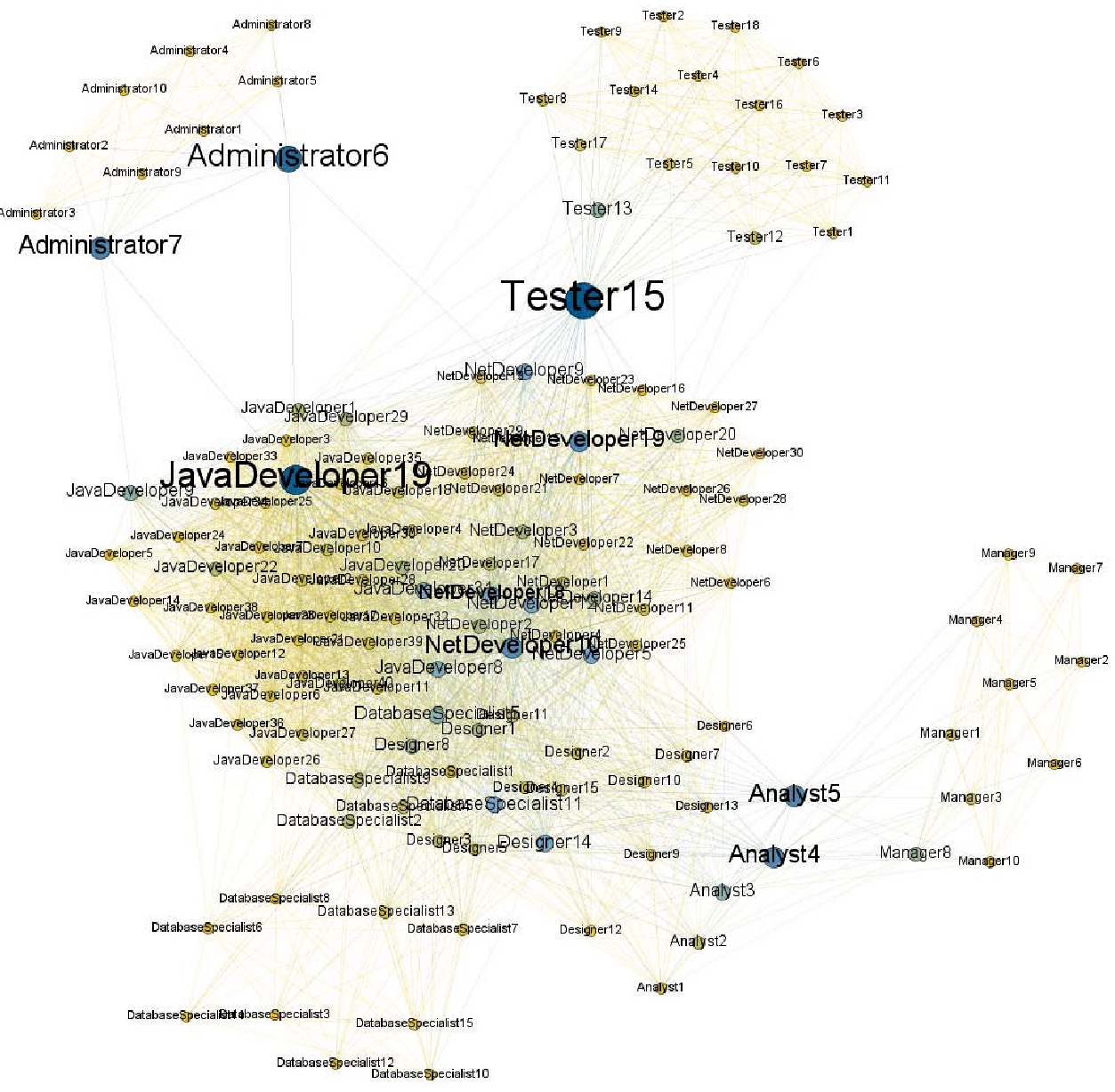 Figure 2: The size of the node represents its Betweenness Centrality. Larger nodes like "Tester15" are the essential connectors between siloed teams.
For instance, Tester15 acts as a bridge between the Testing community and both Java and .NET developer clusters. If Tester15 leaves the company, the "communication distance" between these technical groups effectively doubles.
Critical Insight: Data-Driven Team Composition
The authors demonstrate that when staffing a task like "System Architecture Analysis," the "best" person isn't always the one with the highest score on a single test. By looking at Neighboring Communities, they found that an Analyst with a connection to "Database Specialists" might be a superior choice for a database-heavy project than a statistically higher-ranked Analyst who lacks those latent network ties.
Conclusion & Limitations
Takeaway: This paper proves that synthetic social networks can turn HR data into a strategic asset for Decision Support. It moves us away from "matching keywords" toward "matching networks."
Limitations:
- The study uses a threshold that is somewhat arbitrary; setting this too high or too low drastically changes the network topology.
- The data remains "synthetic" in that it represents potential collaboration based on skill similarity, not necessarily actual social affinity.
Future Work: Integrating actual communication logs (Slack, GitHub, Email) with these competency graphs would likely create a "Digital Twin" of the organization that is unparalleled in accuracy.