
Beyond Popularity: Synthesizing Trust, Social Ties, and Semantics for Blog Recommendation
A synthetical approach for blog recommendation: Combining trust, social relation, and semantic analysis
This paper introduces a synthetical blog recommendation mechanism that integrates a Trust Model, Social Relation analysis, and Semantic Similarity evaluation. Using a Back-Propagation Neural Network (BPNN), the system learns personalized preference patterns to recommend blog posts and bloggers, achieving superior satisfaction scores on the Taiwanese platform "Wretch" compared to traditional popularity-based or random methods.
TL;DR
In the vast and sparse landscape of the "blogosphere," traditional recommendation engines often fall short because they ignore the social fabric of trust. This paper presents a holistic framework that combines Trust Models, Social Intimacy, and Semantic Analysis. By feeding these metrics into a Back-Propagation Neural Network (BPNN), the system transforms raw social data into highly personalized recommendations, outperforming standard popularity-based metrics by significant margins.
The "Loneliness" of the Blogosphere: Why Simple Recommendations Fail
Most recommendation systems thrive on dense data. However, the blogosphere is notoriously sparse. As the authors highlight, 57.22% of blog objects are isolated, receiving no comments or citations. Furthermore, humans are subjective; a "popular" post isn't necessarily a "trustworthy" one for a specific reader.
The authors argue that a blog recommender is not just a search tool—it is a social provider. It must navigate the "Small World" phenomenon (the Six Degrees of Separation theory) to find content that is semantically relevant and socially vetted.
Methodology: The Three Pillars of Recommendation
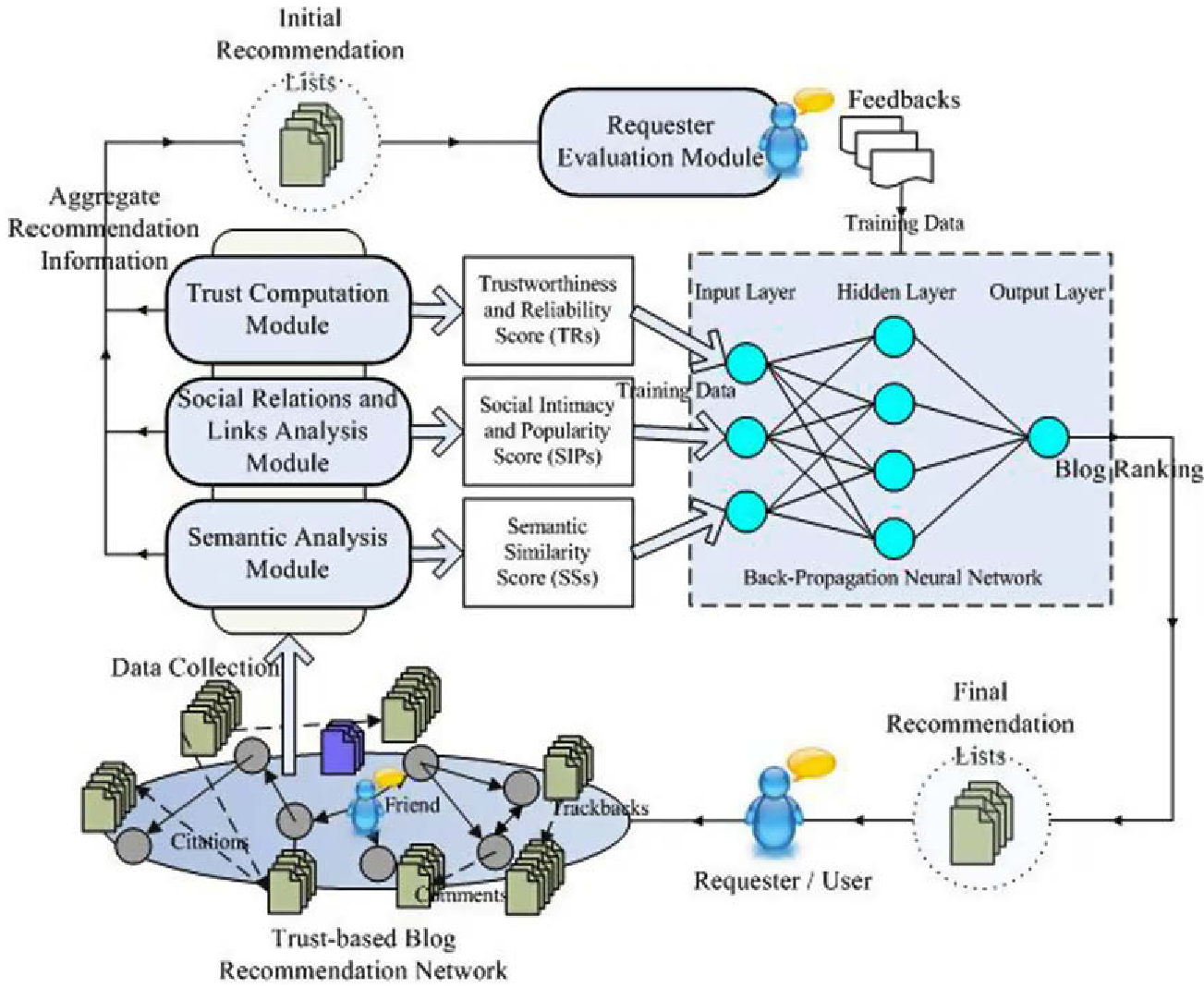
The core innovation lies in the triplet of scores that feed the prediction engine:
- Trustworthiness and Reliability (TR): Unlike static ratings, trust here is propagated. If User A trusts B, and B trusts C, the system infers a level of referral trust from A to C.
- Social Intimacy and Popularity (SIP): This goes beyond "hits." It looks at implicit links—who is commenting on the same authors? Who shares common tags? It distinguishes between global popularity and local social intimacy.
- Semantic Similarity (SS): Using the CKIP Chinese word segmentation system and TF-IDF weighting, the system performs deep-content matching between the requester’s past posts and potential recommendations.
Architecture Overview
The following diagram illustrates how these three dimensions are standardized and fed into the Neural Network layer:
The Neural Learning Layer
Why use a Neural Network? Human preferences are non-linear. One user might value trust over content similarity, while another seeks "hot" topics regardless of who wrote them. The BPNN acts as a personalized weighting engine, learning the specific "flavor" of a user's preference by training on their feedback.
The authors utilized a three-layer BPNN with adaptive learning rates. Even with limited training data (20 subjects per user), the model was able to capture complex decision patterns that linear weighted sums missed.
Experimental Results: Wretch Case Study
The researchers tested their model on Wretch, Taiwan's premier blogging platform. They compared their "ANN + ALL" approach against seven strategies, including random selection, comment count, and "hotness."
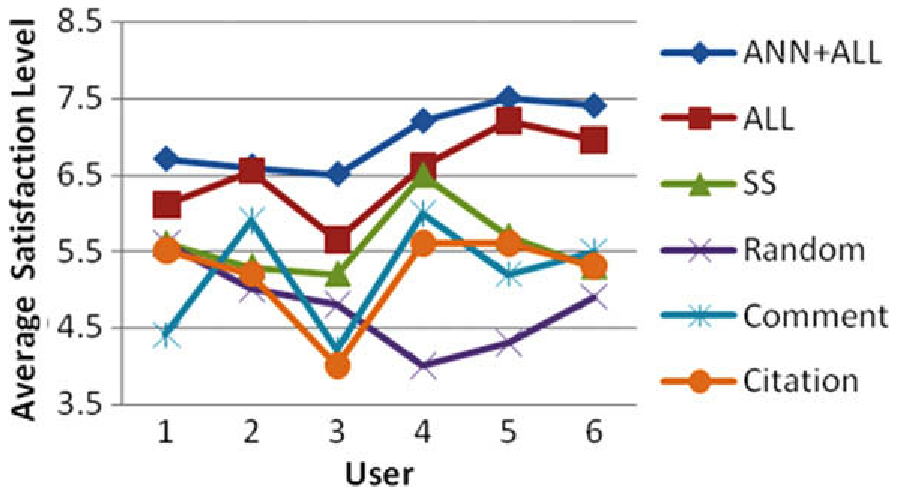 Figure: The ANN + ALL strategy consistently yields higher satisfaction scores than traditional baselines.
Key Findings:
- Significance: Paired t-tests confirmed that the proposed method is statistically superior (p < 0.05) to all other strategies.
- Small World Justification: The study found that the "Wretch" network reaches saturation within 5-6 layers, empirically validating the Six Degrees of Separation theory within digital social networks.
- Adaptability: The system effectively mitigated the "sparsity problem" by using implicit social links where explicit interactions were missing.
Global Insight & Conclusion
This paper serves as a vital reminder that in social computing, context is king. By mathematically modeling "Trust" and "Social Intimacy," we can move away from the "tyranny of the popular" and toward a more nuanced, human-centric information filter.
Limitations to Consider:
- Invasive Data Collection: The model currently requires users to manually assign trust values, which can be burdensome.
- Dynamic Evolution: As social networks grow, the computational overhead of semantic analysis and trust propagation across millions of nodes remains a challenge for real-time systems.
Future iterations of this work could likely leverage automated sentiment analysis to "infer" trust from comments, further reducing the friction for the end-user.