
Beyond Static Equilibrium: Why Green Certificate Markets Defy Conventional Economic Logic
Combining System Dynamics and Experimental Economics to Analyse the Design of Tradable Green Certificates
This paper presents a hybrid analytical framework combining System Dynamics (SD) and Experimental Economics to evaluate Tradable Green Certificates (TGCs). The study demonstrates that market volatility and price formation are heavily influenced by investment lags and trading strategies rather than just static marginal costs.
TL;DR
Tradable Green Certificates (TGCs) are designed to subsidize renewable energy through market forces. However, static models often fail to predict actual price behavior. This research utilizes System Dynamics and Experimental Economics to show that investment "sluggishness" and speculative trading strategies drive prices much higher than the actual cost of technology, often leading to boom-bust cycles.
The Gap Between Theory and Reality
In a perfect economic world, a TGC price should equal the difference between the cost of new renewable energy and the market price of electricity. Yet, when Sweden launched its market, prices didn't settle at the "expected" equilibrium—they skyrocketed toward the penalty cap.
The author argues that the problem lies in Dynamics. Most models ignore the "lead time" required to build new capacity and the fact that renewable output is stochastic (weather-dependent).
Methodology: Simulating the Human and the Machine
The research approaches the problem from two angles:
1. System Dynamics (The Machine)
The author builds a feedback loop where certificate prices influence investment profitability, which in turn dictates capacity growth. Unlike static models, this captures Adaptive Expectations—investors look at past prices to guess future ones, creating a lag that destabilizes the market.
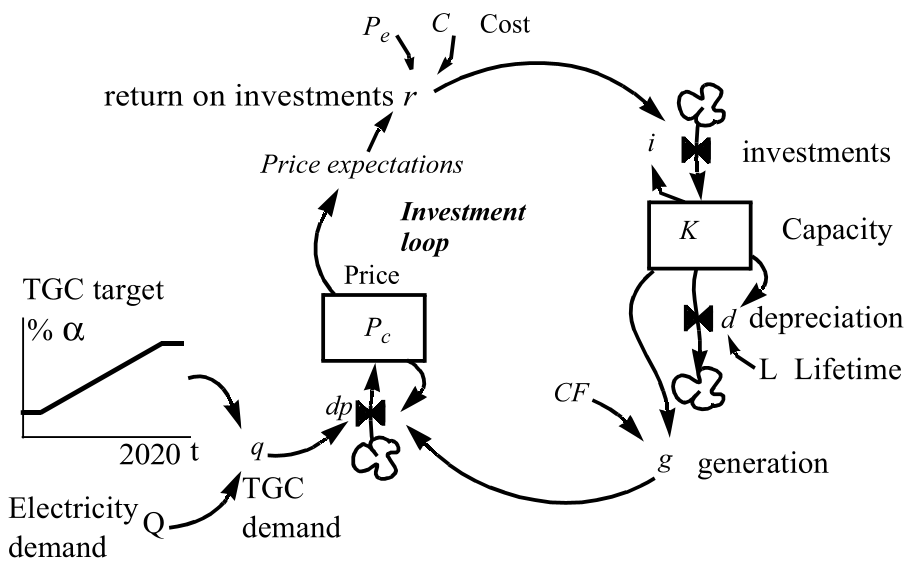 Figure 1: The core feedback loop where price signals stimulate capacity, which eventually increases generation.
2. Experimental Economics (The Human)
To find out how people actually trade these assets, the author ran a "network game" with 10 participants. This laboratory setup revealed a critical behavior: Speculative Withholding.
Key Insights: Why Prices Boom and Bust
The study highlights two major phenomena:
- The Growth Premium: In a growing market, the TGC price must be significantly higher than the static LRMC. The model showed that while a 100 NOK/MWh gap was expected, a 188 NOK/MWh price was actually needed to pull enough "marginal" projects into the market fast enough to meet rising targets.
- The Banking Paradox: While "banking" (saving certificates for later) is intended to smooth prices, the experiment showed that sellers often hoard certificates during the initial phase, fearing scarcity. This drives prices up to the penalty ceiling, leading to over-investment and a subsequent catastrophic price crash.
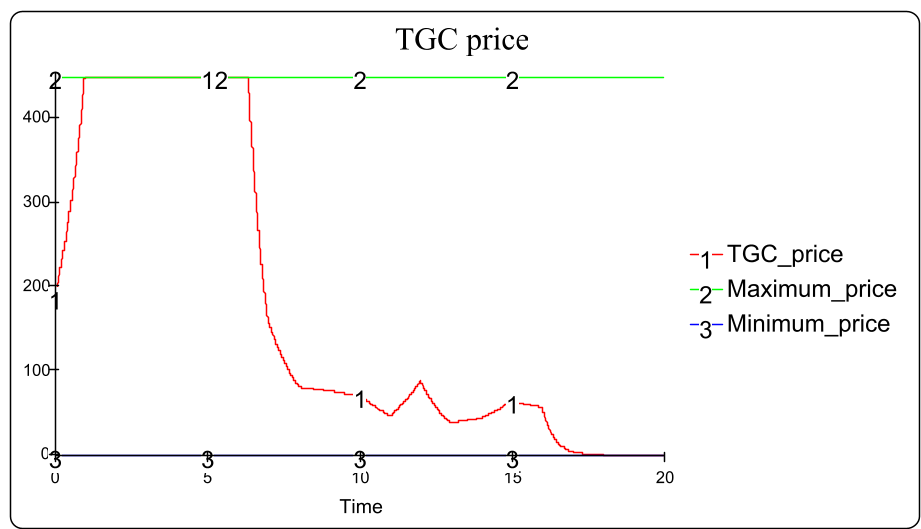 Figure 2: Results from the NTNU experiment showing the characteristic price spike and crash caused by speculative behavior.
Conclusion and Policy Implications
The research concludes that the design of environmental markets cannot rely on simple supply-and-demand curves. Strategic behavior and physical investment delays are "features," not "bugs."
Takeaway for Policy Makers:
- Longer Horizons: Investors need certainty beyond a 5-10 year window to reduce risk premiums.
- Flexible Mechanisms: Banking must be balanced with managed "borrowing" or price collars to prevent speculative hoarding.
- Dynamic Monitoring: Regulators should monitor "holdings" of certificates, as accumulation in private hands is a leading indicator of market inefficiency.
By combining the math of System Dynamics with the psychology of Experimental Economics, we can design green markets that are actually sustainable—not just on paper, but in practice.