
System Dynamics: Decoding the "Hidden Wiring" of Healthcare Systems
System dynamics: What’s in it for healthcare simulation modelers
This paper provides a comprehensive introduction to System Dynamics (SD) for healthcare simulation, comparing it with the traditional Discrete-Event Simulation (DES). It demonstrates how SD’s feedback loop mechanisms can model complex patient flows and social care demand, marking its rise as a critical tool for strategic healthcare policy.
TL;DR
In healthcare simulation, we often focus on the "queue"—individual patients waiting for specific tasks. System Dynamics (SD) shifts the lens to the "system," modeling the feedback loops and structural relationships that govern behavior over time. This paper argues that SD is not just an alternative to Discrete-Event Simulation (DES), but a superior tool for strategic policy-making where data is scarce and unintended consequences are common.
The Motivation: Why Detail Complexity is a Trap
For decades, the Operations Research community has relied on Discrete-Event Simulation (DES). DES is fantastic for "detail complexity"—knowing exactly which nurse is helping which patient at 2:00 PM. However, in large-scale healthcare systems (like national social care or hospital-wide admissions), this obsession with detail leads to:
- Data Hunger: DES requires massive amounts of precise empirical data to fit distributions.
- Missing the Big Picture: By focusing on individual entities, we often ignore the macro-level feedback loops.
- The "Vicious Circle" Ignorance: Policy changes often cause behavioral shifts (e.g., more beds leading to more referrals) that DES might not naturally capture.
Methodology: From Causal Loops to Stock-Flows
The core of SD is the belief that structure determines behavior. The author breaks this down into two critical modeling phases:
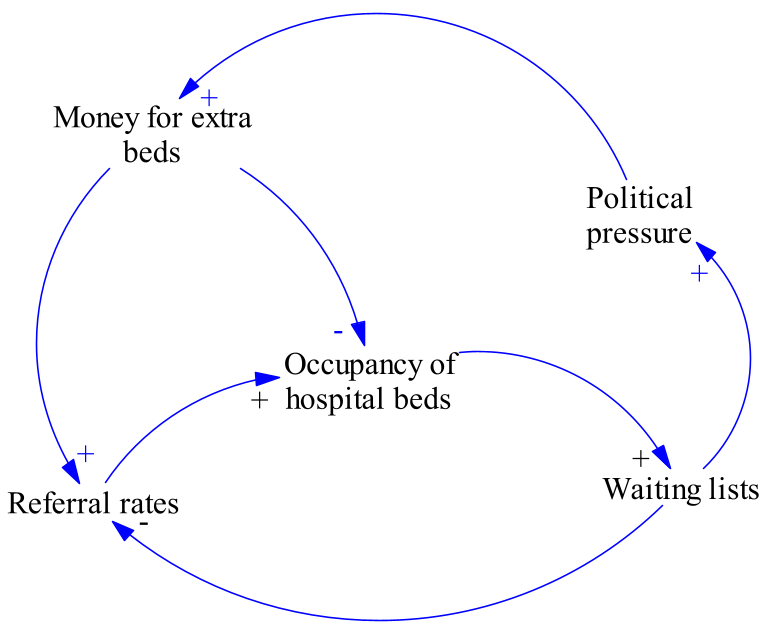
1. Qualitative: Causal Loop Diagrams (CLD)
This is where the "logic" of the system is mapped.
- Balancing Loops: These stabilize the system (e.g., longer waiting lists naturally discouraging new referrals).
- Reinforcing Loops (Vicious/Virtuous Circles): These cause exponential growth or collapse (e.g., more funding leading to more publicity, which increases demand, eventually leading back to high occupancy).
2. Quantitative: Stock-Flow Models
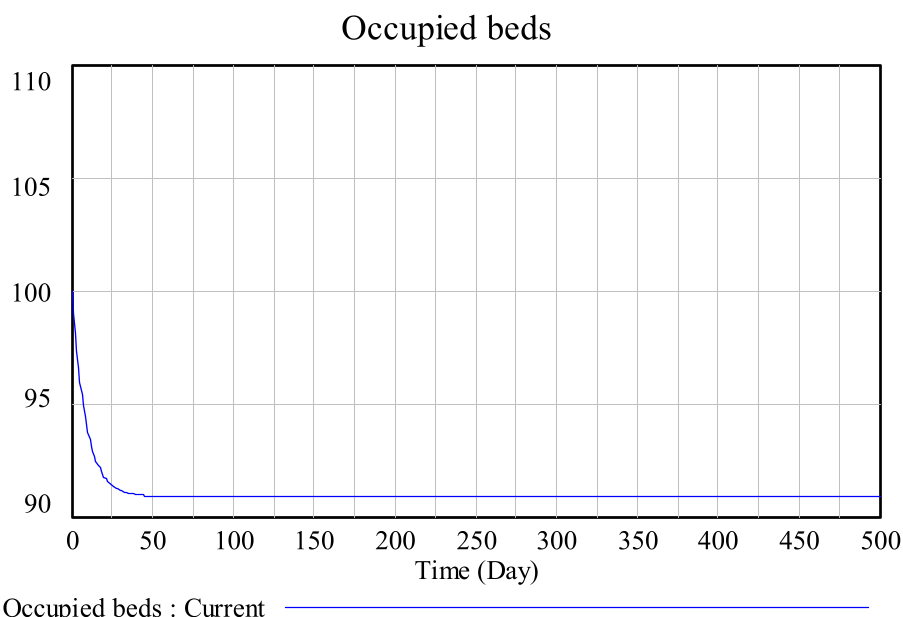
Once the loops are understood, they are converted into a "water tank" analogy.
- Stocks: The accumulations (e.g., patients currently in beds).
- Flows: The rates (e.g., admissions and discharges per day).
- Equations: Instead of stochastic individual events, SD uses difference equations to model the continuous change in stocks over time.
Real-World Impact: The Hampshire Social Care Study
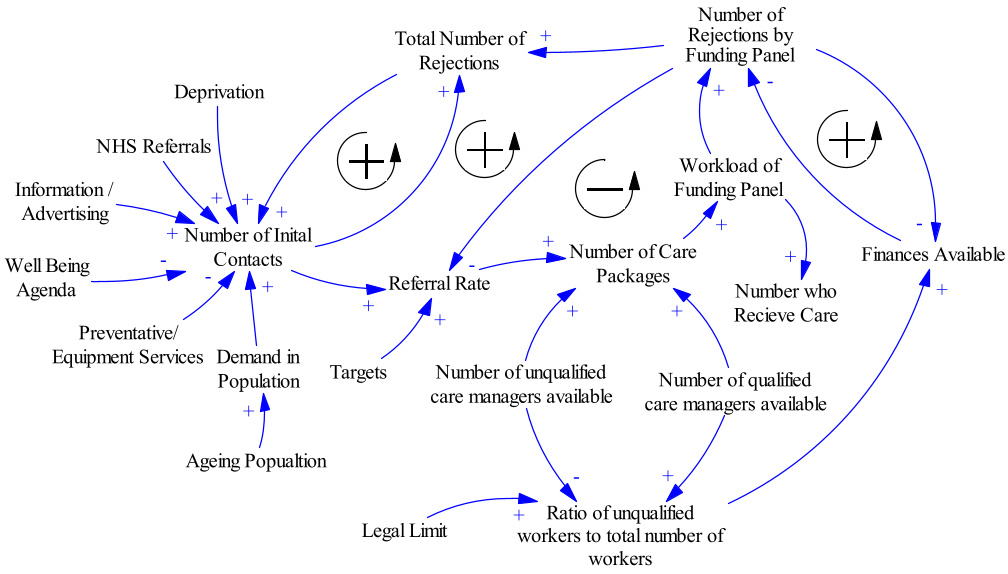
The paper highlights a case study in Hampshire, UK, where Social Services needed to cut costs. Many stakeholders suggested only funding the most "Critical" patients and cutting support for "Substantial" need patients.
- The Insight: The SD model revealed that while this policy looked good on paper, it triggered a feedback loop. Many "Substantial" patients who were denied early help deteriorated rapidly and returned to the system as "Critical" patients, costing the system even more.
- The Result: The model showed only 84% of the expected savings would actually be realized. This "strategic learning" is something a detailed queueing model might have missed entirely.
Strategic Takeaways & Future Outlook
System Dynamics thrives in the "Strategic Gray Area." It is particularly well-suited for healthcare because:
- Dynamic Complexity > Detail Complexity: It helps us understand why a system oscillates or fails over months/years.
- Interactive Simulation: SD models run nearly instantaneously, allowing policy-makers to sit around a screen and run "what if" scenarios in real-time.
- Data Parsimony: Useful insights can be gained from aggregated data and expert opinion, rather than waiting years for "clean" individual-level data.
Limitations: SD is not for everyone. If you need to know the optimal number of chairs in a specific waiting room or the exact scheduling of a surgeon, stick to DES.
Future Work: The industry is moving toward Hybrid Modeling, where software like AnyLogic allows modelers to use SD for the macro-environment and DES for the micro-logistics—offering the best of both worlds.