
Deciphering Industrial Evolution: A System Dynamics Approach to Economic Structural Optimization
13621_Research on System Dynamics Model of Industrial Economic System Structure Evolution Based on Computer Aided Analysis.
This paper presents a System Dynamics (SD) model focused on the evolution of industrial economic system structures using computer-aided analysis. It explores how interactions between industrial departments, regional factor endowments, and investment structures drive the transition from labor-intensive to technology-intensive industries to achieve sustainable economic growth.
Executive Summary
TL;DR: This research tackles the complexity of industrial economic systems by moving beyond static neoclassical models to a dynamic System Dynamics (SD) framework. It maps out how population, investment, and technology interact to shift an economy through the primary, secondary, and tertiary stages. By utilizing computer-aided simulation, the paper identifies the "driving forces" behind structural upgrades, offering a roadmap for sustainable, leapfrog economic development.
Positioning: This work serves as an application-oriented study that bridges Evolutionary Economics with computational simulation, specifically targeting the optimization of regional industrial chains.
The "Thinking" Shift: From Equilibrium to Evolution
The core motivation of the author, Hang Su, lies in the fundamental flaw of neoclassical economics: its preoccupation with static optimization. In reality, industrial systems are Dissipative Structures—they are open, dynamic, and constantly evolving.
The author argues that the current industrial pain points—such as land resource scarcity and environmental pollution—are symptoms of a "saturated" structural model. To solve this, we must understand the Causal Loops where investment doesn't just increase output, but changes the very nature of the sectors involved.
Methodology: The Architecture of Industrial Change
The paper employs a System Dynamics model to decompose the industrial economic system into interacting subsystems. The mathematical core rests on the relationship between total growth () and the weighted growth of sectoral outputs:
This formula reveals that the total growth rate is highly sensitive to the proportion () of each industry. Even if individual sectors grow, a "bad" structural mix can drag down the entire national economy.
1. Overall Model Structure
The author proposes a net-like feedback loop where innovation, enterprise decision-making, and market mechanisms interact.
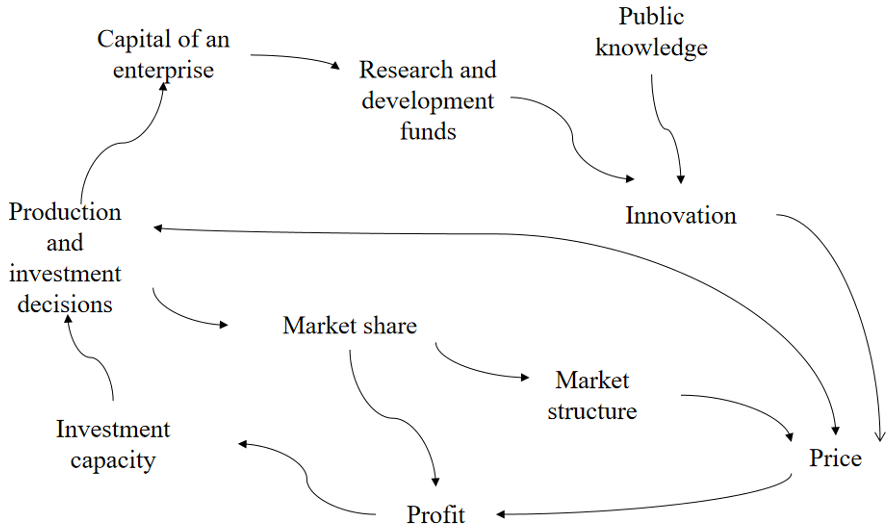
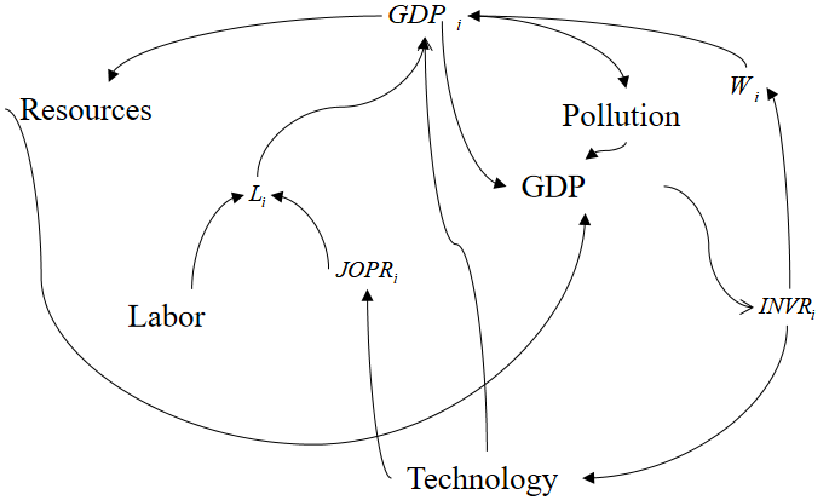
2. Causal Loops and Flow Diagrams
The model tracks variables such as Fixed Capital Investment, Employment Rate, and GDP per industry. It specifically notes how the "Green Output Value" of industry is often decreased by pollution losses, creating a negative feedback loop that necessitates technological progress.
Key Insights & Experimental Results
- The Agricultural "Brain Drain": The study finds that while the secondary industry pulls the economy, it often does so by eroding agricultural profits and absorbing surplus labor without immediate feedback into agricultural productivity growth.
- The Tertiary Push: The growth of the tertiary industry (service sector) acts as an extension of the secondary industry, showing a "push-pull" trend where modern services drive efficiency.
- Structural Resistance: A major finding is that many provinces in China suffer from "structural resistance" because they choose identical, non-complementary industrial structures, leading to resource waste and weak regional ties.
Critical Analysis & Conclusion
Takeaway
The true value of this research is its emphasis on Self-Organization. Instead of micro-managing industries, the government should focus on "controlling the external variables"—such as R&D investment and environmental regulations—that allow the industrial system to evolve naturally into a higher-order state.
Limitations
- Openness: As noted by the author, the model largely ignores the influence of Foreign Trade and external regional dependencies, focusing primarily on internal factor endowments.
- Data Scarcity: The paper highlights a lack of enterprise-level databases in China, which limits the granularity of the computer-aided analysis.
Future Outlook
The integration of AI-driven forecasting with these System Dynamics models could provide even more robust policy simulations, allowing for real-time adjustments to industrial strategy in an increasingly globalized world.