
Trust, Flexibility, and the Internationalization Paradox: A System Dynamics View of SME Supply Chains
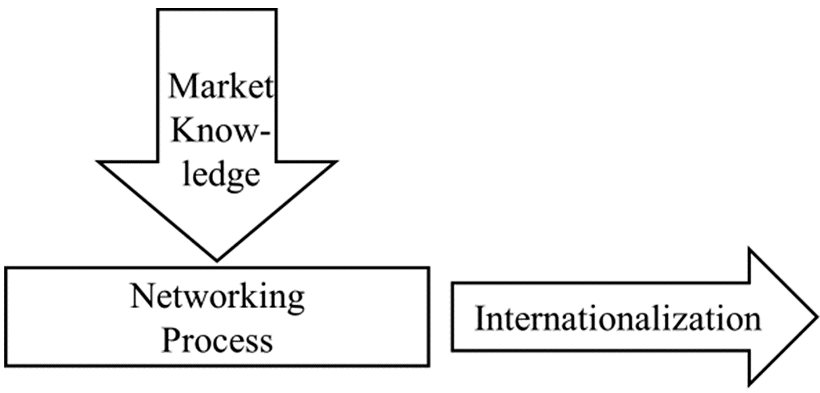
A System Dynamics Approach for SMEs Internationalization Networking Process
This paper analyzes the networking process of SME internationalization by integrating logistics capabilities and supply chain flexibility (SCF) through a system dynamics lens. It constructs a causal-loop diagram to model the reinforcing feedback between trust, commitment, logistics capabilities, and internationalization, while also identifying a critical trade-off: increased relational commitment reduces SCF. The work provides a novel theoretical framework but remains at the conceptual, pre-empirical phase, setting the stage for future hypothesis testing and empirical validation.
TL;DR
This paper pioneers a system dynamics approach to model the intricate feedback loops governing SME internationalization. It reveals a critical tautology in the networking process: while trust and commitment are essential for building logistics capabilities and supply chain flexibility (SCF), deeper commitment can paradoxically reduce SCF as the firm becomes locked into specific relationships. By translating these soft variables (trust, commitment) into causal-loop structures, the authors provide a foundational framework for testing how SMEs can pursue flexibility as a sustainable competitive advantage without falling into the commitment trap.
Background Positioning: This work is a theoretical consolidation piece. It does not simulate or experiment but synthesizes existing constructs (Uppsala model, logistics capability theory, social exchange theory) into a unified causal model, preparing the ground for quantitative simulation.
Problem & Motivation
The static gap in a dynamic process. Existing research treats SME internationalization as a linear path driven by resource availability or external pressure. However, the networking process is inherently iterative: market knowledge builds trust, trust fosters commitment, and commitment shapes logistics decisions. Prior studies (e.g., Mandal 2016; Gligor & Holcomb 2012) established pairwise relationships (e.g., trust → logistics capabilities) but failed to capture the reinforcing and balancing loops that emerge when these components interact over time.
The Paradox: The authors' key insight is that "commitment" is a double-edged sword. In the initial stages, it enables deeper collaboration (a reinforcing loop). However, as internationalization deepens, relational commitment creates dependency and reduces the firm's supply chain agility (a balancing loop). No prior network model had explicitly formalized this trade-off.
Methodology - The Core
Architecture: Causal-Loop Diagrams as Knowledge Maps
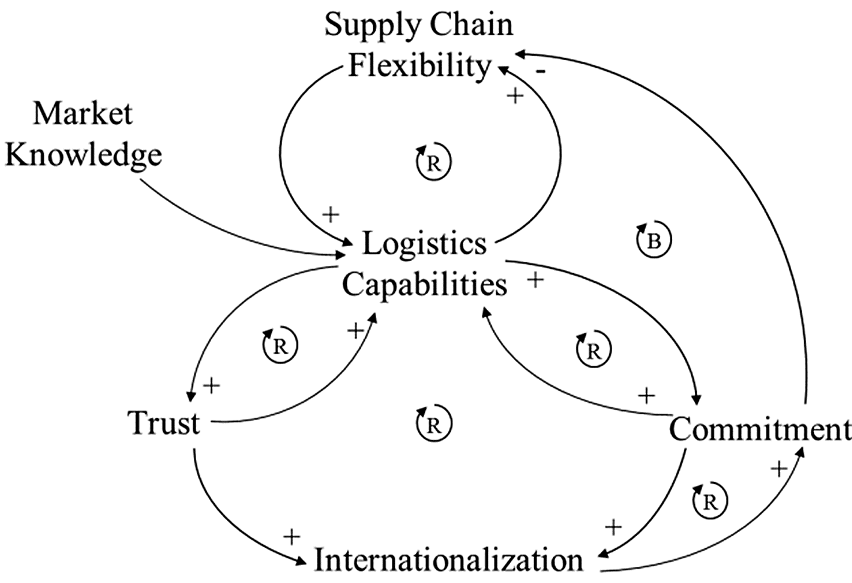
The authors adopt System Dynamics (SD) not to predict numbers but to map the qualitative structure of feedback. The core of the paper is Figure 2 (see below), which translates verbal theory into a visual causal model.
Key Variables & Their Roles:
- Market Knowledge: The exogenous input that fuels the entire system. Enters via logistics capabilities (e.g., information exchange).
- Logistics Capabilities: The central hub. They are both an output (enhanced by trust/commitment) and an input (enabling SCF and internationalization).
- Trust & Commitment: The "social glue." Trust enables commitment.
- Supply Chain Flexibility (SCF): The ultimate competitive advantage, but vulnerable to high commitment.
- Internationalization: The goal state, which also feeds back into commitment.
The Two Core Feedback Loops
The model hinges on three interacting loops, though two are dominant:
-
Reinforcing Loop (Trust-Logistics):
- Path: Logistics Capabilities (+) → Trust (+) → Commitment (+) → Logistics Capabilities (+)
- Logic: Effective information sharing (a logistics capability) builds trust. Trust leads to deeper commitment (e.g., joint investments). This commitment, in turn, demands even better integration capabilities, creating a virtuous cycle.
-
Reinforcing Loop (Flexibility-Building):
- Path: Logistics Capabilities (+) → SCF (+) → Logistics Capabilities (+)
- Logic: Integrated logistics (e.g., demand-management) improves a firm's ability to reconfigure its supply chain. This higher flexibility proves its value (e.g., faster customer response), which further motivates investment in logistics capabilities.
-
Balancing Loop (The Commitment Trap):
- Path: Internationalization (+) → Commitment (+) → SCF (-) → Internationalization (-)
- Logic: This is the critical discovery. As the firm commits to a specific foreign distributor, its flexibility to switch partners or renegotiate terms decreases. The "investment" becomes a sunk cost, reducing the firm's ability to respond to market fluctuationsasi. This, in turn, can limit further internationalization due to rigidity.
[Textual depiction of the causal loop structure]
Internationalization (+) ---> Commitment (+) ---> SCF (-)
    ^                                      |
    |                                      v
    +------- Supply Chain Flexibility -----+
Why This Matters: This model transforms the relationship from a simple linear regression (X influences Y) into a dynamic system. It explains why some SMEs become globally agile while others become trapped in rigid partnerships—the tipping point is where the balancing loop overpowers the reinforcing loops.
Experiments & Results
No simulation is performed. The "experiment" is entirely conceptual. The result is the causal-loop diagram itself. The authors validate their structure through logical argumentation and alignment with established empirical evidence (e.g., Mandal 2016).
Key Assertion: The model suggests that for SCF to serve as a sustainable competitive advantage, managers must intentionally manage commitment levels. The system has an implicit optimal zone of commitment—enough to enable trust and logistics synergy, but not so much that it triggers the balancing loop.
Critical Analysis & Conclusion
Summary (Takeaway): This paper successfully translates a soft, process-based problem (SME networking) into a rigorous causal structure. It formally identifies the commitment-flexibility trade-off as a key dynamic constraint in SME internationalization.
Limitations:
- Pre-Empirical State: The model lacks mathematical formalization (stock equations) and empirical calibration. It serves as a hypothesis-generating framework, not a validated predictor.
- Homogeneity Assumption: It treats all SMEs as uniform, ignoring industry-specific differences in supply chain configuration (e.g., manufacturing vs. service).
- Neglect of External Shocks: The model focuses on internal relational dynamics but does not incorporate macroeconomic or political uncertainties that severely impact SME internationalization.
Future Work & Industry Value: The immediate next step is to parameterize the model using longitudinal panel data from internationalizing SMEs. The key research question becomes: At what point does the marginal benefit of commitment on logistics capabilities become less than the marginal cost of reduced flexibility?
For practitioners, the takeaway is clear: Invest in logistics capabilities for information exchange to build trust, but be wary of deepening commitment to any single partner before assessing its impact on overall supply chain agility. The authors have provided a conceptual dashboard for this strategic balancing act.