
Social Ties Over Likes: Rethinking Video Prefetching in the Age of Mobile OSNs
Systematic, large-scale analysis on the feasibility of media prefetching in Online Social Networks
This paper presents a large-scale empirical analysis of video consumption patterns on Facebook to evaluate the feasibility of media prefetching. By analyzing data from over 700 users, the authors identify social "closeness" and viewport dwell time (pre-click delay) as superior predictors for content consumption compared to traditional popularity metrics like "Likes" or "Comments."
TL;DR
Researchers from the University of Darmstadt and Dresden conducted a massive study on Facebook usage to fix two mobile headaches: battery drain and video buffering. Their discovery? If you want to predict what someone will watch, ignore the "Like" count. Instead, look at who posted it (Family/Close Friends) and how long the user stares at the post before clicking. This "pre-click delay" offers a golden 2-second window to start downloading video chunks, potentially slashing startup delays to zero.
Context: The High Cost of the "Play" Button
As of 2014—the period of this study—mobile video traffic was already skyrocketing. However, the infrastructure faced a paradox. Accessing data via LTE is up to 32 times more energy-intensive than WLAN. Furthermore, data caps and high startup latencies (the "spinning wheel" of death) severely degrade the Quality of Experience (QoE).
Prefetching (downloading content before a user asks for it) is the logical solution, but it is risky. Prefetch the wrong video, and you've wasted the user's data plan and battery. The challenge: How do we predict what a user actually wants to see in a chaotic social feed?
The "Popularity" Myth
The industry often assumes that "Viral = Frequently Watched." This paper systematically dismantles that assumption for personal feeds. By analyzing over 600,000 wall entries, the authors found that the distribution of likes and comments for clicked vs. unclicked videos is nearly identical.
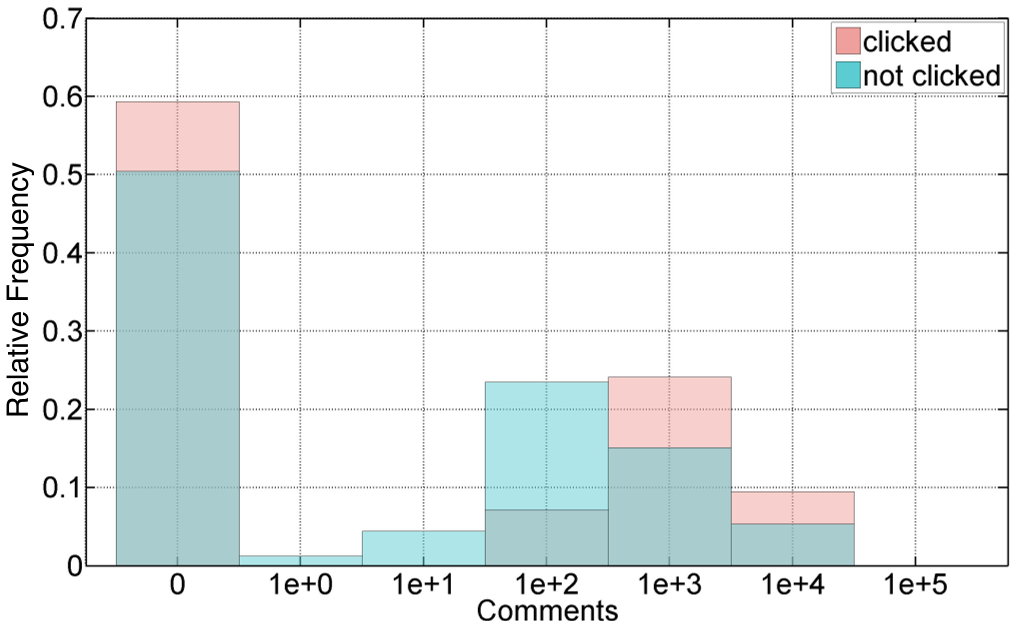 (a) & (b): The overlapping curves show that high engagement counts don't necessarily drive individual consumption.
Methodology: The Power of the Inner Circle
The researchers pivoted from "What is popular?" to "Who is important?" They categorized Facebook authors into:
- Close Friends/Family
- Regular Friends
- Pages/Groups (Public entities)
They also tracked Micro-Interactions: specifically, how long a post stays in the user's "viewport" (the visible part of the screen) before they click it.
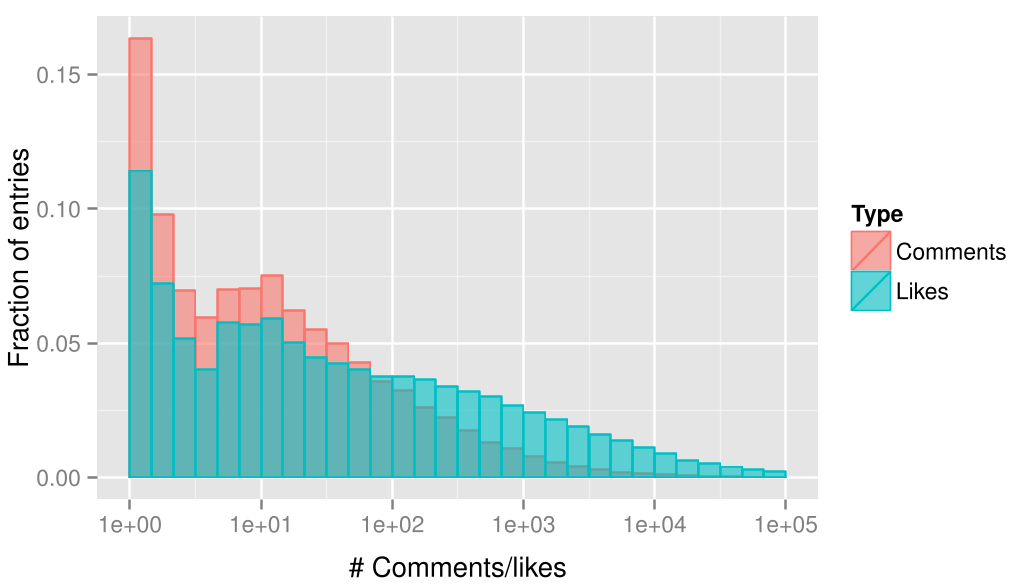 Fig 3. Box-plot showing the distribution of clicked content items relative to authorship.
Key Findings: The 2-Second Window
The study yielded two "Aha!" moments for technical architects:
1. The "Close Friend" Predictor
While "being a friend" generally didn't provide enough signal, the specific subgroups of Close Friends and Family were predictive goldmines.
- 85.7% of videos shared by close friends were watched.
- Only 8.3% of videos from "other" friends were clicked.
- Implication: Mobile OSN apps should prioritize prefetching content from the user's inner circle, regardless of the video's global popularity.
2. Exploiting the "Pre-Click" Delay
The authors discovered that users are not impulsive clickers. They spend significantly more time "evaluating" a post they intend to click than one they intend to scroll past.
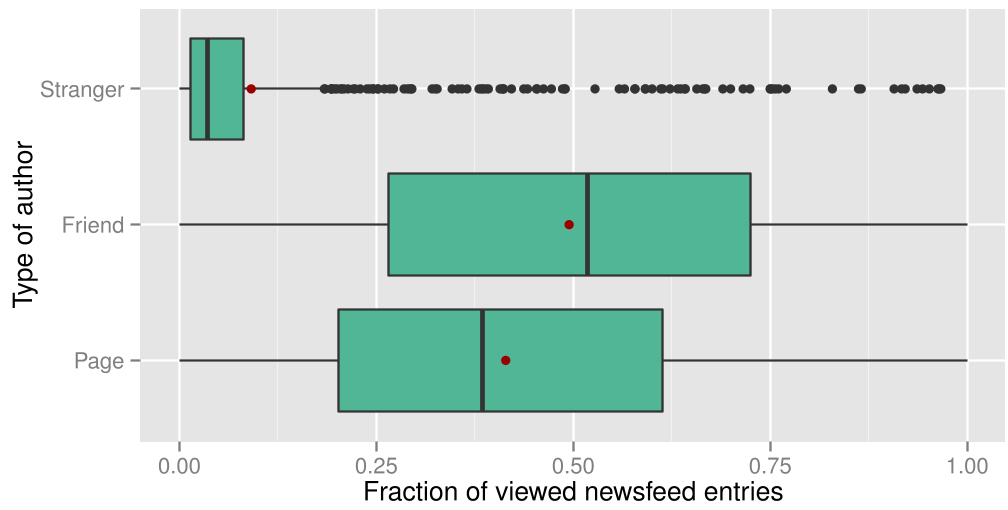 Table showing that clicked items (Photo/Video/Link) have specific interaction timestamps.
By setting a threshold—for instance, 2 seconds of dwell time—the system can initiate the download of the first 10 seconds of a video. This drastically reduces the perceived startup delay without requiring the massive overhead of pre-downloading an entire feed.
Critical Analysis & Conclusion
Takeaways
- Personalized over Global: In social contexts, social graph distance is a better feature for prefetching than global popularity metrics.
- Short-term Prefetching: Using viewport dwell time as a trigger (short-term prefetching) balances the trade-off between latency reduction and bandwidth waste.
Limitations
The study focuses on Facebook's 2014-era feed. In modern "Algorithm-First" feeds (like TikTok), the "Social Graph" distance might be superseded by "Interest Graph" similarity. Furthermore, with the advent of 5G, the energy ratio between cellular and WLAN might have narrowed, though the core logic of reducing startup delay remains vital for QoE.
Future Work
This research invites the development of "Context-Aware Prefetchers" that combine social closeness with real-time UI telemetry (like scroll speed and dwell time) to create a seamless, zero-latency video experience on mobile devices.