
Decoding Data-Driven Learning: A Systematic Map of Flipped Classrooms and Analytics
A systematic mapping study of educational technologies based on educational data mining and learning analytics
This paper presents a systematic mapping study of 122 academic articles focusing on the integration of Educational Data Mining (EDM) and Learning Analytics (LA) within Flipped Classroom (FC) environments. It establishes a classification scheme to categorize research trends, video-based learning strategies, and the technological landscape essential for optimizing data-driven educational outcomes.
TL;DR
The Flipped Classroom (FC) model is no longer just about watching videos at home and doing homework in class. This systematic mapping study of 122 papers demonstrates how Educational Data Mining (EDM) and Learning Analytics (LA) are becoming the backbone of modern pedagogy, shifting the focus from passive content delivery via videos to active, data-driven self-paced learning.
Motivation: The Blind Spot in the Flipped Model
While the Flipped Classroom offers flexibility, it traditionally suffers from a "black box" problem: teachers often don't know where students struggle until they return to the physical classroom. The authors argue that the rapid development of data science provides a unique opportunity to use learner footprints—such as video pause rates, replay segments, and navigation logs—to optimize the learning process in real-time.
Methodology: Mapping the Educational Tech Landscape
The researchers conducted a multi-stage systematic review, filtering hundreds of papers down to a core set of 122 studies. They structured their analysis around a three-pillar classification scheme:
- Main Field of Interest: Categorizing papers by domain (e.g., MOOCs, FC, EDM).
- Video Field of Interest: Focusing on the "how" of video interaction (e.g., video segments, navigation logs).
- Technology Stack: Cataloging the tools used for creation, hosting, and LMS integration.
 Figure 1: The study's classification framework, linking broad educational fields to specific video interaction technologies.
Key Insights and Trends
The study highlights a significant surge in interest regarding educational analytics since 2012. Interestingly, while the technology for hosting videos (like YouTube) is mature, the technology for video interaction—collecting granular analytics on student behavior—is still an emerging frontier.
1. The Dominance of EDM and LA
The analysis shows that EDM and LA represent the largest share of the literature (36.9%), followed by specific Flipped Classroom implementations (25.4%). This suggests that the academic community is pivoting away from "whether" the flipped model works toward "how" we can measure and improve it using data mining.
2. The Power of Video Navigation Logs
The researchers identified "Video Navigation" as a critical sub-field. By analyzing how students move through a video, educators can identify "bottleneck" topics where many students pause or rewind, allowing for targeted interventions.
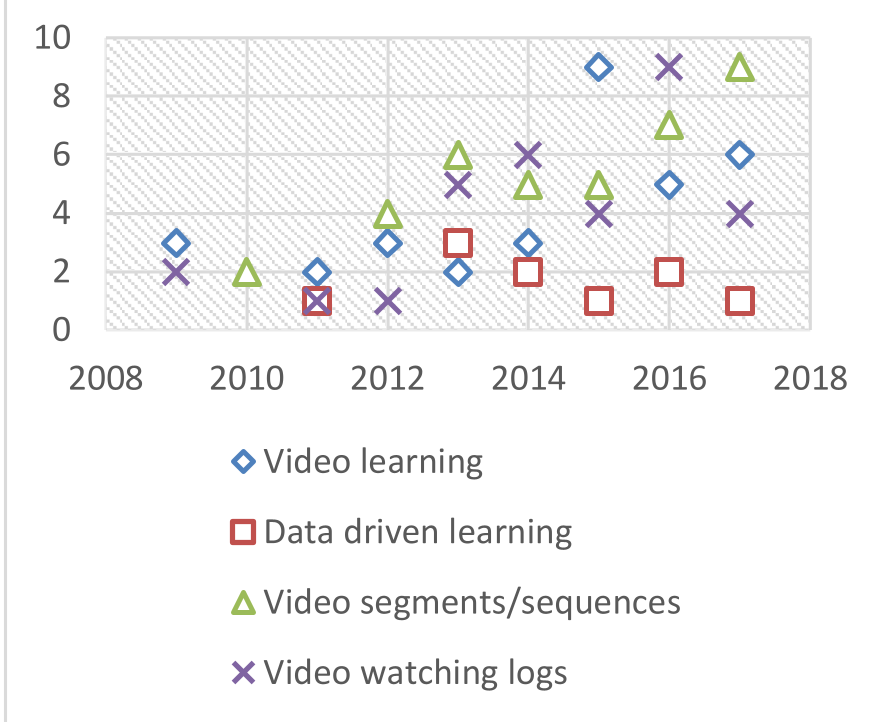 Figure 2: Time series analysis showing the diversification of research into data-driven learning and video interaction over the years.
Critical Analysis: Where do we go from here?
The study concludes that while we have the tools to create and host content, the "interactivity" layer remains underdeveloped. Most current systems track that a student watched a video, but not how they learned from it.
Future Research Directions:
- Predictive Modeling: Using EDM to predict student performance early in a semester based on early video interaction patterns.
- Self-Paced Navigation: Developing algorithms that automatically suggest review segments based on a student’s unique browsing history.
- Refined Student Models: Moving beyond generic analytics to create individualized cognitive profiles based on data-driven insights.
Conclusion
This paper serves as a strategic roadmap for EdTech researchers. It validates that the future of the Flipped Classroom is inextricably linked to our ability to mine educational data. For practitioners, the takeaway is clear: the most valuable asset in the modern classroom isn't just the video content—it's the data generated by the students who watch it.