
Beyond Expert Scripts: The Rise of Data-Driven Intelligence in Educational Games
A systematic review of data-driven approaches in player modeling of educational games
2017-12-30
Summary
Problem
Method
Results
Takeaways
Abstract
This systematic literature review (2008–2017) synthesizes data-driven player modeling in educational games, categorizing research into behavior modeling, goal recognition, and procedural content generation (PCG). It highlights the shift from expert-heavy Knowledge Engineering to automated machine learning techniques like LSTMs and Markov Logic Networks for predicting student actions.
## TL;DR
Educational games are evolving from rigid, scripted tutors into dynamic environments that "understand" the learner. This systematic review by Hooshyar et al. surveys a decade of research, revealing how data-driven approaches—ranging from Markov models to Deep LSTMs—are replacing manual Knowledge Engineering to predict player goals, model behaviors, and automatically generate personalized content.
## The Motivation: Escaping the "Knowledge Engineering" Trap
For decades, making an educational game "smart" required a human expert to sit down and map out every possible student mistake and learning path. This is known as **Knowledge Engineering**. However, modern games have massive state spaces (the number of possible actions). If a student can build 10 structures in 100 locations, the combinations explode exponentially.
The authors argue that traditional "Model-based" systems are too brittle for this complexity. The shift toward **Data-driven (Model-free)** approaches allows AI to observe raw "click-stream" data and discover patterns of exploration, error, and mastery without needing a pre-defined pedagogical script.
## Methodology: Mapping the AI Landscape
The researchers filtered 67 significant works down to 21 core studies to answer one central question: *What is the state-of-the-art in data-driven player modeling?*
### 1. Behavior Modeling (The "What")
This is the most mature area. Researchers use techniques like **Hidden Markov Models (HMMs)** and **Support Vector Machines (SVMs)** to classify players into types (e.g., "achievers" vs. "explorers") or predict their next move.
### 2. Goal Recognition (The "Why")
This focuses on predicting a player's high-level intention from low-level actions. A standout finding is the efficacy of **Deep Learning**:
* **Stacked Denoising Autoencoders** and **Long Short-Term Memory (LSTM)** networks have replaced older logic-based systems, offering superior accuracy in non-linear games.
### 3. Procedural Content Generation (The "How")
Instead of hand-crafting levels, PCG uses algorithms to create content on the fly. In educational games, this is used for **Dynamic Difficulty Adaptation (DDA)**—if a student is frustrated, the AI generates a "hint" level or modifies the puzzle to ensure the student stays in the "Flow" state.
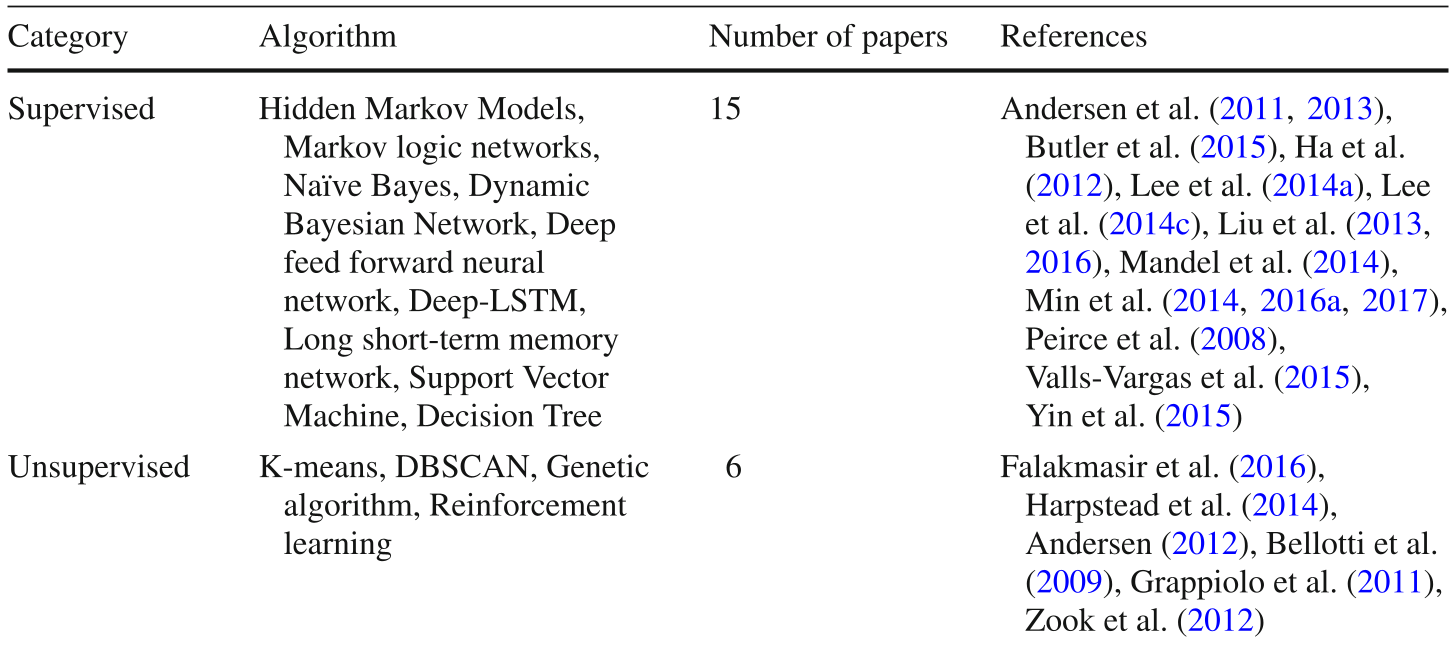
*Table: A breakdown of supervised vs. unsupervised algorithms used in the surveyed literature.*
## Critical Challenges: The Data Sparsity Problem
Despite the promise, data-driven modeling faces several "bottlenecks":
* **Semantic Interpretability**: A Neural Network might predict a student will fail, but it rarely explains *why* (e.g., "The student lacks a conceptual understanding of fractions").
* **Data Sparsity**: In open-world games, students diverge so quickly that many game states are only visited by a single person, making it hard for statistical models to generalize.
* **Temporal Forecasting**: Player skill isn't static. A model built on Monday might be obsolete by Friday as the student learns, requiring models that can account for **temporal variations**.
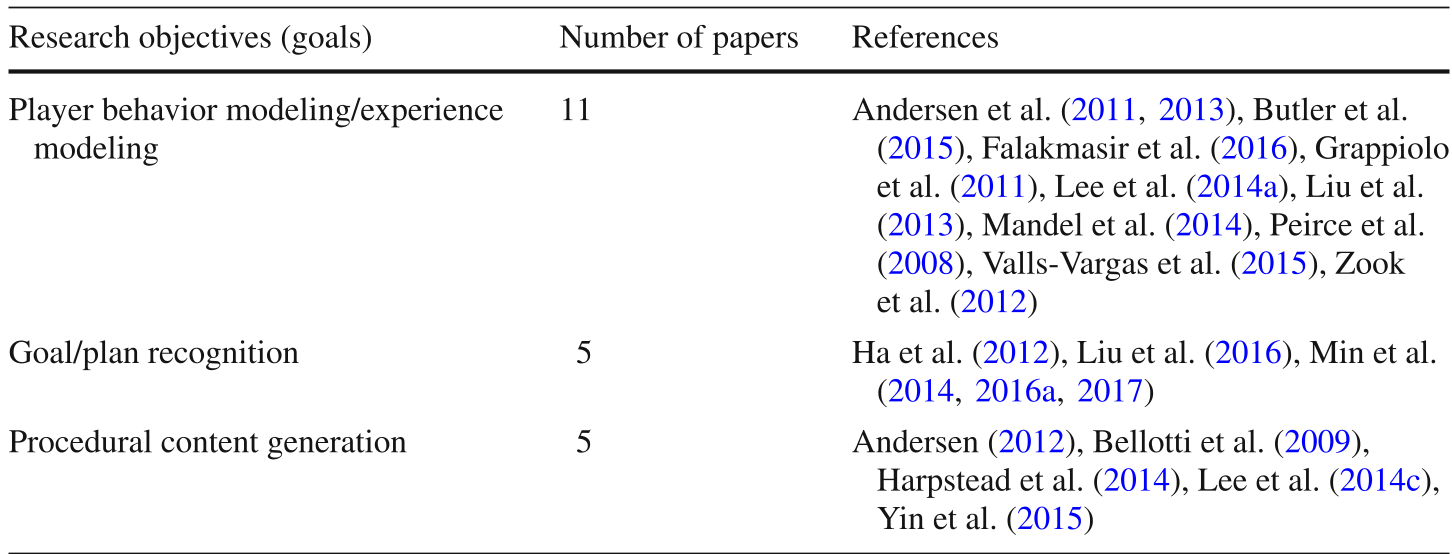
*Table: The distribution of research focus, showing a heavy tilt toward behavior modeling.*
## The Future: Hybrid Intelligence
The review concludes that the "Holy Grail" of educational gaming is a **Hybrid Model**. This approach combines the raw predictive power of Deep Learning with a "thin layer" of expert knowledge to ensure the AI's predictions remain pedagogically sound and human-interpretable.
To reach this, the industry needs:
1. **Rich Multimodal Datasets**: Combining click-stream logs with eye-tracking or physiological data.
2. **Public Benchmarks**: Unlike the CV or NLP communities (ImageNet/GLUE), educational gaming lacks a standardized dataset to compare model performance fairly.
## Final Takeaway
We are moving toward a world where every "click" in a learning environment is a data point for a personalized curriculum. By mastering data-driven modeling, we can transform games from mere entertainment into precision instruments for cognitive development.