
Navigating the Scientific Social Network: A Systematic Survey on Collaborator Finding Systems
A systematic survey on collaborator finding systems in scientific social networks
This paper presents a systematic survey of collaborator finding systems within scientific social networks (SSNs). It categorizes existing literature into expert finding and collaborator recommendation, while evaluating current tools in platforms like ResearchGate, Mendeley, and Aminer to identify research gaps in personalized academic collaboration.
TL;DR
The explosion of online scientific social networks (SSNs) has made finding the right research partner like searching for a needle in a haystack. This systematic survey by Roozbahani et al. dissects the evolution of Expert Finding and Collaborator Recommendation systems. It identifies a critical gap: current systems move too far away from the human "Why" of collaboration. The paper advocates for a shift toward multidimensional, interpretable models that combine what you know (content) with who you know (topology).
The Core Challenge: Beyond Simple Search
The academic world is no longer confined to university hallways; it lives on ResearchGate, Mendeley, and Academia.edu. However, the problem has shifted from "information scarcity" to "information density."
Existing methods generally fall into two traps:
- Content-Only Focus: They find people who use similar keywords (e.g., "Deep Learning") but ignore whether those people actually collaborate or are in completely different seniority brackets.
- Topology-Only Focus: They predict links based on mutual friends (Common Neighbors) but ignore if the researchers' actual expertise is complementary.
Methodology: The Three Pillars of Academia
The authors categorize the research landscape into three distinct technical approaches to bridge these gaps.
1. Content-Based Analysis
Utilizing Information Retrieval (IR) and Natural Language Processing (NLP), these models analyze publications, CVs, and project descriptions. The paper notes a trend moving from simple Vector Space Models to Topic Modeling (LDA) and more recently, Deep Learning (doc2vec).
2. Social Network Analysis (SNA)
This treats SSNs as graphs. Key measures like Betweenness Centrality (to find bridge-builders) and H-index (to measure influence) are used to rank the "authority" of a potential collaborator.
3. Combined/Integrated Models
The most sophisticated approaches use "Multilayer Networks," where one layer represents the social relationships (following, co-authoring) and another represents the knowledge/concept space.
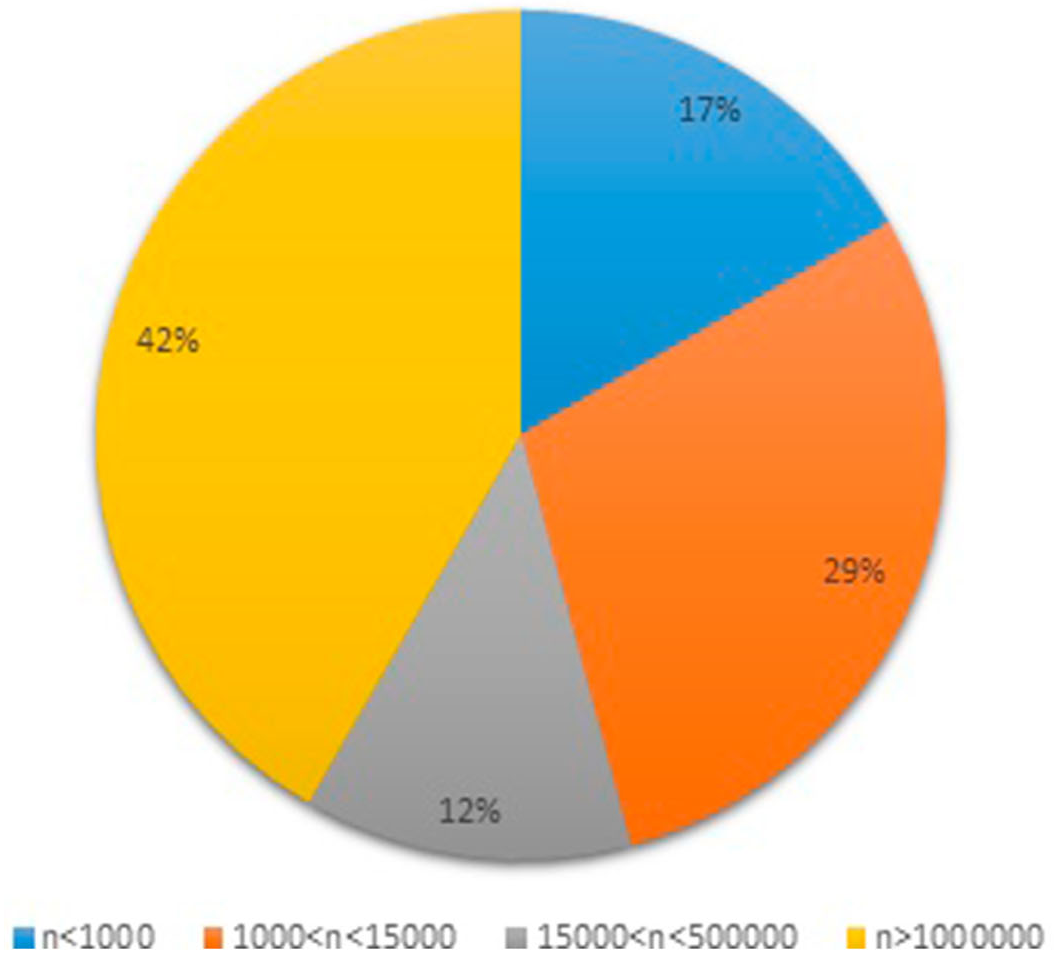 Data distribution and size across various datasets used in current literature.
Detailed Comparison of SOTA Methods
The survey meticulously maps out how different algorithms utilize specific data sources:
| Method Type | Key Algorithms | Focus |
|---|---|---|
| Expert Finding | PageRank, HITS, CNN | Identifying "who knows what" |
| Collaborator Finding | Similarity-based, K-means, BCR | Identifying "who should work together" |
One standout insight is the Benefit Function. The authors argue that a recommendation isn't "one size fits all." A PhD student looking for a supervisor needs different criteria (weighting seniority) than two senior professors looking to merge labs (weighting complementary expertise).
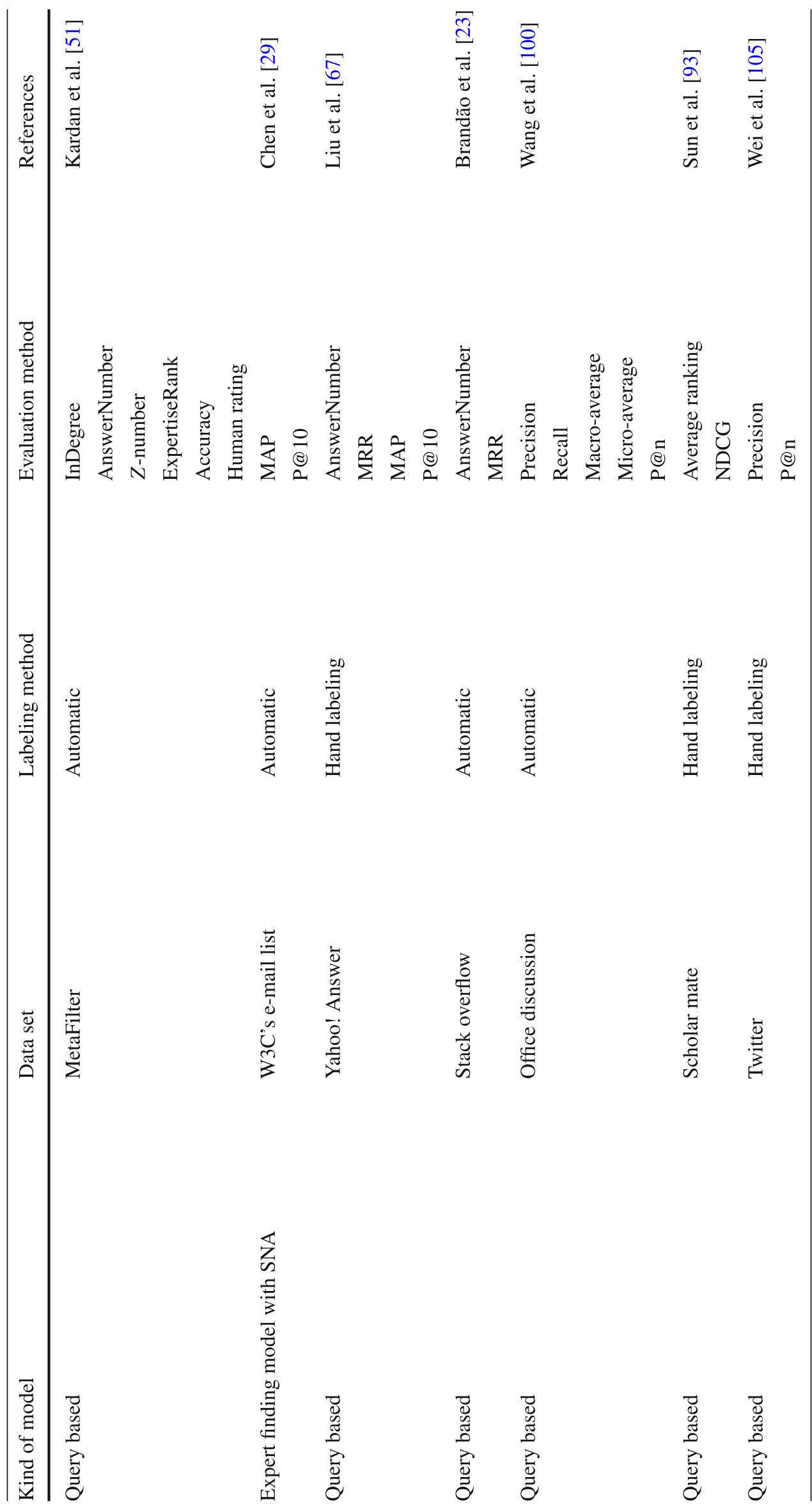 Summary of evaluation metrics and labeling methods for Expert Finding.
Critical Analysis & The Road Ahead
Despite the progress, several "Open Challenges" remain:
- The Cold Start Problem: How do we recommend a first-year PhD student with no papers yet? The authors suggest using "Liked Journals" or "University Affiliation" as proxy features.
- Interpretability: Researchers don't trust "Black Box" recommendations. Systems need to explain why a collaborator was suggested (e.g., "Recommended because your projects in 'NLP' overlap with User X's expertise in 'Graph Theory'").
- Reliability: Current systems don't measure "trust." Future systems might need to incorporate blockchain or peer-validated reputation scores.
Conclusion
This survey serves as a vital map for anyone building the next generation of academic discovery tools. The shift from simple expert search to Personalized Collaboration Recommendation is the new frontier. By moving toward multilayer networks that capture both the "semantics" of our work and the "topology" of our social ties, we can finally turn global platforms into productive research labs.
Key Takeaway: Don't just model the nodes; model the intent of the collaboration.