
Social Re-ranking: Taming the Redundancy in Tag-Based Image Search
Tag-Based Image Search by Social Re-ranking
This paper introduces a Social Re-ranking (SR) system for tag-based image search on social media platforms like Flickr. It leverages a two-stage re-ranking process—inter-user and intra-user—combining visual features, semantic co-occurrence, and social clues (user contribution and view counts) to achieve a SOTA balance between relevance and results diversity.
TL;DR
Search results on social platforms are often cluttered with dozens of nearly identical photos from a single user's vacation or event. This paper presents a Social Re-ranking (SR) system that filters this "user-centric" redundancy by ranking users based on their contribution and selecting only the most relevant, popular image from each, significantly boosting both search relevance and diversity.
Background & Motivation
In the era of Web 2.0, tag-based image retrieval (TBIR) is the backbone of platforms like Flickr. However, it faces a persistent "Diversity vs. Relevance" trade-off.
- Tag Mismatch: Users tag photos subjectively (polysemy/synonyms).
- Social Redundancy: A single user might upload 50 photos of a "Zebra." Standard algorithms might rank all 50 at the top, leaving no room for other perspectives.
The authors' core insight is that images from the same user taken at the same time and spot are inherently redundant. By introducing "User Information" as a primary filter, they can force diversity at the source.
Methodology: The Dual-Layer Re-ranking
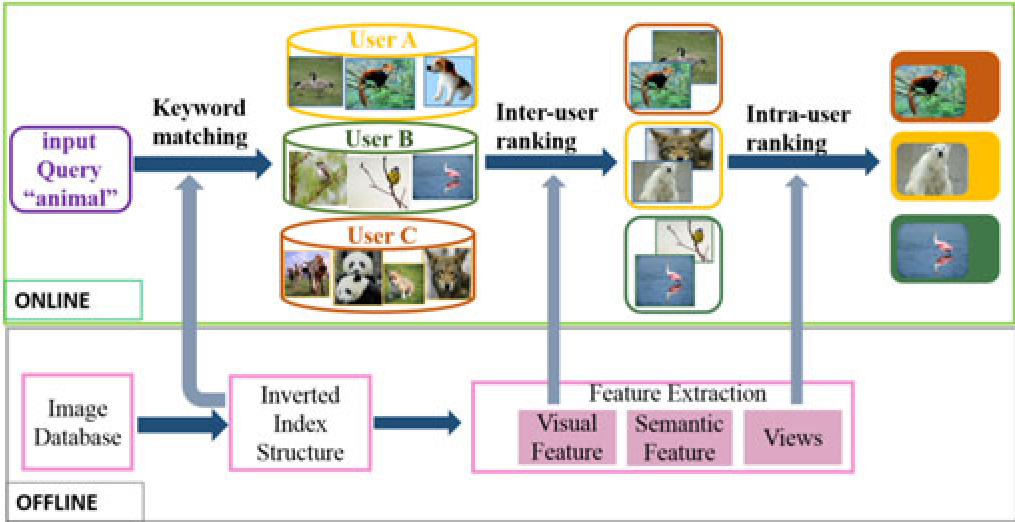
The proposed system bifurcates the retrieval process into two distinct online stages:
1. Inter-User Re-ranking
Instead of ranking images directly, the system first ranks users. A user’s rank is determined by their "contribution" () to the query, calculated by how many of their images are tagged with words that co-occur frequently with the query tag (e.g., if the query is "Sky," a user with many photos tagged "Cloud" or "Blue" ranks higher).
2. Intra-User Re-ranking
Once users are ranked, the system must pick the "best" image from each. This is achieved via a Regularization Framework:
- Visual Term: Ensures visually similar images have similar scores.
- Semantic Term (): Prefers images with high tag co-occurrence similarity.
- Social Term (): Prefers images with higher view counts (popularity).
Experimental Validation
Testing on a massive dataset of 6 million images, the authors compared SR against traditional View-based (VR) and Diverse Relevance (DRR) methods.
- Relevance: By including view counts and semantic co-occurrence, the SR method ensured that the top images were not just diverse, but actually "good" photos.
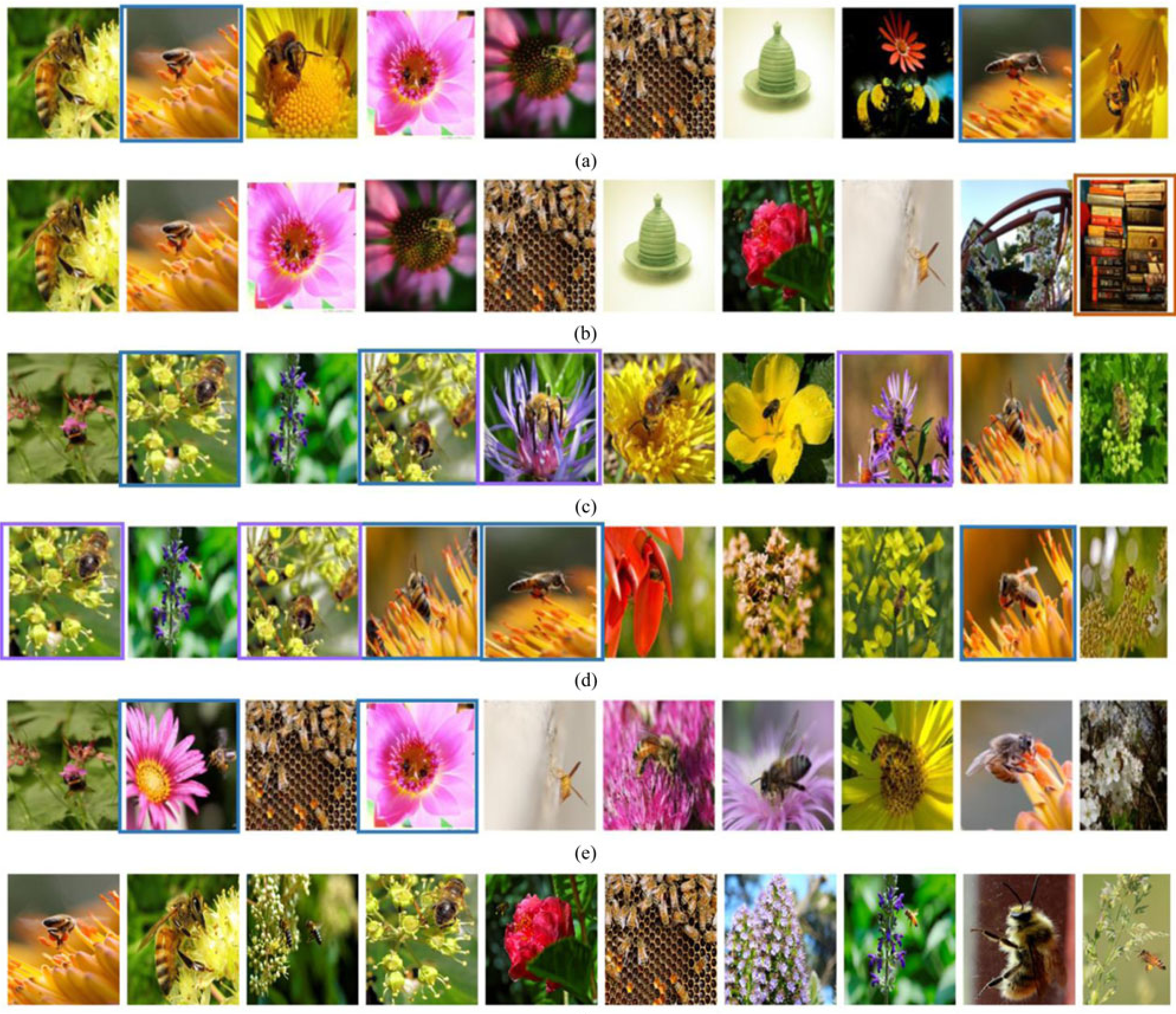
- Diversity: As shown in the comparative figure below, while VR and RR often return multiple photos from the same user (marked with the same color), the SR method successfully presents a unique user for every result in the top 10.
Quantitative Edge
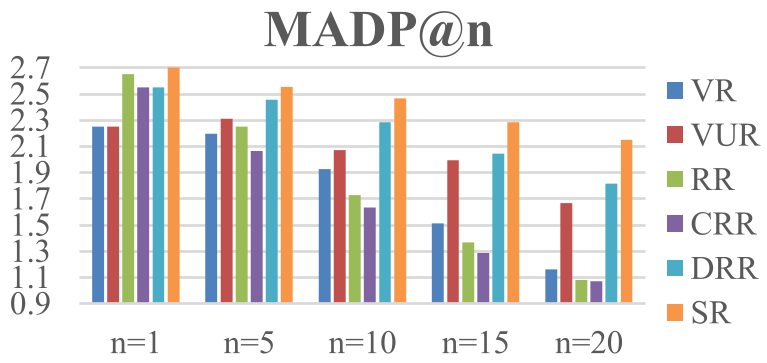
The Mean Average Diverse Precision (MADP) highlights the win: SR achieved a score of 2.148, nearly doubling the performance of simple view-based ranking (1.16).
Deep Insight: Is Deep Learning Necessary?
The authors conducted an ablation using AlexNet features. While deep features improved relevance slightly, they massively increased computational complexity. Interestingly, their "hand-crafted" 215-D color and texture features, when combined with their social re-ranking logic, provided a "sweet spot" of high performance and low latency (ranking 9,000 images in ~10s).
Conclusion
This paper serves as a reminder that in social media contexts, metadata is a signal of intent. By treating the "User" as a first-class entity in the ranking algorithm, the Social Re-ranking method solves the redundancy problem more elegantly than complex visual-clustering methods ever could. Future work remains in exploring the "social circles" and relationships between users to further refine these results.