
Refined Tags, Better Search: Solving the Noise Problem in Social Image Metadata
TAG QUALITY IMPROVEMENT FOR SOCIAL IMAGES
This paper introduces a novel optimization framework for improving the quality of user-provided tags in social images (e.g., Flickr). By utilizing an iterative bound optimization method, the proposed scheme refines noisy, imprecise, and incomplete tags to better reflect actual image content.
TL;DR
Social image tags are often messy—imprecise, subjective, or missing entirely. This paper introduces a mathematical optimization framework that fixes these tags by ensuring that visually similar images have semantically similar tags, while respecting the original tags provided by users. Using an iterative optimization approach, it significantly boosts the accuracy of image metadata on platforms like Flickr.
Background: The 50% Relevance Gap
In the world of social media, tags are the lifeblood of discoverability. However, research indicates a frustrating reality: nearly half of user-provided tags are irrelevant to the actual pixels. A photo of a park might be tagged with "family" (subjective) or "vacation" (contextual), but miss "tree" or "bench" (objective content).
Existing solutions often relied on static dictionaries like WordNet or simple visual clustering. The authors of this paper argue that these methods miss the "big picture"—specifically, the intrinsic link between how an image looks and what its tags should mean.
Methodology: The Consistency-Compatibility Balance
The core of the paper is an optimization objective that balances two distinct forces:
- Visual-Semantic Consistency: If Image A and Image B look alike (visual similarity ), their tag sets and should be semantically close. The authors use a tag similarity matrix (based on co-occurrence) to ensure that even if different words are used (e.g., "automobile" vs "car"), the system recognizes the semantic bridge.
- Compatibility: We shouldn't throw the baby out with the bathwater. User tags, though noisy, contain "valuable hints." The model includes a penalty term to prevent the refined tags from drifting too far from the original labels ().
 The unified objective function combining visual-semantic alignment and tag compatibility.
The Solver: Iterative Bound Optimization
Because the optimization problem is complex, the authors derive an iterative algorithm. They create an "upper bound" of the objective function and solve for (the improved tags) and (a scaling factor) alternately until the system converges to a stable, cleaner set of tags.
Experimental Proof: Cleaning up Flickr
The researchers tested their approach on 10,000 images from Flickr across 10 popular categories (cat, sky, etc.). They used 343-dimensional visual features (color, texture, shape) and the "Google Similarity Distance" to map tag relationships.
Performance Boost
The results were clear: the proposed method significantly outperformed both the raw tags and the previous State-of-the-Art (CBAR).
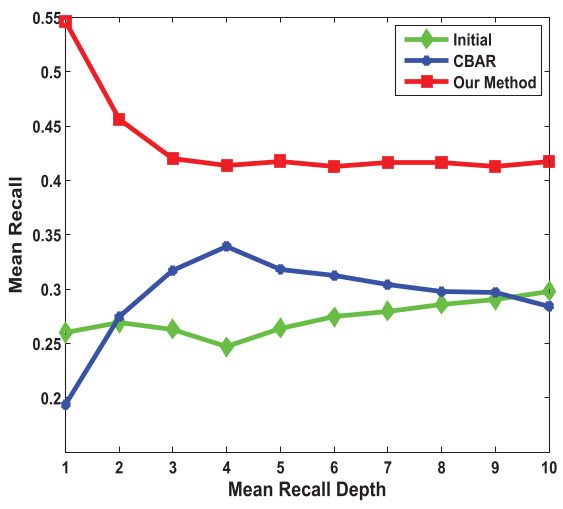 Figure: Examples of tag improvement. Notice how generic or incorrect tags are suppressed in favor of high-confidence descriptive terms.
- Precision: The model effectively filtered out noise like "cool" or "vacation" from being primary descriptors.
- Recall: It successfully "filled in the blanks" for missing tags that were visually evident but ignored by the original uploader.
Critical Insight: Why This Works
The brilliance of this work lies in its treatment of tags as a latent manifold that must align with the visual manifold. By utilizing a scaling matrix (), the system manages the different "magnitudes" of visual vs. semantic data, ensuring that the visual evidence doesn't overwhelm the textual evidence or vice-versa.
Conclusion & Future Directions
This paper provides a robust mathematical foundation for cleaning up the "Wild West" of social media metadata. While this work focused on ten categories, the framework is flexible enough to integrate more advanced semantic measures (like WordNet) or deeper visual features. As we move into an era of massive multi-modal AI, these techniques for "denoising" human-provided labels remain critical for training the next generation of vision models.
Limitations: The reliance on tag co-occurrence means that very rare but accurate tags might still be penalized or "smoothed away" toward more common synonyms.