
Tagged Data Breaches: The Hidden Vulnerabilities in Social Privacy Controls
Tagged Data Breaches in Online Social Networks
This paper investigates the efficacy of privacy control mechanisms for tagged data (photos, status, geo-tags) in Online Social Networks (OSNs), specifically focusing on Facebook. Through multi-scenario analysis, it demonstrates how current authorization models fail to resolve conflicts between content owners and tagged users, leading to unintended exposure of Personally Identifiable Information (PII).
TL;DR
Even with "strict" privacy settings, your personal photos might be visible to people you've explicitly blocked. This paper exposes the architectural flaws in Facebook’s tagging system, where the conflict between a content owner's settings and a tagged user's intentions often results in Data Leakage. The authors prove that the "owner-centric" model of social media is fundamentally insufficient for protecting multi-party PII.
The "Ownership" Paradox in Social Media
The central motivation of this research is a simple but dangerous observation: Social data is collaborative, but privacy controls are individual.
When you are tagged in a photo, you become a stakeholder in that data. However, in most OSNs, the person who uploaded the photo (the "owner") holds the ultimate "Administrative" power. The authors highlight that while you can "remove a tag," the photo remains in the News Feed and Search results. This lack of semantic interoperability between different users' privacy preferences is the root cause of contemporary data breaches.
Methodology: Scenario-Based Stress Testing
The researchers mapped out a social graph involving multiple actors (User A to User H) to test varying levels of visibility. They moved beyond simple "Public vs. Private" switches to explore "Custom" settings—the very settings users rely on for granular protection.
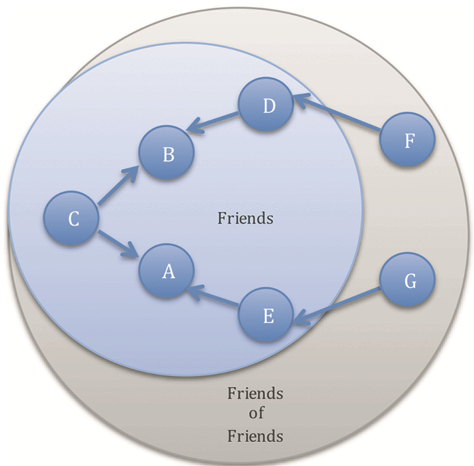
The methodology split social relationships into two levels:
- Fine-grained level: Sharing with direct friends.
- Social Circle level: Granting indirect access to "friends of friends."
Key Findings: Where the System Breaks
Through a series of scenarios, the paper identifies several critical failure points:
1. The Mutual Friend Loophole
In Scenario 4A, if User A shares a photo with "Friends" but excludes "Friends of Tagged User B," a mutual friend (User C) can still bridge the gap. User C sees the photo on both timelines, effectively bypassing the exclusion intended by User A.
2. The Dominance of the Content Owner
As shown in the table below, when User A (Owner) sets a photo to "Only Me," User B (Tagged) has zero ability to share that memory with their own audience, regardless of their own settings. Conversely, if the owner sets it to "Public," the tagged user's privacy becomes extremely difficult to manage.
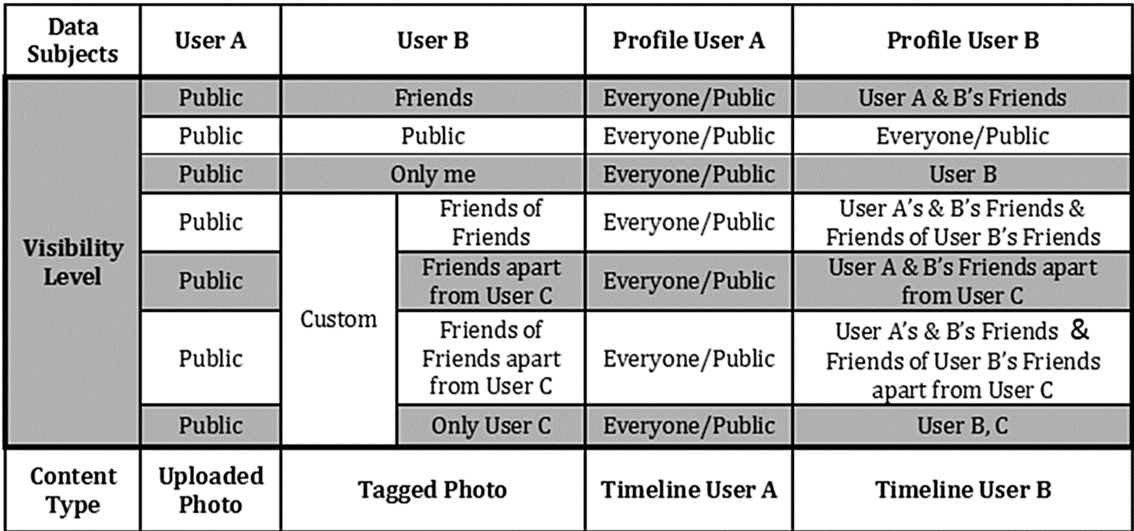
3. Cross-Platform Leakage
The study also looked at Instagram-to-Facebook sharing. They found that tags often don't carry over (requiring re-tagging), but hashtags do. More alarmingly, private Instagram links shared to Facebook often become "clickable" and viewable to anyone with the direct link, even if the primary account is set to private.
Critical Insight: Why Does This Happen?
The "Privacy Gaps" identified are not just bugs; they are a result of the Social Relationship Management (SRM) logic used by OSNs. These platforms prioritize Engagement (making it easy to see content) over Restriction.
When two users have conflicting privacy settings for the same piece of content (e.g., User A wants it public, User B wants it private), the system usually defaults to the most permissive setting or the owner's setting. The paper argues that we need a "Multiparty Access Control" (MPAC) model where the most restrictive setting among stakeholders takes precedence.
Conclusion and Future Outlook
The authors conclude that existing privacy menus are too "vague" and "unstable." For future OSN development, they suggest:
- Collaborative Approval: Both owner and tagged users must agree on the audience.
- Context-Aware Controls: Mechanisms that understand the relationship between User A, User B, and the observer.
- Link Privacy: Ensuring that cross-platform permalinks respect the most private setting of the source.
As face recognition and automated tagging become more ubiquitous, the "collateral damage" to user privacy will only grow unless we move toward these more sophisticated, democratic privacy models.