
Mapping the Taiwan Academic Landscape: A Social Network Analysis Perspective
Taiwan Academic Network Discussion via Social Networks Analysis Perspecitve
This paper explores the structure of the Taiwan Academic Network (TAN) within the IT and Information Management (IM) domains using Social Network Analysis (SNA). By analyzing 15 major conferences held in 2009, the study constructs networks based on Call for Papers (CFP) topics and committee memberships, identifying key "bridge" conferences like TANET, OOTA, and IMP.
TL;DR
Understanding the "who's who" and "what's what" in a specific academic field is a daunting task for newcomers. This paper systematically decodes the Taiwan Information Technology (IT) and Information Management (IM) landscape by treating conferences as social hubs. By analyzing 15 target conferences through the lens of committee members and CFP topics, the research reveals the hidden "bridge" conferences and domain clusters that define the region's academic reality.
Background: The Hidden Map of Academia
Academic Networks (AN) are more than just lists of researchers; they are dynamic ecosystems. For a master's student or a junior researcher, identifying which conference is purely technical and which serves as a gateway to management applications is vital. However, search engines like Google often fail to provide this structural insight. The authors argue that the Committee Member composition and CFP (Call for Papers) Topics are the DNA of a conference, containing the blueprint of its influence and domain expertise.
Methodology: From Conferences to Graphs
The study transforms 15 major Taiwan-based conferences (such as TANET, ICIM, and OOTA) into a graph.
The Two-Perspective Approach:
- The Committee Aspect: If Professor A sits on the committee of Conference X and Conference Y, a link is formed. The more shared members, the stronger the connection. This reflects "Domain Expertise."
- The Topic Aspect: Using CFP keywords, the authors measure similarity. If two conferences share a high percentage of topics (e.g., Electronic Commerce or Medical Informatics), they are linked.
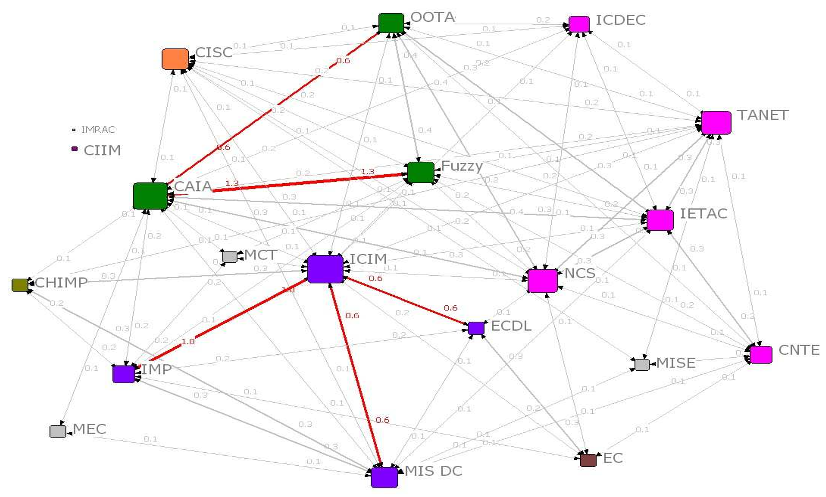 Figure 1: Visualizing the clusters of IT (Green) and IM (Purple) conferences.
Key Insights and Discoveries
1. The "Bridge" Conferences
The study identifies TANET, OOTA, and IMP as critical "bridge" conferences. In SNA terms, these nodes have high Betweenness Centrality. They act as the connectors between the purely technical IT world (like Fuzzy Theory or Artificial Intelligence) and the application-heavy IM world (like MIS Doctoral Consortium).
2. Domain Silos and Hotspots
- Isolated Nodes: The CISC (Cryptology and Information Security) conference appeared as an isolated node in the topic network, indicating its highly specialized niche.
- Emerging Trends: By analyzing topic overlaps, the paper identified a tight cluster involving e-Health and Cloud Computing, predicting early on that IT applications in medicine would become a dominant research trend.
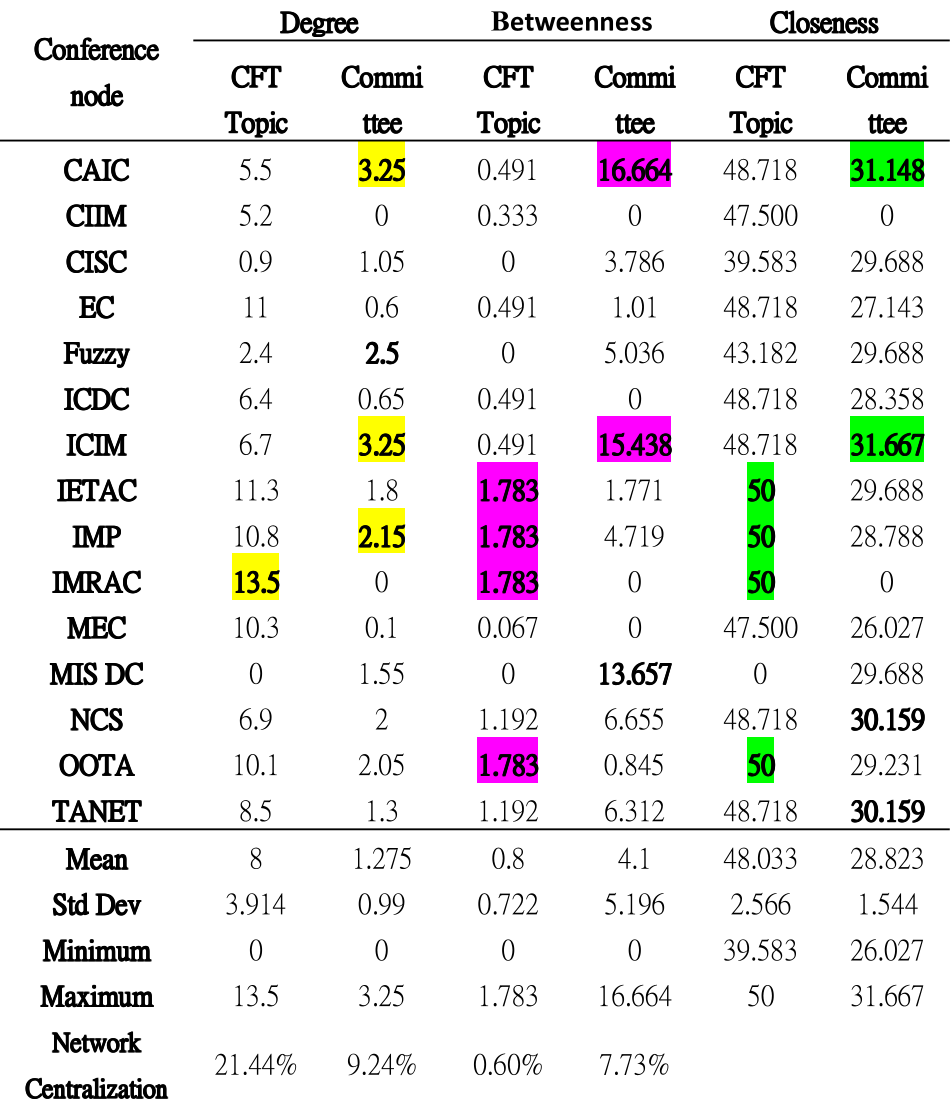 Table 1: Quantitative metrics (Degree, Betweenness, Closeness) for 15 target conferences.
Critical Analysis: Beyond the Data
The strength of this work lies in its Inductive Bias: the assumption that committee members are better proxies for "Expertise" than general participants (who might be students or passive attendees). This reduces noise in the network.
However, there are limitations:
- Temporal Snapshot: The data is from 2009. Academic networks are "Dynamic Variations"; a follow-up study would be required to see how the rise of AI (Deep Learning) has reconfigured these bridges.
- Geographic Scope: The study is localized to Taiwan. While valuable for local researchers, the methodology's scalability to international venues (like ACM/IEEE) remains a potential area for future work.
Conclusion: A Roadmap for Junior Researchers
For someone entering the Taiwan IT/IM scene, this research provides a "cheatsheet." Instead of blindly submitting to conferences, one can look at the Betweenness and Closeness values to decide where their research—especially interdisciplinary work—would gain the most relevant exposure. The study proves that academic influence isn't just about volume, but about the strategic position within the network.
Main Findings Summary:
- Top Bridge Conferences: CAIC, ICIM, and MISDC.
- Trend Identification: Medical IT and Electronic Commerce show the highest topic coherence.
- SNA Value: Provides a systematic way to identify domain experts through cluster analysis.