
Taking the Pulse of Latin America: Why Simple Sentiment Analysis Fails in Politics
11872_Taking the Pulse of Political Emotions in Latin America Based on Social Web Streams.
This paper presents a computational social science framework for real-time political emotion tracking in Latin America, analyzing 165,484 social media mentions of 18 presidents. Using an English-to-Spanish translated NRC Emotion Lexicon (EmoLex), the authors demonstrate that multi-dimensional emotion vectors significantly outperform simple polarity models in predicting public approval ratings.
TL;DR
Researchers from the L3S Research Center have developed a way to bypass slow, expensive regional polling by analyzing the "emotional pulse" of Twitter. By mapping tweets to eight complex emotions rather than just "positive" or "negative," they achieved an 81% accuracy rate in predicting the approval rankings of 18 Latin American presidents.
Executive Summary
In the high-stakes world of Latin American politics, understanding public sentiment is often a race against time. Traditional polls are slow and expensive. This paper positions itself as a landmark study in Computational Social Science, shifting the focus from simple binary sentiment (Good vs. Bad) to a multi-dimensional emotional framework based on Plutchik’s Wheel of Emotions. It proves that what people feel (joy, fear, trust) is a far more accurate predictor of political health than simply what they like.
The Problem: The Blindness of Polarity
Most sentiment analysis tools categorize text as "positive," "negative," or "neutral." However, politics is rarely that simple. A president might have a "negative" sentiment because of a tragedy (generating sadness/sympathy) or a scandal (generating disgust/anger). These two types of "negative" sentiment have vastly different impacts on a leader's approval rating.
Prior works often ignored this nuance or were limited to single-country studies (like the US elections). This study addresses the gap by covering 18 countries and tackling the multilingual hurdle of processing Spanish-language social media streams in real-time.
Methodology: Mapping the Emotional Vector
The core innovation lies in the President’s Emotional Vector. Instead of translating millions of tweets into English (which is computationally expensive), the researchers translated the NRC Emotion Lexicon (EmoLex) into Spanish once.
The Workflow
- Data Harvesting: Collecting 155,280 tweets and 10,204 blog snippets.
- Linguistic Processing: Using TreeTagger to isolate nouns and adjectives.
- Emotion Mapping: Assigning words to Plutchik’s eight basic emotions: Joy-Sadness, Anger-Fear, Trust-Disgust, and Anticipation-Surprise.
- Vector Calculation: Creating a probability vector for each president that represents their "emotional footprint" on the web.
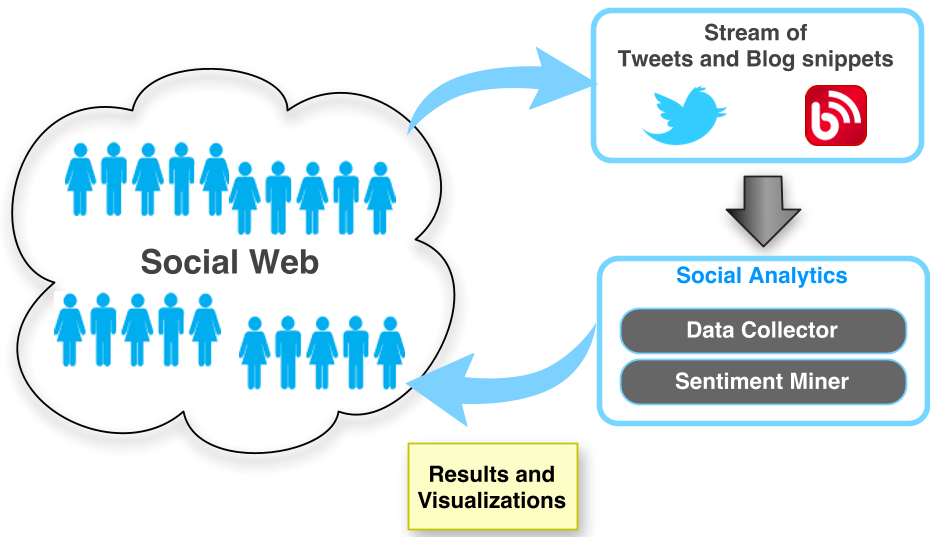 Figure 1: The real-time loop from social interaction to global pattern discovery.
Experiments: Polarity vs. Emotion
To test their method, the authors compared their social media results with the Consulta Mitofsky opinion polls (the "gold standard" for Latin American leadership approval).
The findings were striking:
- Polarity Alone: Is "too coarse-grained." For example, Mexican President Felipe Calderón showed 54% negative polarity, but the types of negative emotions (fear and disgust) were the real drivers of his specific poll numbers.
- The Predictive Model: By training a Support Vector Machine (SVM) on emotion pairs, the researchers could predict poll outcomes with an AUC of 0.81. When they tried to use only positive/negative polarity, the performance crashed to 0.61—barely better than a random guess.
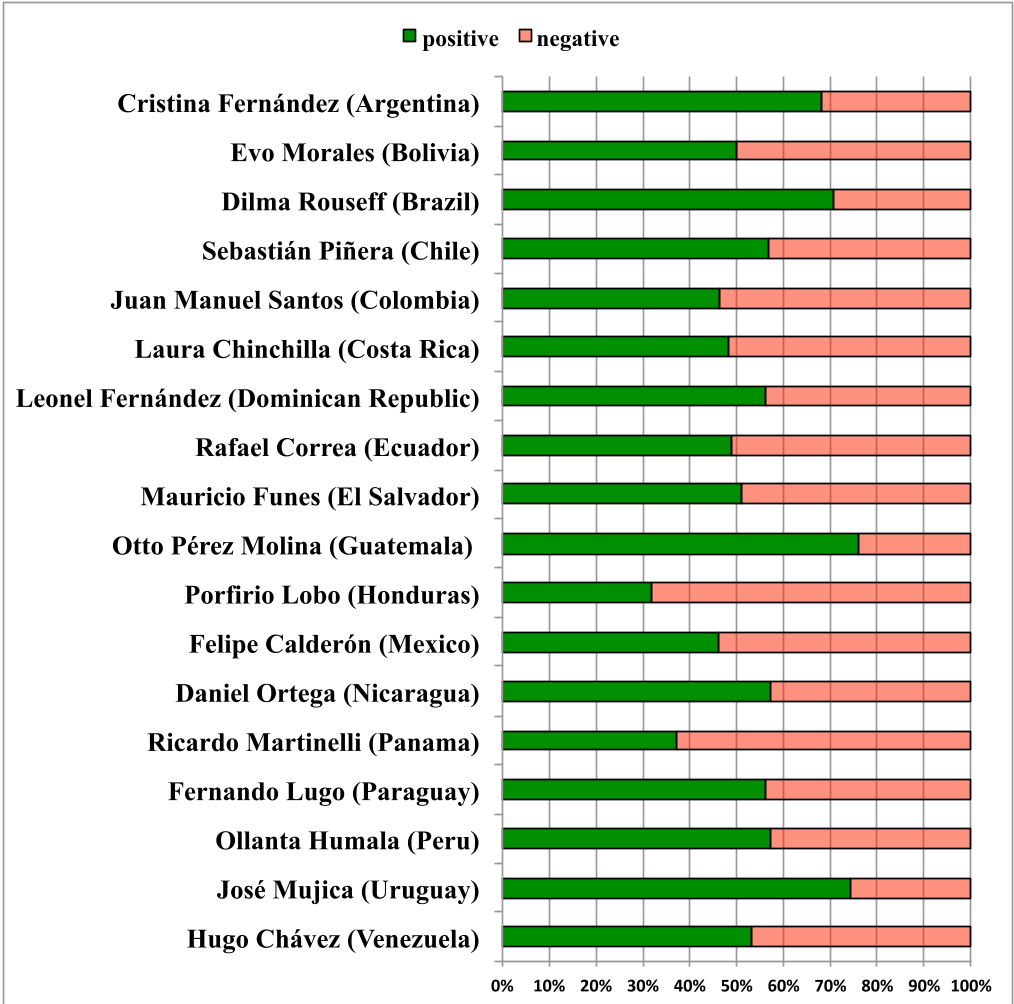 Figure 2: Distribution of Polarity across Latin American leaders—showing that "Positive" sentiment doesn't always equal "Approved."
Deep Insights: Which Emotions Matter Most?
The study discovered that Joy-Sadness and Anticipation-Surprise were the most influential emotion pairs.
- Joy correlates strongly with approval.
- Anticipation often acts as a leading indicator of public hope or expectation.
- Interestingly, the Trust-Disgust pair showed a negative correlation, suggesting that in political discourse, "disgust" is a uniquely potent or toxic sentiment that spreads differently than simple "negativity."
Critical Analysis & Conclusion
Takeaway
This research demonstrates that the "Social Web" isn't just noise; it’s a high-resolution mirror of societal health. For policy makers and social researchers, the message is clear: granular emotion tracking is the future of political forecasting.
Limitations
The study relies on exact name matching, which might miss mentions using nicknames or titles (e.g., "El Peje" or "The President"). Furthermore, the lexicon-based approach struggles with irony and sarcasm—the favorite weapons of the politically disgruntled.
Future Outlook
As we move into an era of more sophisticated AI, integrating this emotional framework with Context-Aware Models (like LLMs) could provide even deeper insights into why these emotions are shifting, allowing for a truly real-time "Taking the Pulse" of global democracy.