
TALISON: Uncovering the Multidimensional Fabric of Social Media via Tensor Analysis
TALISON - Tensor analysis of social media data
This paper introduces TALISON (Tensor Analysis of Latent Interactions in Social Online Networks), a multidimensional framework for analyzing social media data. By utilizing PARAFAC tensor decomposition, the method integrates users, terms, hashtags, and time into a single representation to reveal latent social structures and temporal topic evolutions.
TL;DR
Social media is not just a graph of "who follows whom"; it is a complex, evolving landscape of language, hashtags, and time. This paper presents TALISON, a framework that moves beyond 2D matrices to N-way Tensors. By using PARAFAC decomposition, it can "dissect" a chaotic stream of tweets into clear, distinct events, revealing why specific topics trend and how different users cluster around them over time.
The Limitation of Flat Data
Most traditional Social Network Analysis (SNA) treats data as a flat matrix: User A connects to User B. While powerful, this "flatland" view ignores the context (What are they talking about?) and the dynamics (When did this happen?).
Existing Latent Semantic Analysis (LSA) techniques help find hidden meanings in text, but they often collapse time or relationship types to fit into a 2D table. When you flatten data, you lose the "latent interactions"—the subtle ways a hashtag might change meaning over a week or how a specific group of users only communicates during specific events.
Methodology: Entering the Third (and Fourth) Dimension
The core innovation of TALISON is the transition from Matrices to Tensors.
1. The Tensor Representation
Instead of a table, imagine a cube (3-way tensor) where the dimensions are Users, Terms, and Time. A cell contains a value if User used Term at Time . For more complexity, the authors use a 4-way tensor adding Hashtags as a separate dimension.
2. PARAFAC Decomposition: The "Unmixing" Engine
To make sense of this massive cube, the authors use PARAFAC decomposition. Mathematically, it breaks the large tensor into a sum of components (rank-one tensors):
Each component represents a "Principal Factor." In the context of social media, one factor might represent a "Protest Event," another a "News Broadcast," and another "Spam."
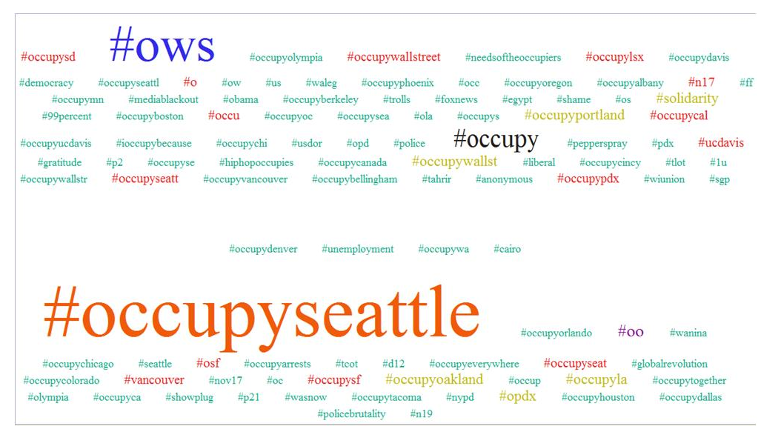 Fig. 3. Comparison of SVD (Matrix) and Tensor Decompositions (Tucker and PARAFAC), showing how multi-way structures are preserved.
Case Study: The Occupy Movement
The researchers tested TALISON on Twitter data during the "Occupy Wall Street" movement. The results proved that tensors can distinguish between different "narratives" of the same physical event.
For example, in November 2011, two major incidents happened: an 84-year-old woman was pepper-sprayed, and a pregnant woman was also pepper-sprayed. Traditional analysis might lump these into one "police clash" topic. TALISON, however, isolated them into separate principal factors:
- Factor 11: Captured the "old woman" narrative, specifically correlating terms like "old," "woman," and "pepper spray" on specific dates.
- Factor 1: Isolated the "miscarriage controversy," linking the pregnant woman narrative to later dates when that specific story evolved.
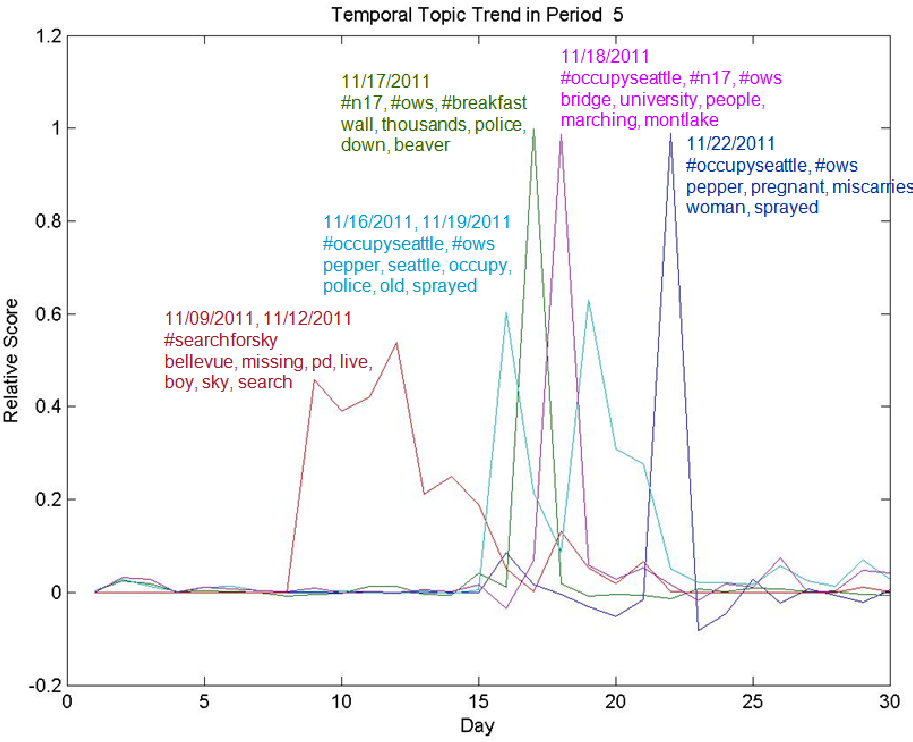 Fig. 13. Topic trend discovery showing how different hashtags (#n17, #occupyseattle) peak and fade over the month of November.
Deep Insight & Conclusion
The true power of TALISON lies in its Inductive Bias. By assuming that social media events are the "product" of specific users, specific words, and specific times, the tensor model naturally aligns with how social reality is constructed.
Key Takeaways:
- Simultaneity: Unlike step-by-step methods, tensor decomposition solves for users, topics, and time all at once.
- Sparsity Handling: Tensors are excellent at finding patterns even when data is missing (e.g., users who don't tweet every day).
- Beyond Matrices: While matrix factorization is the industry standard for recommender systems, tensor analysis is the future for multi-contextual understanding.
Limitations: The current approach requires significant computational power as dimensions grow (the "Curse of Dimensionality"). Future work involves leveraging cloud computing and sentiment analysis to move from "What happened" to "How did people feel about what happened."