
TANTP: Navigating Emotional Landscapes via Tree-Based Attention
TANTP: Conversational Emotion Recognition Using Tree-Based Attention Networks with Transformer Pre-training
This paper introduces TANTP, a novel framework for Conversational Emotion Recognition (CER) that combines Transformer pre-training with Tree-based Attention Networks. It achieves state-of-the-art results on EmoryNLP and MELD datasets by modeling fine-grained compositional semantics within utterances.
TL;DR
In the realm of Conversational Emotion Recognition (CER), understanding what was said is often easier than understanding how it was structured to convey emotion. TANTP (Tree-based Attention Networks with Transformer Pre-training) breaks the mold of treating dialogue as a flat sequence. By leveraging binary constituency parse trees and fine-tuned Transformers, TANTP captures subtle semantic transitions (like "not even... anymore") that traditional models ignore, setting new benchmarks on the EmoryNLP and MELD datasets.
The Sequential Blind Spot
Most existing CER frameworks rely on CNNs or GRUs to encode utterances. While these are great for local patterns or temporal order, they are "structurally blind."
Consider the sentence: "We're not even shooting them anymore?!!" A sequential model might focus on "shooting" or "not." However, the emotional weight lies in the compositional structure—the negation combined with the emphatic "even... anymore" signaling surprise. Without understanding the syntactic hierarchy, a model accumulates "noisy" semantic features, leading to a memory bank full of misinterpreted emotional cues.
Methodology: Marrying Syntax with Transformers
The TANTP architecture operates through a sophisticated four-stage pipeline:
1. Context-Rich Embedding
Instead of static embeddings, TANTP utilizes a RoBERTa-Large model specifically fine-tuned for emotion tasks. This ensures that the tokens are already imbued with emotional potential before structural analysis begins.
2. Hierarchical Tree Attention
This is the heart of the paper. TANTP maps each utterance to a binary constituency parse tree.
- Leaf Level: Aggregates token features into parent nodes using attention weights.
- Child Level: Refines parent node representations by analyzing the relationship between their left and right children (e.g., how a "not" node modifies a "happy" node).
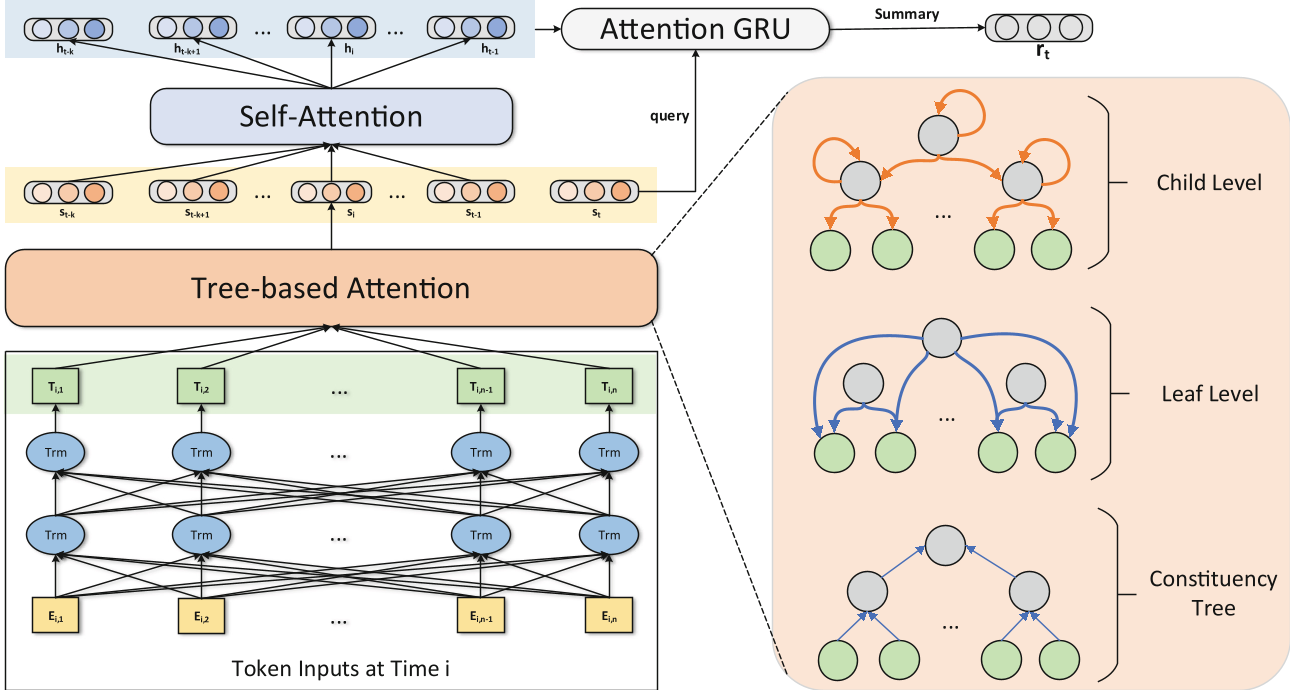
3. Interactive Memory Bank
The refined utterance representations are stored in a memory bank. TANTP employs Self-Attention within this bank to capture how historical turns interact with the current query, ensuring the model tracks the "emotional venation" of the conversation.
4. Attention GRU Prediction
The final classification is handled by an Attention GRU (AGRU), which selectively weights historical context to predict the emotion of the query utterance.
Experimental Mastery
TANTP was evaluated against heavyweights like COSMIC and DialogueRNN.
| Dataset | Metric | TANTP | Improvement over Baseline |
|---|---|---|---|
| EmoryNLP | Weighted F1 | 39.17 | +1.06 vs COSMIC |
| MELD | Weighted Acc | 65.48 | +1.96 vs AGHMN |
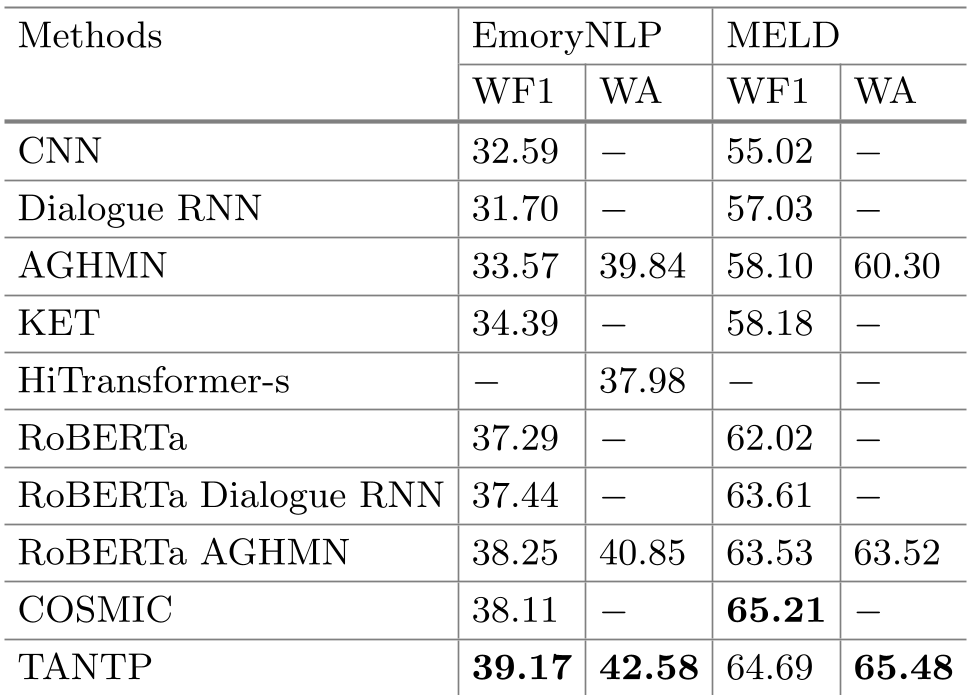
Key Insight from Ablation Study: Removing the "Tree" component or the "Child-level" interactions significantly degraded performance. This confirms that syntactic guidance acts as a crucial inductive bias, allowing the model to focus on phrases that actually drive emotional shifts.
Case Study: Catching the Emotional Turn
The paper includes a striking case study where a character (Joey) expresses "Surprise." Traditional models (TANTP w/o Tree) failed because they gave uniform weight to all previous utterances. TANTP, however, correctly identified the specific historical triggers through its tree-informed representations, proving it can "read between the lines" of complex dialogues.
Critical Analysis & Conclusion
Takeaway: TANTP demonstrates that even in the age of massive Transformers, linguistic structure matters. By explicitly modeling the constituency of a sentence, we can resolve ambiguities that purely statistical models struggle with.
Limitations: One potential bottleneck is the reliance on an external parser to generate constituency trees. If the parser fails (e.g., in highly informal or "slangy" internet chat), the downstream emotion recognition may suffer.
Future Work: A fascinating next step would be integrating this tree-based approach with State Space Models (SSMs) like Mamba to handle extremely long conversational histories with sub-quadratic complexity, or extending it to multimodal data where "visual syntax" (gestures) matches the text.