
TAO: Reconciling GPU Heterogeneity with Verifiable ML
TAO: Tolerance-Aware Optimistic Verification for Floating-Point Neural Networks
TAO is a Tolerance-Aware Optimistic verification protocol for floating-point neural networks. It enables verifiable inference on heterogeneous hardware by replacing bitwise equality with principled, operator-level acceptance regions, achieving SOTA results with negligible overhead (0.3% on Qwen3-8B).
TL;DR
The industry is moving toward decentralized ML inference, but a massive hurdle remains: Non-determinism. The same model on an A100 and an RTX 4090 will produce slightly different floating-point outputs. TAO (Tolerance-Aware Optimistic verification) solves this by moving away from "bit-for-bit" matching. Instead, it uses a sophisticated error-bounding framework and an interactive dispute game to verify that outputs are "correct enough" based on the physics of floating-point math.
The Problem: The Bit-Exact Trap
If you outsource a LLM query to a cloud provider, how do you know they didn't swap the model for a smaller, cheaper version (quantization) or manipulate the embeddings?
Current solutions like zkML are too slow (orders of magnitude overhead), and Deterministic Replay requires disabling highly optimized vendor kernels (like cuBLAS/cuDNN), killing performance. The fundamental issue is that IEEE-754 floating-point operations are non-associative: . On parallel GPUs, the order of these operations changes based on thread scheduling, making bitwise equality a pipe dream for heterogeneous systems.
Methodology: The Dual-Error Model
TAO's genius lies in its two-pronged approach to defining what an "acceptable" error looks like:
- Theoretical IEEE-754 Bounds: Using first-order sensitivity analysis, TAO computes a worst-case error bound for every operator (MatMul, Softmax, etc.). This is a "hard" limit that is sound by construction but can be conservative (loose).
- Empirical Percentile Profiles: TAO calibrates thresholds by observing how operators actually behave across different GPUs (A100, H100, 4090). These thresholds are 100x to 1000x tighter than theoretical limits, making it nearly impossible for an attacker to inject malicious "small" changes without being caught.
The Interactive Dispute Game
When a challenger disputes a result, TAO doesn't re-run the whole model on-chain. It uses a Merkle-anchored bisection game:
- The graph is partitioned into subgraphs.
- The challenger identifies which subgraph first exceeds the empirical thresholds.
- This repeats until they isolate a single operator (e.g., one specific convolution layer).
- Only this single operator is adjudicated via a committee vote or a verifiable bound check.
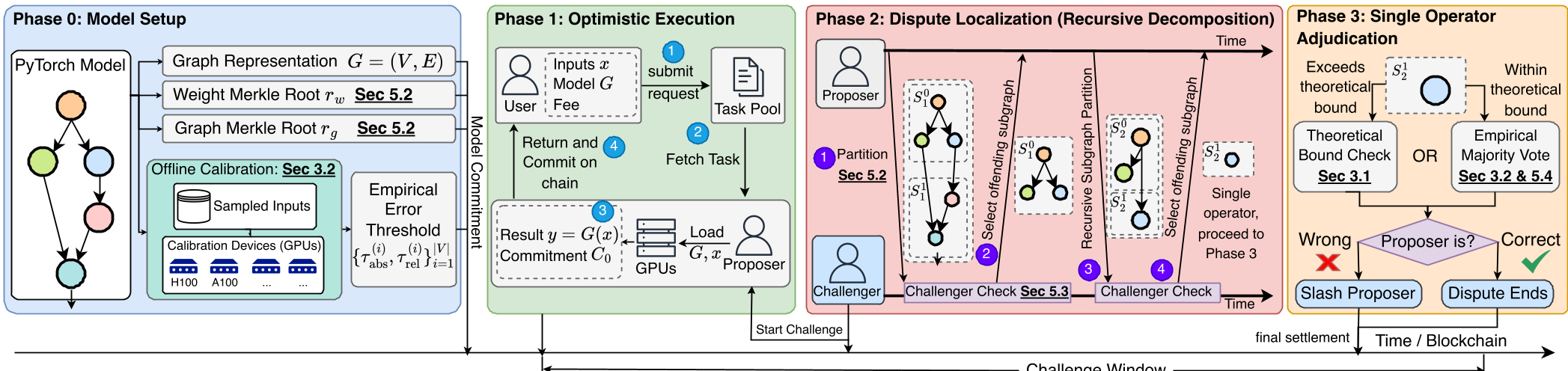
Experimental Results: Security without the Tax
The authors implemented TAO as a PyTorch runtime. The overhead for the "Happy Path" (optimistic execution) is virtually zero—just 0.3% additional latency on a Qwen3-8B model.
Robustness Against Adversarial Attacks
To test if an attacker could hide a "malicious flip" (making a "No" output a "Yes") within the allowed error tolerance, the researchers used Projected Gradient Descent (PGD) to find the most devious perturbations.
- Theoretical bounds allowed a tiny success rate (2.4%) for LLMs.
- Empirical thresholds resulted in a 0% Attack Success Rate.
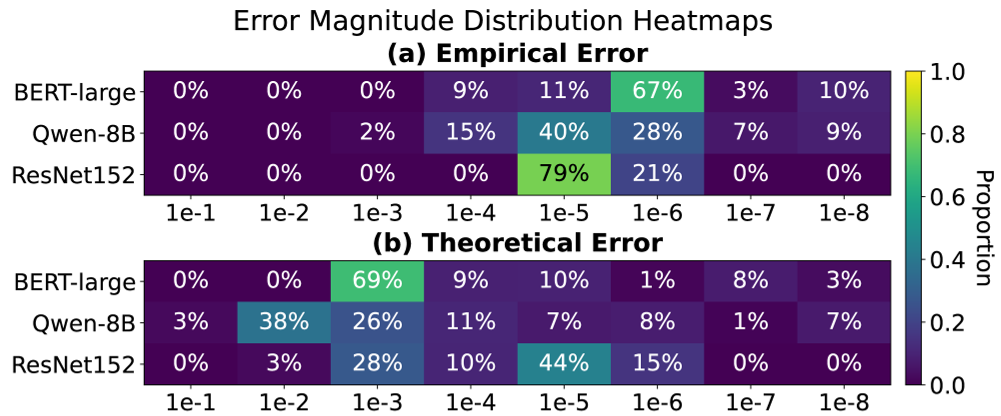
The heatmaps above show that while theoretical bounds (right) are quite permissive, the empirical behavior (left) is extremely concentrated, leaving no room for attackers to maneuver.
Deep Insight: Why This Matters for the Future
TAO shifts the paradigm of Verifiable Computing for AI. It recognizes that Neural Networks are inherently robust to tiny rounding errors, but highly sensitive to intentional tampering. By mathematically defining the boundary between "standard hardware noise" and "malicious deviation," TAO provides a framework for economic security in decentralized AI markets.
Conclusion & Limitations
TAO is a major step toward permissionless, verifiable AI. However, it currently targets the open-model setting (where weights are public). For proprietary models, it would require a "trusted middle layer" or further integration with zero-knowledge primitives. Yet, for the burgeoning community LLM market, TAO offers exactly what is needed: SOTA performance with cryptoeconomic guarantees.
Takeaways:
- Determinism is not required for accountability.
- Operator-level localization turns an impossible O(N) verification problem into a logarithmic bisection game.
- 0.3% overhead makes it production-ready today.