
k-Beam Search: Balancing Efficiency and Intelligence in Social Graph Crawling
Optimization of Target Oriented Network Intelligence Collection for the Social Web by Using k-Beam Search
The paper introduces a k-Beam Search Heuristic to optimize Target Oriented Network Intelligence Collection (TONIC) on the Social Web. By acquiring the top-k potential leads simultaneously rather than a single best lead per iteration, the method achieves State-of-the-Art performance in intelligence gathering while significantly reducing computational overhead in dense social graphs.
TL;DR
Reconnaissance in Online Social Networks (OSNs) often requires finding "leads" (friends) to learn about a restricted target profile. This paper introduces a k-beam search optimization for the TONIC problem, which reduces the computational cost of heuristic calculations by 50% while maintaining high discovery accuracy in dense network environments.
Background & Motivation
In the era of privacy-restricted profiles, Government agencies and researchers use Target Oriented Network Intelligence Collection (TONIC) to gather info about malicious actors (fake news spreaders, hate speech perpetrators) via their publicly accessible friends.
The prevailing approach treats this as a social graph search problem. However, modern social graphs are "dense"—a target might have thousands of neighbors. Conventional Best-First Search algorithms recalculate the "promising factor" of every potential lead every time a single new node is added. In dense clusters, this is a massive waste of CPU cycles because the ranking of candidates rarely shifts dramatically after just one observation.
Methodology: The k-Beam Wrapper
The core innovation is the k-Beam Heuristic. Instead of picking the single "Best" candidate from the OPEN list, the algorithm selects the top k candidates.
The Bayesian Promising Lead Heuristic
The authors specifically wrap the Bayesian Promising Lead (BysP) heuristic, which calculates the probability that a neighbor () is a lead based on the ratio of discovered leads in its vicinity:
Where represents the promising factor of lead .
The k-Beam Logic
By using a beam of size , the algorithm "batches" the API calls.
- Identify the top nodes using BysP.
- Acquire all nodes.
- Update the Currently Known Graph (CKG) only once for the whole batch.
(Note: Refer to Algorithm 1 in the paper for the specific pseudocode structure involving OPEN/CLOSED sets)
Experimental Validation
Using the Google+ Dataset (comprising 211,000 nodes and 1.5 million links), the researchers tested the algorithm against varying budgets (5 to 50 API calls).
Key Findings:
- Leads Found: The number of relevant profiles discovered remained virtually identical between the standard BysP and the optimized KBysP.
- Computational Efficiency: KBysP (with ) required 50% fewer function calls.
- Scalability: The advantage of KBysP grows as the local density of the target's neighborhood increases.
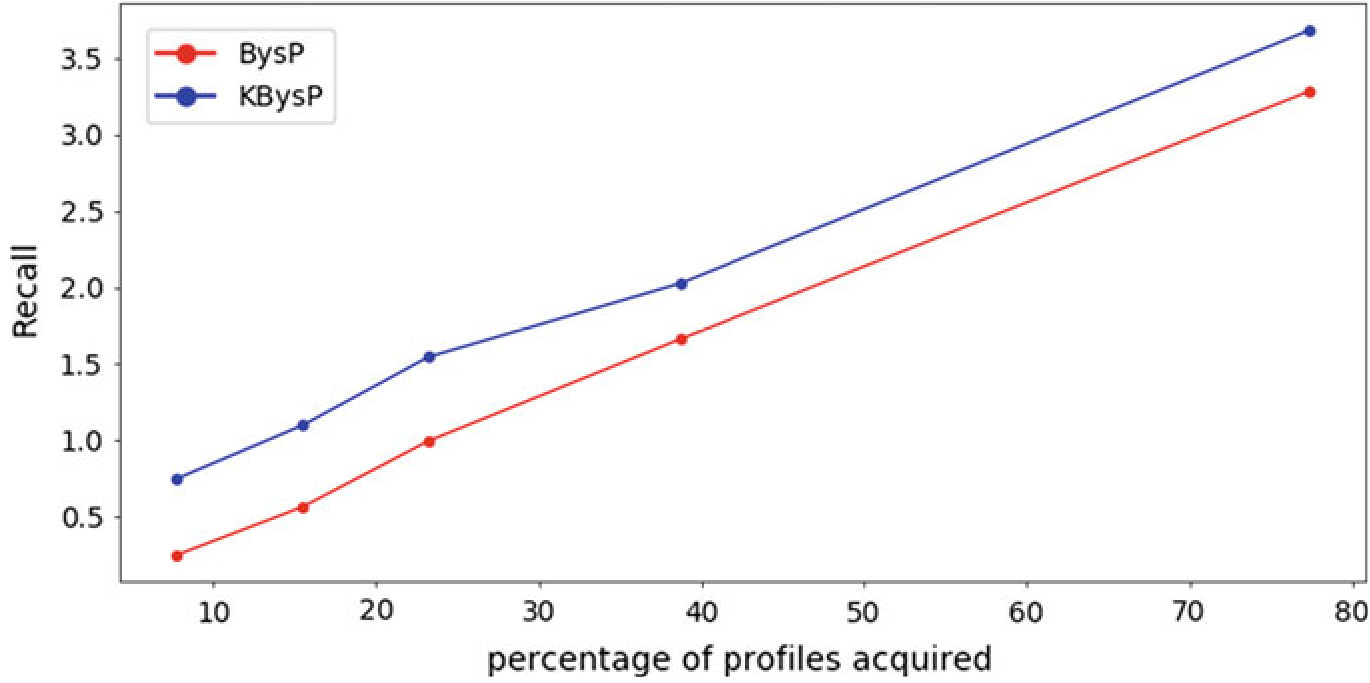 Fig 4: Percentage of leads found vs. potential leads checked, showing near-identical performance in discovery quality.
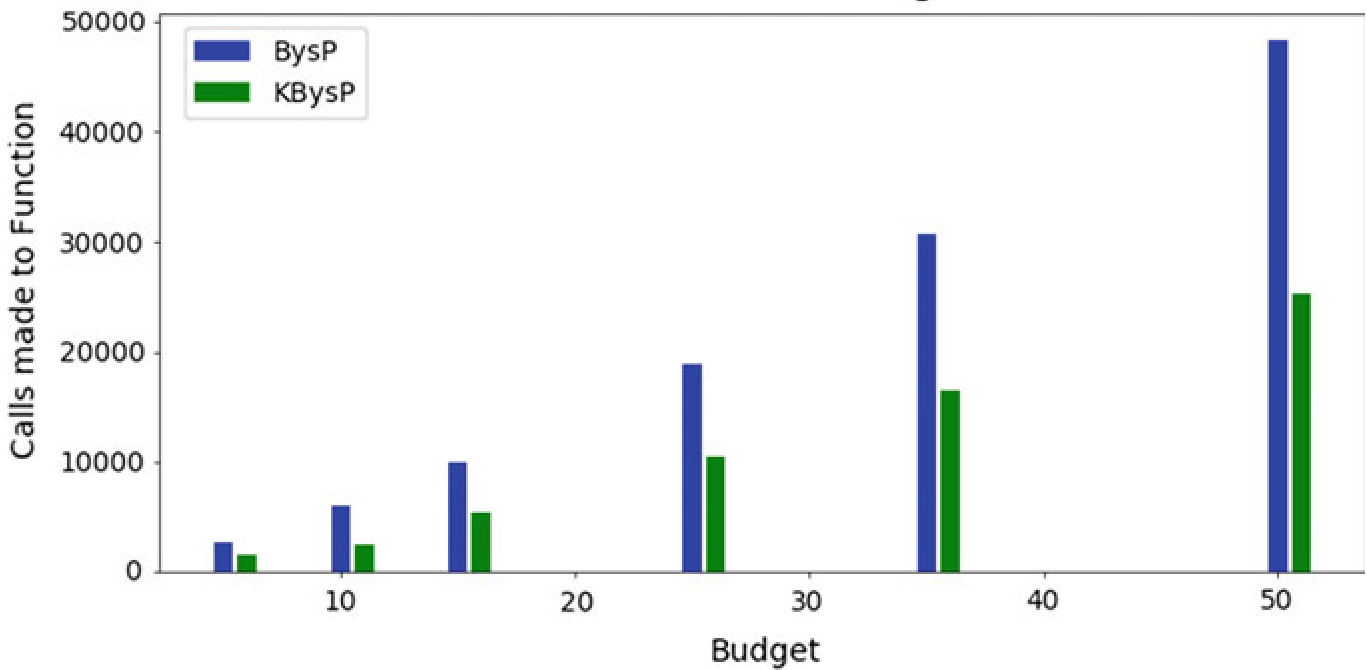 Fig 5: Significant reduction in total function calls as the budget increases, highlighting the scalability of the k-beam approach.
Critical Analysis & Conclusion
The takeaway is clear: In the context of Online Social Networks, social "homophily" (the tendency of similar people to group together) creates redundant information in the graph topology. This redundancy allows us to bypass fine-grained step-by-step updates in favor of batch processing.
Limitations & Future Work
- Static 'k': The paper uses a fixed . In highly dynamic or heterogeneous graphs, a fixed might be sub-optimal.
- Hyperparameter Optimization: The authors suggest that future work should involve learning k as a hyperparameter using reinforcement learning (reward-based) to adapt to shifting graph densities in real-time.
This work provides a practical blueprint for building faster, more efficient OSN crawlers for intelligence and security applications.