
Beyond Viral Awareness: Rethinking Targeted Product Adoption in Labeled Social Networks
Target specific influence maximization: An approach to maximize adoption in labeled social networks
This paper introduces the Target Adoption Model (TAM) and an In-Out Discounting heuristic to solve the Labeled Influence Maximization (LIM) problem. It focuses on maximizing actual product "adoption" among specific target users identified by network labels, rather than just general "awareness" across the entire social network.
TL;DR
Information spread is not the same as product sales. This paper moves the goalposts of Influence Maximization (IM) from simply making nodes "active" to making specific "target" nodes "adopt" a product. By introducing the Target Adoption Model (TAM) and a novel In-Out Discounting heuristic, the researchers provide a framework that distinguishes between "tattlers" (who spread news) and "customers" (who buy).
Background: The Gap Between Knowing and Buying
In classical IM, if you tell a friend about a new women's cosmetic product, and they tell five others, the model considers all six "influenced." However, if the first person is a male who will never buy the product, he is merely a conduit of awareness—a "tattler." Standard models like Linear Threshold (LT) or Independent Cascade (IC) ignore this distinction, leading to inefficient "seed" selection for marketing budgets.
Methodology: The Target Adoption Model (TAM)
The authors define a Labeled Social Network where nodes have attributes (age, gender, hobbies). These attributes determine a node's Cumulative Profit (Cprofit)—a measure of how "useful" a product is to them.
1. The Three States of a Node
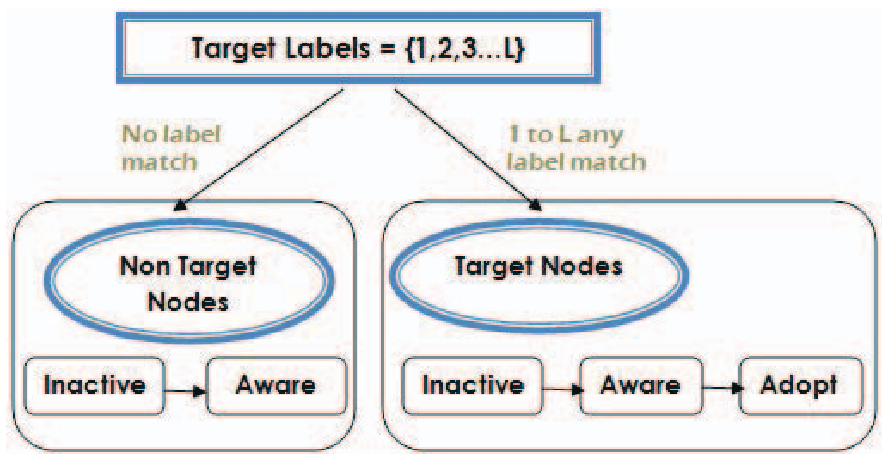
Unlike binary models, TAM uses a tripartite state system:
- Inactive: Unaware of the product.
- Aware: Know about the product but haven't bought it (Non-target nodes stop here).
- Adopted: Target nodes move here if social influence + product usefulness cross a threshold.
2. The Influence Equation
The model introduces a weighting factor (alpha). The intuition is that you are more likely to buy a product if your neighbor has actually bought it (Adopted) than if they just heard about it (Aware).
3. In-Out Discounting Algorithm
To pick the best seeds, the authors propose an "In-Out" mechanism. Instead of just picking high-degree nodes, they calculate Influence Potential: the sum of the usefulness values of all a node's neighbors. When a seed is picked:
- In-Discount: Reduce the potential of its incoming neighbors (to avoid redundancy).
- Out-Discount: Calculate which neighbors might now "adopt" and further discount their local neighborhoods.
Experimental Results
The researchers tested their model on three specific datasets: the Football network, Polblog, and the massive Enron Email network.
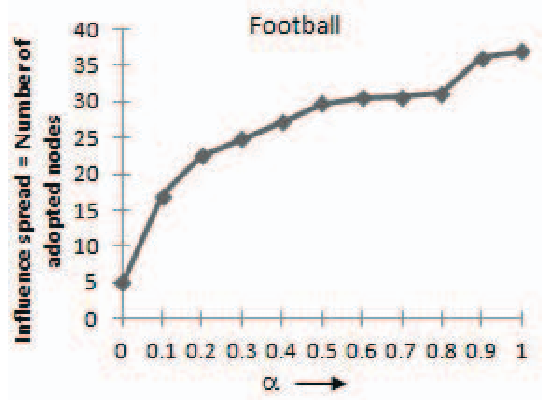
Finding the Golden
They discovered that the optimal value for (the influence of an "Aware" node vs an "Adopted" node) sits between 0.5 and 0.8. Set it too low, and you underestimate the spread; too high, and you overestimate it.
Dominating the Baselines
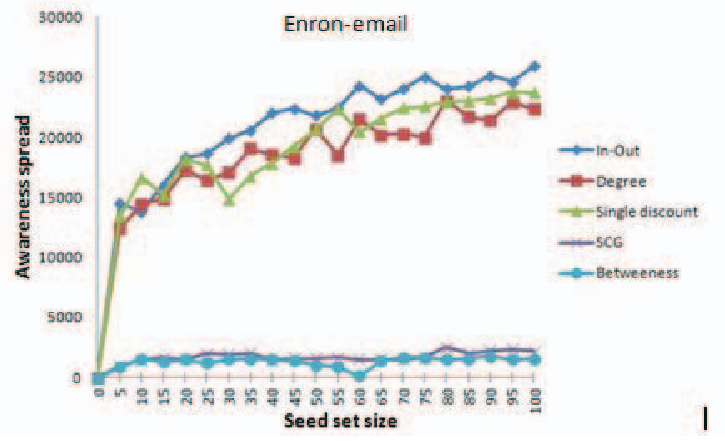
The In-Out Discounting approach consistently triggered more "Adoptions" than standard Degree Centrality or the Single Degree Discount method across all budgets (seed set sizes).
Critical Insight: Who are the Best Seeds?
One of the most profound takeaways is that the "best" seed isn't necessarily the person with the most friends. It is often the person who is connected to the highest number of high-value target customers. A seed who is a "non-target" can still be an elite seed if they act as a bridge (tattler) to a cluster of target adopters.
Conclusion & Future Work
The paper successfully transitions LIM from a theoretical graph problem to a pragmatic marketing tool. However, the authors note a few limitations:
- Usefulness Values: Currently, these must be manually assigned. Future work could use Machine Learning to predict these values from historical purchase data.
- Negative Sentiment: The model doesn't account for "anti-adoption" or negative reviews, which often spread faster than positive ones.
This work serves as a foundational step toward more nuanced, attribute-aware information diffusion modeling in the age of big data and hyper-targeted advertising.