
The Art of the Stealthy Crawl: Modeling Intelligent Cyber-Reconnaissance in Social Networks
Targeted cyber-attacks: Unveiling target reconnaissance strategy via Social Networks
This paper introduces the Adaptive Targeted Crawling Maximization (ATCM) problem, which models how intelligent attackers conduct reconnaissance in closed Online Social Networks (OSNs) like Facebook. The authors propose an adaptive greedy policy based on submodularity theory to maximize information gathering while mimicking human behavior to avoid detection.
TL;DR
Reconnaissance is the silent precursor to any major cyber-attack. This paper formalizes this "quiet phase" on Online Social Networks (OSNs) as the Adaptive Targeted Crawling Maximization (ATCM) problem. By leveraging Adaptive Submodularity, the researchers prove that an intelligent attacker can follow a simple greedy strategy to gain near-optimal information about a target organization while remaining stealthy enough to bypass traditional bot-detection systems.
Background: Beyond the Bot
Traditional OSN threats often involve high-volume socialbots that flood networks with friend requests. However, modern security monitors easily flag this abnormal behavior. An intelligent attacker operates differently: they send one request, wait for the response, and then decide their next move based on what they just learned. This "adaptive" nature makes them dangerous.
The authors position this work as a bridge between graph theory and cybersecurity, moving from simple public-web crawling to sophisticated, privacy-aware social reconnaissance.
The Problem: Information Gain vs. Risk
In a "closed-wall" network like Facebook, you can't see a user's profile unless you are a friend. Attackers face two challenges:
- Probabilistic Success: Not every request is accepted.
- Invisible Topology: The exact "who-knows-who" is unknown, though it can be estimated using link prediction.
The attacker wants to maximize two types of benefits:
- Friending Benefit (): Direct access to a target's profile.
- Information Benefit (): Indirect access to the target's friends' lists.
Methodology: The Power of Adaptive Submodularity
The researchers prove that the Expected Utility Function for this crawl is not just monotone, but Adaptive Submodular.
Core Intuition
In technical terms, "Submodularity" is the law of diminishing returns. In an adaptive context, it means that the information gain from friending a specific person "now" is always greater than or equal to the gain from friending them "later," after we've already gathered other data.
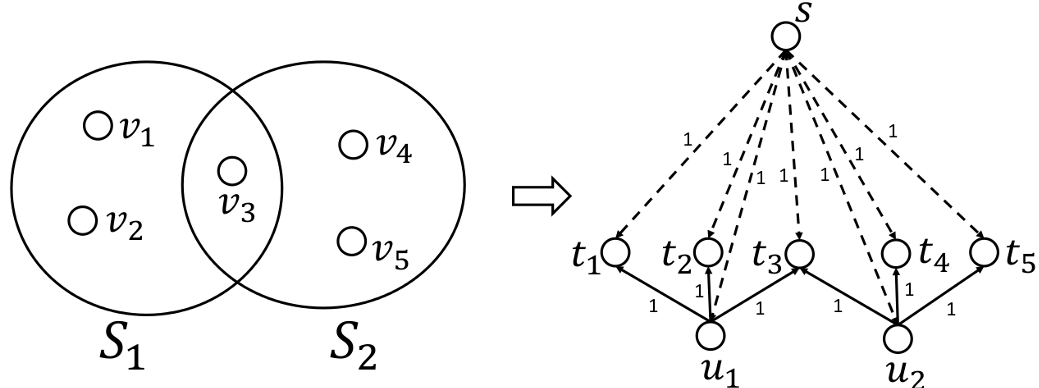 Figure 1: Proof of NP-hardness by reducing the Maximum Coverage problem to ATCM.
The Greedy Policy
Because the problem is NP-hard, finding the absolute best strategy is computationally impossible. However, because the function is adaptive submodular, the Adaptive Greedy Policy (shown in Algorithm 1) is guaranteed to be at least (specifically ) as effective as the theoretical optimum.
```python
# High-level logic of the Greedy Policy
For i = 1 to Budget (k):
    1. Calculate 'Expected Marginal Gain' for all potential targets
    2. Select the target with the highest gain
    3. Send request and update the 'Global Knowledge' based on outcome
```
Experimental Results: Dominating Baselines
The authors tested their strategy against three common approaches:
- Random: Pure chance.
- Degree: Targeting the most popular people first.
- Pagerank: Targeting the most influential people first.
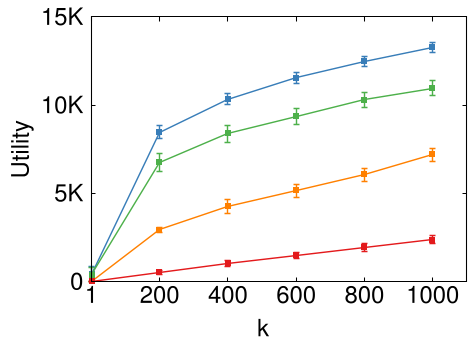 Figure 2: Performance comparison on the Enron-email dataset. The Greedy Policy (red line) significantly outperforms the heuristics.
The results were conclusive: The Greedy Policy achieved utility scores several orders of magnitude higher than Degree or Pagerank methods.
Targeted Attack Insight
When the attacker focuses on a specific organization (community), the policy occasionally selects nodes outside the target group. Why? Because these "outsiders" might provide better bridge connections to hidden members of the target group, further demonstrating the "intelligence" of the adaptive approach.
Critical Analysis & Conclusion
Takeaways
- Strategic Vulnerability: Organizations cannot rely purely on privacy settings. If an attacker identifies the "bottleneck" employees (those likely to accept requests and have many connections), the entire organizational chart can be mapped.
- Efficiency: The greedy approach is not just effective; it is scalable. Using a priority queue for updates allows the strategy to run on networks with nearly 100k nodes efficiently.
Limitations
The model assumes attackers can accurately estimate friending success probabilities and friendship links using public data—an area of research (link prediction) that is itself a moving target. If the attacker's initial "estimates" are poor, the greedy policy's effectiveness will drop.
Future Outlook
This paper serves as a wake-up call for OSN platform operators. Security systems must evolve to detect these "slow and low" adaptive crawlers that successfully hide within the noise of normal social activity.