
The Targeting Arbitrage: Outsmarting OSN Ad Algorithms for 40% Better Reach
Targeting algorithms for online social advertising markets
The paper introduces and formalizes the "Targeting Problem" in Online Social Networks (OSNs), focusing on how advertisers can optimally distribute a budget across various user characteristics to maximize reach within a preferred audience. It proposes a polynomial-time approximation algorithm for the OSN's perspective and a data-driven greedy algorithm for the advertiser's perspective, specifically leveraging "subset targeting" to achieve a near-SOTA performance improvement of up to 40%.
TL;DR
Advertising on platforms like Facebook or LinkedIn is often treated as a "black box" where you pay for a specific audience. This paper reveals that the direct approach is rarely the most efficient. By strategically splitting your budget across subsets of your target audience (e.g., targeting "Junior Developers" and "Senior Developers" separately instead of just "Developers"), advertisers can reach up to 40% more unique users for the same budget.
Problem & Motivation: The Information Gap
In the world of Online Social Networks (OSNs), there is a massive information asymmetry:
- The OSN's Advantage: Platforms like Facebook know exactly which user has which labels (Age, Salary, Location, Skills). They can calculate the exact overlap between audience segments.
- The Advertiser's Blindness: Advertisers only see "suggested bids" and "estimated audience sizes." They don't know if the audience for "Luxury Car Enthusiasts" heavily overlaps with "High Earners in CA."
This "Blindness" leads to wasted budget. If an advertiser targets two overlapping categories, they might pay twice to reach the same person, or worse, ignore a cheaper way to reach the same population.
Methodology: The "Subset Targeting" Insight
The authors propose that the optimal way to target a set of users is not always to buy directly. Instead, they look for Cheap Subsets.
Heuristic 1: Subset Targeting
Through massive data analysis (1M+ data points), the authors found that Superset Targeting (targeting a broader group to get your niche) and Overlap Targeting are almost never cost-effective. However, Subset Targeting—targeting specific segments that fall entirely within your goal—violated the "direct is best" hypothesis 53% of the time on Facebook. This means there is massive "arbitrage" potential.
The Hierarchical Greedy Algorithm
The authors designed a fast greedy algorithm that traverses labels rather than the exponential combinations of label sets.
- Step 1: Identify the attribute that offers the most "marginal increment" (more users per dollar).
- Step 2: Allocate budget to disjoint subsets of that attribute.
- Step 3: Recursively refine the allocation until the budget is exhausted.
Note: The algorithm replaces the impossible task of enumerating combinations with a targeted search through available labels.
Experiments: Real-World Evidence
The researchers crawled Facebook and LinkedIn for months to validate their theory with "Bid Suggestions."
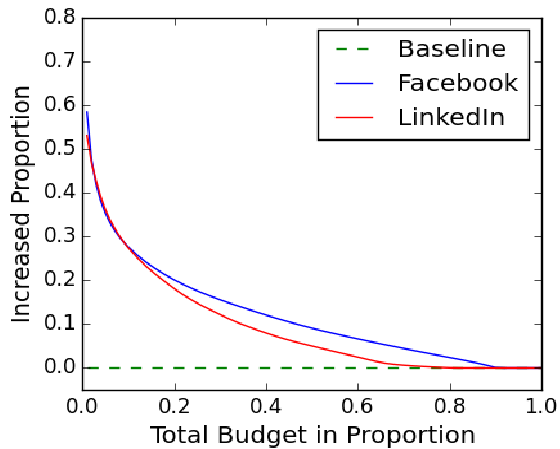
1. The Budget-Increment Curve
The more "limited" your budget is, the more powerful this algorithm becomes. At very low budgets, the algorithm found segments so cheap that it outperformed the baseline by 40.8% on Facebook and 37.6% on LinkedIn.
2. The Price Factor
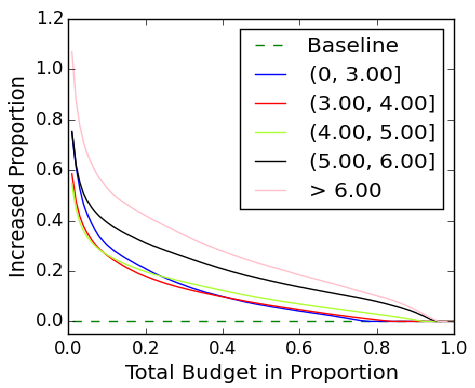
Does this only work for cheap ads? No. In fact, as the price of the "Preferred Label Set" increases, the effectiveness of the greedy algorithm grows. This suggests that the OSNs’ pricing algorithms often have "pricing holes" in high-value segments that savvy advertisers can exploit.
Critical Analysis & Takeaways
Conclusion
This research proves that the "Targeting Problem" is not just a theoretical math exercise but a practical strategy for ad optimization. By avoiding direct targeting and focusing on a portfolio of disjoint subsets, advertisers can significantly stretch their dollars.
Limitations
- Dynamic Markets: The study uses "snapshots" of suggested bids. In a real real-time auction, as soon as an advertiser shifts budget to a "cheap subset," the price of that subset might rise.
- User Quality: The model assumes all users within a preferred set are of equal value. In practice, a "Senior Developer" might be worth more than a "Junior Developer" even if both fit the advertiser's criteria.
Future Outlook
As OSNs move toward more opaque, AI-driven "Auto-bidding," the ability for advertisers to perform this kind of manual arbitrage may diminish. However, the fundamental principle—that the sum of the parts (subsets) is often cheaper than the whole—remains a vital lesson for programmatic advertising.