
The Mediator’s Advantage: Why Hub-Targeting Fails in Realistic Social Influence
Which Targets to Contact First to Maximize Influence over Social Network
The paper introduces the "Target Selection Problem" (TSP), a novel influence maximization variant where an external source seeks to maximize its reach by strategically linking to existing users. Unlike traditional source selection, TSP accounts for the probabilistic nature of activating these entry points, achieving up to 7.2x higher influence than standard baselines.
TL;DR
In social network theory, we often assume that if we pick the right "influencers," our message will spread. However, this paper reveals a fatal flaw in that logic: influencers are hard to influence. By introducing the "Target Selection Problem," the authors demonstrate that to maximize reach, an external agent should focus on targets that are easier to activate—specifically those with fewer incoming connections—rather than the high-traffic hubs traditionally favored by "Source Selection" algorithms.
Problem & Motivation: The "Source" vs. "Target" Fallacy
Most influence maximization research (pioneered by Kempe et al.) focuses on Source Selection. It asks: "If I can magically turn on nodes, which ones should I pick?"
In the real world, you don't have a "magic switch." If you are a new brand on Twitter, you act as an external node trying to connect to existing users. You are a Target Selector. The probability that your target actually adopts your idea is governed by the same stochastic rules as the rest of the network. Traditional methods fail here because they pick nodes that are great at sending information but terrible at receiving it from an outsider.
Methodology: Proving Submodularity in Target Selection
The authors tackle two primary diffusion models:
- Independent Cascade (IC): Sender-side "push" (like a disease spread).
- Linear Threshold (LT): Receiver-side "pull" (like opinion formation).
The core technical contribution is proving that the influence function for target selection remains submodular.
The Intuition of Equation (3)
The influence of an external node is defined as the sum of all possible activation patterns of the target set, weighted by their probabilities:
Since is a non-negative linear combination of submodular functions , it inherits submodularity. This is a crucial finding—it means we can use an efficient Greedy Algorithm to find a solution within 63% of the absolute optimum.
Figure 1: Conceptual difference between Source Selection (direct activation) and Target Selection (probabilistic activation from external node x).
Experiments: Why "InflMaxSrc" Fails
The authors tested their approach on four datasets, including the Enron Email and Ameblo Blog networks. They compared their method against:
- InflMaxSrc: Using the best nodes from traditional source selection.
- Out-degree: Picking nodes with the most followers.
- Random: A baseline.
Performance Gap
The results were staggering. In the Ameblo network, for , the proposed method produced influence nearly 7.2 times greater than the traditional "InflMaxSrc" method.
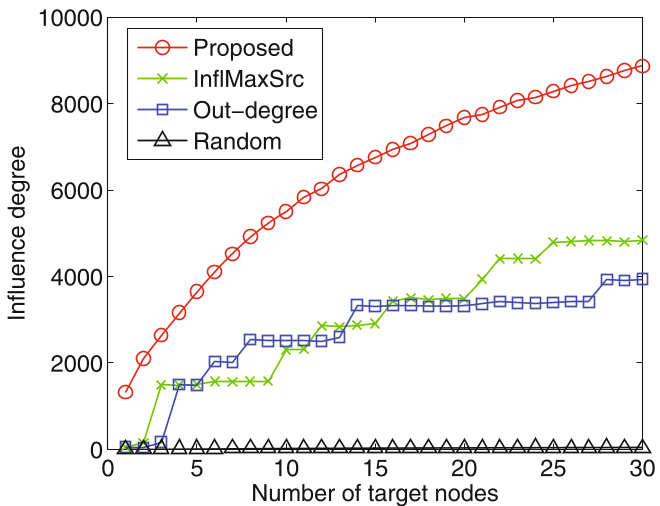 Figure 2: Influence spread comparison across different networks (Proposed vs. Baselines).
The "In-Degree" Revelation
Why the massive difference? Under the Linear Threshold (LT) model, a node's threshold must be met by the sum of its active parents' weights. If a node has many parents (high in-degree), the weight from any single new source (you) is relatively small.
- Source Selection picks nodes with high out-degree (hubs).
- Target Selection picks nodes with high out-degree BUT low in-degree.
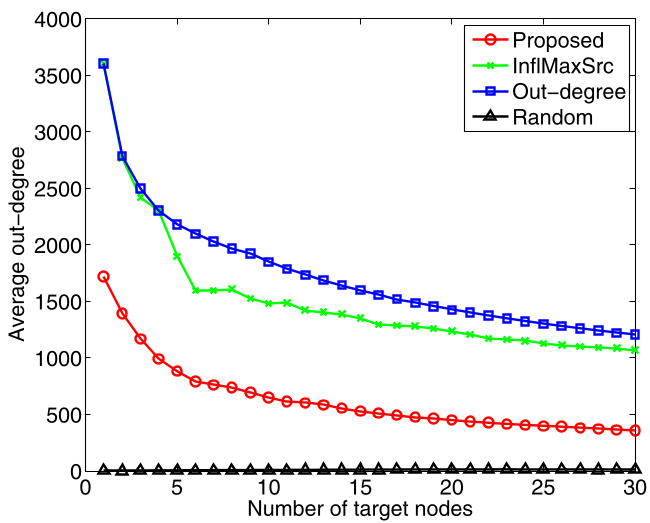 Figure 3: Comparison of in-degree of selected nodes. The proposed method (circles) consistently selects nodes with much lower in-degree than traditional methods.
Critical Analysis & Conclusion
The "Target Selection Problem" shifts the focus from power (how many people you can influence) to susceptibility (how easily you can be influenced).
Key Takeaways:
- Mediators > Hubs: The best targets are "mediators"—users who have a significant following but are not yet overwhelmed by incoming influence from others.
- Context Matters: If you use a strategy designed for "Source Selection" in a "Target Selection" scenario, you are essentially wasting 50-80% of your influence potential.
Limitations: The study primarily focuses on the LT model for the detailed analysis. Future work should investigate how these dynamics change in competitive environments where multiple external sources compete for the same "susceptible" mediators.