
TASA: Converging Online Social Tags and Offline Mobility for Efficient 5G Traffic Offloading
TASA: traffic offloading by tag-assisted social-aware opportunistic sharing in mobile social networks
TASA is a traffic offloading framework that leverages Tag-Assisted Social-Aware opportunistic sharing to migrate data from cellular links to Device-to-Device (D2D) communications. By integrating online Social Network Service (SNS) user tags with offline Mobile Social Network (MSN) mobility patterns, it achieves a maximum cellular traffic reduction of up to 78.9%.
TL;DR
Mobile traffic is exploding, yet much of it is redundant (popular videos/news). TASA (Tag-Assisted Social-Aware sharing) solves this by turning users into "mobile caches." By analyzing social media tags to predict what you want and mobility traces to see who you'll meet, TASA offloads up to 78.9% of cellular traffic onto local D2D links (Bluetooth/Wi-Fi Direct) without ruining the user experience.
Problem & Motivation: The Redundancy of Infrastructure
Modern Mobile Network Operators (MNOs) face a paradox: despite massive investments in spectrum efficiency, the "YouTube Effect" means the same popular files are transmitted thousands of times over expensive cellular links.
Prior research into Mobile Social Networks (MSNs) attempted to use opportunistic meetings to share files. However, they lacked a crucial piece of the puzzle: Context. Just because two people meet doesn't mean they want the same content. TASA’s core insight is that Online Social Network (SNS) behavior—specifically social tags—provides the perfect signal to predict "who" should be a seed for "what" content.
Methodology: The Dual-Layer Brain
TASA operates across two planes to bridge the gap between virtual interests and physical proximity.
1. The Online Layer: Social Impact ()
TASA uses social tags (e.g., #piano, #sports) to calculate user similarity (). If Cindy and Alex share many tags, the probability of Alex wanting what Cindy has is high.
2. The Offline Layer: Mobility Impact ()
Using a Continuous Time Markov Chain, TASA models the probability of a user receiving content via physical encounters. It accounts for the "Access Delay"—the time between a post appearing online and a user actually checking their phone—modeled via a Weibull distribution.
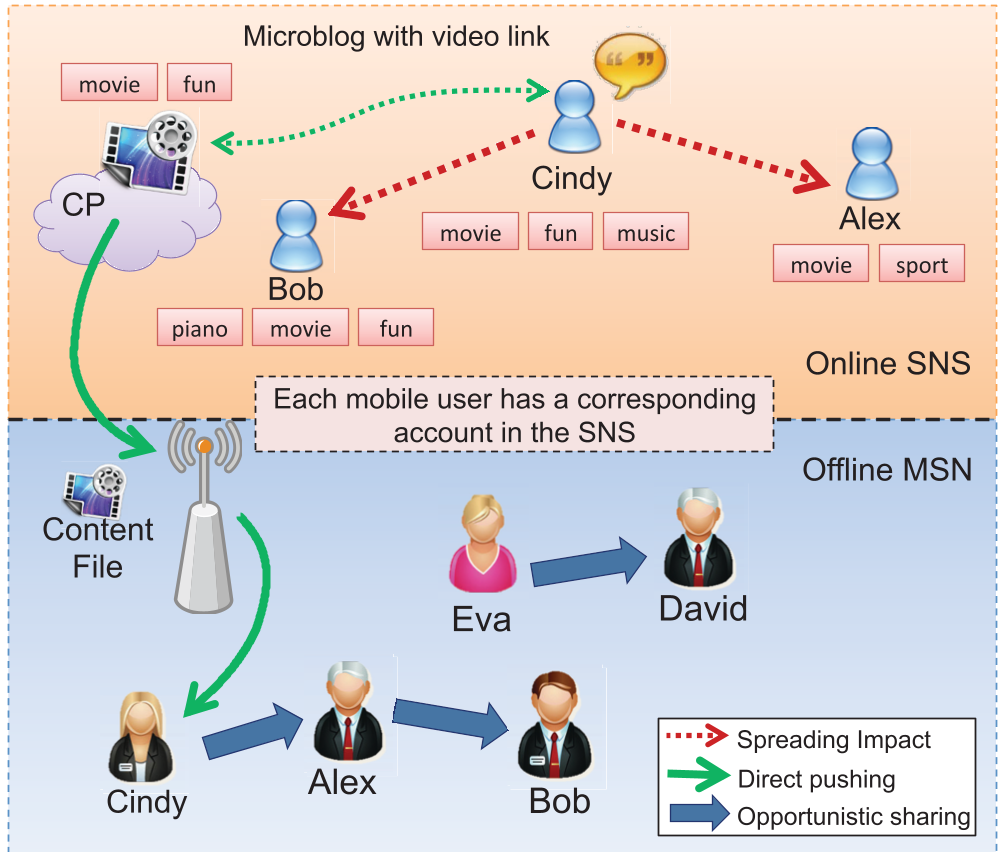 Fig 1: TASA Framework bridging Online SNS interests and Offline MSN mobility.
3. Heuristic Seed Selection
The system solves an optimization problem to select a limited number of "Seeds" (). It uses a Hill-Climbing algorithm to find users who have both high social influence (to spread the word) and high mobility (to spread the data).
Experiments: Real-World Trace Validation
The authors validated TASA using three famous datasets: Infocom (conference attendees), MIT (campus life), and SUVnet (taxis in Shanghai), combined with a 2.2-million-user crawl from Sina Weibo.
Key Findings:
- Traffic Reduction: In the Infocom trace, TASA achieved a 78.9% reduction in cellular load.
- The Mobility vs. Social Trade-off: In high-mobility scenarios (MIT/Infocom), mobility factors () dominated performance. In lower-mobility/constrained environments (SUVnet), social similarity () was the better predictor for successful sharing.
- Efficiency: You don't need to satisfy everyone to win. By targeting 90% of users, the number of required seeds drops drastically, making the system much cheaper for operators to implement.
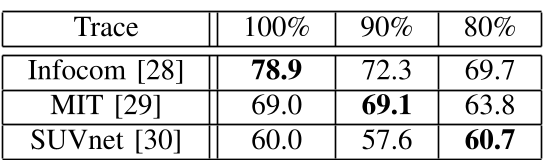 Table 1: Traffic offloading percentages across different mobility traces.
Critical Analysis & Conclusion
TASA represents a sophisticated leap in Socially-Aware Networking. Unlike "blind" epidemic routing, it uses the "Tag" as a filter for relevance.
Limitations: The study assumes users are willing to share their data and battery for D2D (incentive mechanisms are needed). Additionally, the synchronization for device discovery (the "eDiscovery" protocol) adds overhead that needs careful management in real-world implementations.
Future Outlook: As we move toward 6G, where D2D and Sidelink communications are native features, TASA’s logic of using online "digital twins" to optimize physical "data traffic" will likely become a standard architectural component of intelligent edge networks.