
Spatial Crowdsourcing: Navigating the Future of Physical Task Allocation
16797_Task Allocation in Spatial Crowdsourcing Current State and Future Directions.
This paper provides a comprehensive review of Task Allocation in Spatial Crowdsourcing (SC), proposing a conceptual model and a generic framework while categorizing methodologies into single, multiple, low-cost, and quality-enhanced allocation. It establishes a taxonomy for worker selection and server assignment and outlines critical future trends such as skill-based allocation and privacy preservation.
TL;DR
Spatial Crowdsourcing (SC) is redefining the gig economy by moving digital tasks into the physical realm (e.g., UberEats, Waze). This paper provides a seminal survey of how SC platforms manage the "Matching Problem"—assigning the right person to the right place at the right time. It moves beyond simple point-to-point matching to explore complex synergies like multitask bundling, skill-aware teams, and privacy-preserving trajectories.
Problem & Motivation: The Geometry of Human Labor
In traditional crowdsourcing (like Amazon Mechanical Turk), the location of the worker is irrelevant. In SC, location is the primary constraint. This introduces significant friction:
- Mobility Costs: Workers consume energy and time to visit a location.
- Uncertainty: Unlike a CPU, humans may reject tasks, go offline, or provide low-quality data.
- Complexity: Assigning thousands of dynamic tasks to thousands of moving workers is an NP-hard problem when considering budget, time windows, and sensing quality.
The author’s insight is that SC must be treated as a tripartite ecosystem consisting of Tasks, Workers, and the Server, where the server acts as the "brain," optimizing for global efficiency rather than local worker preference.
Methodology: The Generic Framework for Task Allocation
The paper identifies two primary allocation modes: Worker-Selection (WS) and Server Assignment (SAT). While WS gives workers autonomy, SAT is the focus of modern research because it allows for high-level optimization of system resources.
The SC Conceptual Model
- Tasks: Categorized by urgency (Normal vs. Urgent), spatiality (Point, Region, vs. Complex), and dynamics.
- Workers: Profiled by their spatio-temporal context, expertise (Skills), historical reliability (Trust), and Preferences.
- The Server: The optimization engine aiming to maximize Quality of Information (QoI) while minimizing System Cost.
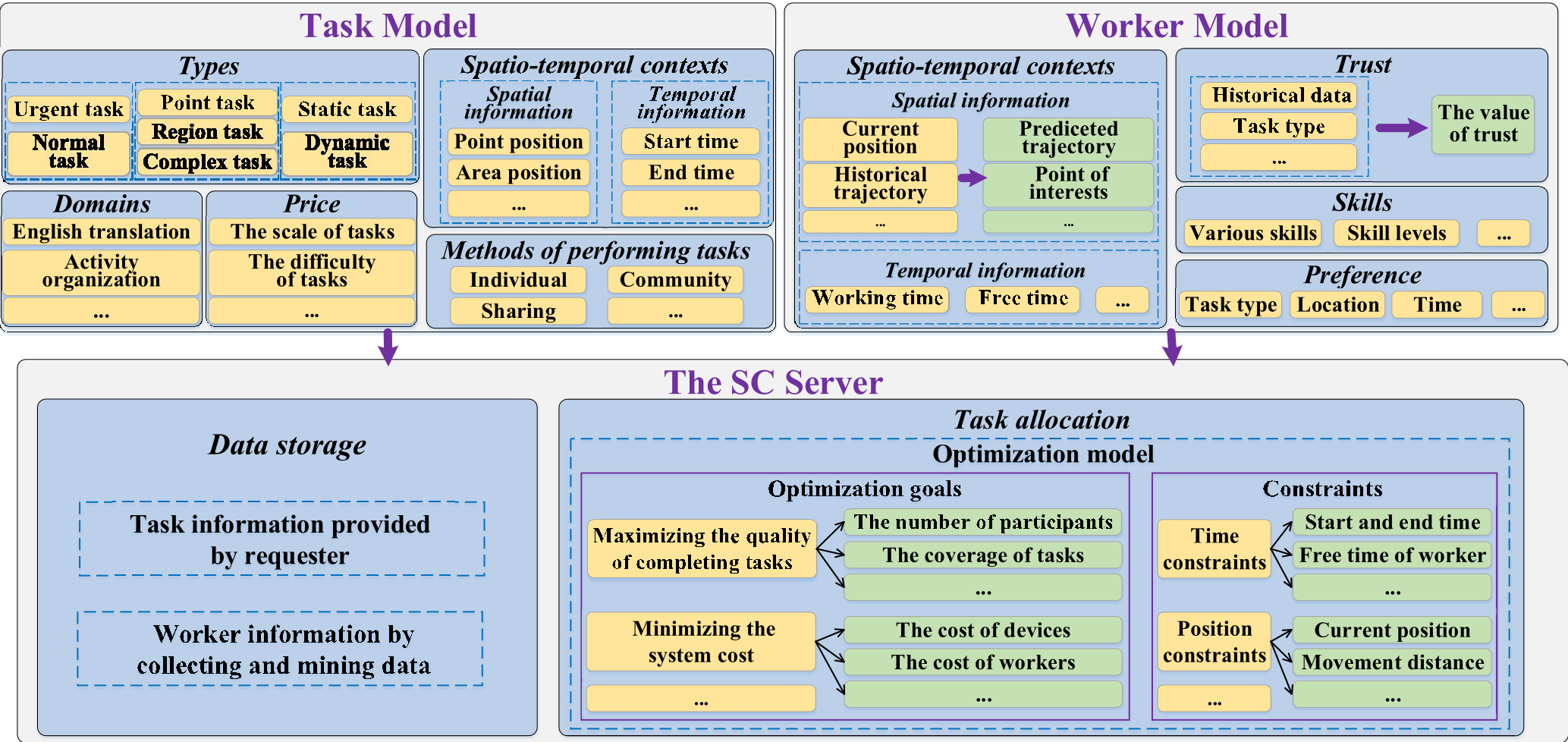
Key Allocation Strategies
- Piggyback Crowdsensing: A brilliant efficiency hack—tasks are mapped to workers who are already moving (e.g., during a commute), effectively reducing the marginal energy cost to near zero.
- Compressive Crowdsensing: Using mathematical sparsity to sense only a fraction of required data and using Bayesian inference to "fill in the blanks," reducing the human labor required.
Experiments & Results: Efficiency through Bundling
The paper surveys performance across various real-world and synthetic datasets (like GeoLife and taxi trajectories).
Key Finding: Task Composition The research highlights that Task Bundling (grouping proximal micro-tasks) significantly improves system throughput. Studies indicate that workers prefer bundled tasks, resulting in a 20% higher completion rate.
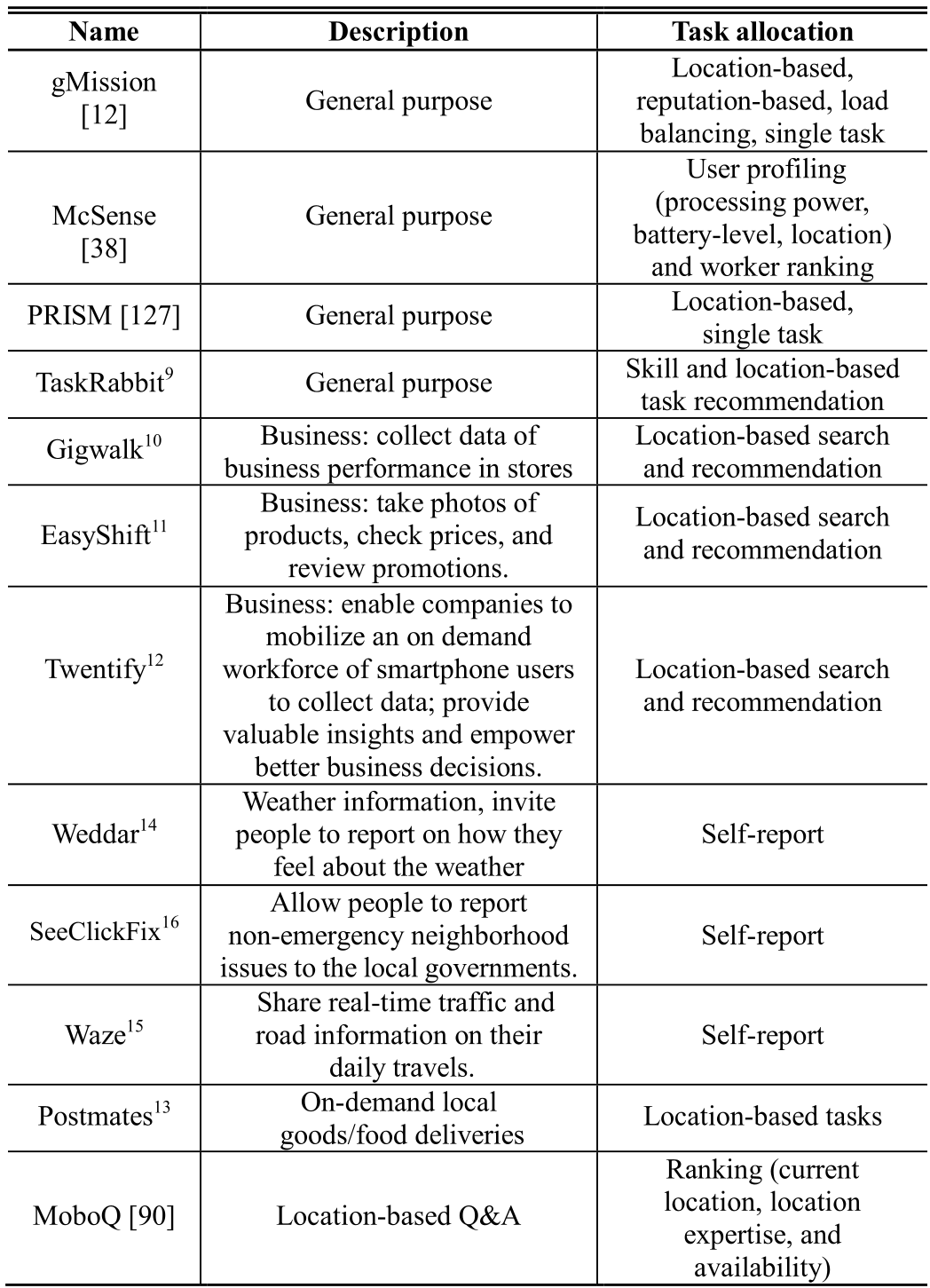
Table 1: State of the art SC platforms and their specific allocation strategies.
Deep Insights & The Road Ahead
The "Wild West" of SC is over; the focus has shifted toward high-quality, specialized labor.
1. Skill-Based Allocation (The Professionalization of SC)
Future systems will not treat all workers as interchangeable. A task involving "identifying architectural structural damage" requires a worker with specific civil engineering skills, not just a random passerby with a smartphone.
2. Privacy vs. Utility
The central paradox of SC: the server needs your precise location to give you a task, but sharing that location is a massive privacy risk. The paper points to Differential Privacy (DP) and Spatial Cloaking (masking location within a region) as the future of worker protection.
3. Complexity & Decomposition
As we move toward "Smart Cities," tasks become multi-step. Imagine a "Disaster Relief" task: it requires decomposition into sub-tasks (Sensing -> Delivery -> Coordination), requiring different teams to work in a synchronized workflow.
Conclusion
Spatial Crowdsourcing is no longer just about taking photos; it’s about a highly coordinated "Human-in-the-Loop" distributed system. The biggest challenge ahead lies in Human Participation—engineering systems that respect human autonomy and privacy while achieving the mathematical efficiency required to run a city.