
Securing the Swarm: Reputation-Based Task Allocation in Undependable Social Networks
Task Allocation for Undependable Multiagent Systems in Social Networks
This paper introduces a novel task allocation model for undependable Multiagent Systems in Social Networks (MAS-SN). It proposes a negotiation reputation mechanism to identify and penalize deceptive agents while optimizing for minimum resource access time, achieving high task success rates and SOTA execution efficiency.
TL;DR
This research tackles the "deception problem" in multiagent systems organized via social networks (MAS-SN). By introducing Negotiation Reputation, the authors create a system where agents are rewarded for truthful resource sharing and penalized for fabrication. The result is a highly resilient allocation model that minimizes communication latency and maximizes successful task completion.
Problem & Motivation: The Deception Gap
In large-scale MAS-SN, we rely on agents to provide resources for tasks. However, real-world systems are often undependable.
- Resource-based models assume agents are honest, leading to frequent failures when "deceptive" agents claim to have resources they don't actually contribute.
- Game-theoretic models address deception but often ignore the topology of the social network, leading to sub-optimal execution times due to high communication costs between distant nodes.
The authors identify a critical need for a mechanism that is both trust-aware and latency-sensitive.
Methodology: The Core Mechanism
The paper moves beyond simple binary trust by defining Negotiation Reputation () based on cumulative negotiation strengths along paths in the social network.
1. Manager and Contractor Selection
The model uses a dual-layered approach:
- Manager Selection: Uses the Estimated Resource Enrichment Factor (). This ensures that the agent leading a task has the best combination of personal resources and "influence" (reputation) over neighbors with required resources.
- Contractor Selection: When a manager lacks resources, it calculates a Negotiation Value () for potential contractors. This value balances communication distance () with the contractor's reputation ().
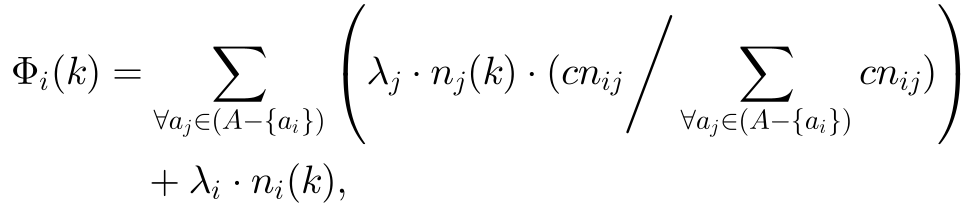
2. Load Balancing and Attenuation
To prevent "reputation bottlenecks" (where high-reputation nodes are overwhelmed), the authors introduce an attenuation function . This penalizes the priority of an agent if its task queue becomes too long, ensuring Load Balancing.
3. The Reward/Punishment Cycle
After execution, the system updates network weights using Algorithm 3. If a task succeeds, edges along the negotiation path are strengthened; if it fails, they are weakened. This "social metabolism" ensures that deceptive agents are gradually isolated from the network core.
Experiments & Results
The authors validated their model against four baselines, including a Transparent Model (clairyoyant knowledge of deception) and a Game Theory Model.
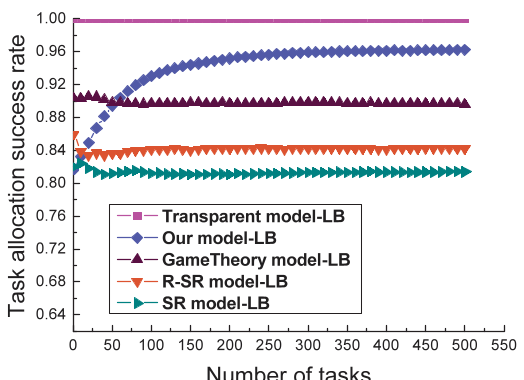
Success Rate Evolution
As the number of tasks increases, the system "learns" who to trust. While it starts slower than game-theoretic approaches (which use immediate incentives), it eventually surpasses them, reaching >90% success rates.
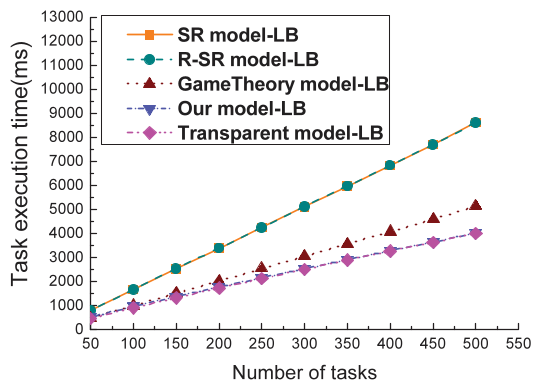
Efficiency and Latency
Remarkably, the execution time of the proposed model is significantly lower than Game Theory models and nearly matches the Ideal Transparent Model. This proves that optimizing for network distance alongside reputation is the "secret sauce" for high-performance MAS.
Critical Insight & Conclusion
The genius of this work lies in treating the social network not just as a static constraint, but as a dynamic ledger of trust. By adjusting edge weights () based on negotiation outcomes, the network itself becomes an intelligent filter.
Takeaways for the Industry:
- Low Overhead: Unlike complex cryptographic proofs or iterative games, reputation-based weighting is computationally cheap and scales to massive networks.
- Future Directions: The model currently assumes a static topology. The next frontier is applying these reputation heuristics to dynamic social networks where agents join and leave frequently (e.g., ad-hoc drone swarms or mobile edge clouds).
In conclusion, Jiang et al. have provided a robust framework for building dependable systems out of undependable parts, ensuring that in the world of MAS, honesty is truly the best (and most efficient) policy.