
TAQR: Balancing Quality and Stability in Crowdsourcing via Stable Matching
Task assignment with guaranteed quality for crowdsourcing platforms
The paper proposes TAQR (Task Assignment with Quality Requirement), a many-to-one matching framework designed to assign heterogeneous workers to crowdsourcing tasks. It uniquely balances individual preferences with both hard budget constraints (upper bounds) and soft quality requirements (lower bounds) to ensure system stability.
TL;DR
In the world of crowdsourcing, assigning the right workers to the right tasks is usually treated as an optimization problem. However, this paper argues that stability—ensuring no worker or crowdsourcer wants to "cheat" or leave the assignment—is the key to a sustainable platform. The authors present TAQR, a matching framework that handles workers with different skill levels and tasks with strict quality requirements and budgets.
Problem & Motivation: The Stability Gap
Most crowdsourcing platforms aim for "Total Utility Maximization." While this sounds efficient, it often leads to instability. If a highly skilled worker prefers Task A over their assigned Task B, and Task A would rather have that worker, the assignment is unstable. In an open market, they will simply bypass the platform's suggestion.
The challenge is threefold:
- Heterogeneity: Workers have different skill levels () and demand different pay.
- Lower Bounds (Quality): A task isn't just "done"; it must meet a minimum cumulative quality .
- Upper Bounds (Budget): Crowdsourcers cannot exceed a budget .
Existing algorithms like the standard Deferred Acceptance (DA) fail here because they assume workers are "units" of the same size. When worker "sizes" vary, cycles of rejections can lead to chaotic, unstable results.
Methodology: The ReDA Algorithm
The core innovation is the Revised Deferred Acceptance (ReDA) algorithm. Instead of a simple "yes/no" based on capacity, the algorithm evaluates potential "displacements."
1. The Matching Logic
When a worker proposes to a task , the algorithm checks:
- Scenario A: Is there remaining budget? If yes, accept .
- Scenario B: No budget? Check if is better than a subset of currently assigned workers. If can replace a group of less-preferred workers while staying within budget and maintaining quality, the swap is made.
2. Architecture & Flow
The system maintains a preference list for every agent. A unique "soft lower bound" check ensures that workers are not moved if their removal would cause their current task to fall below the required quality threshold ().
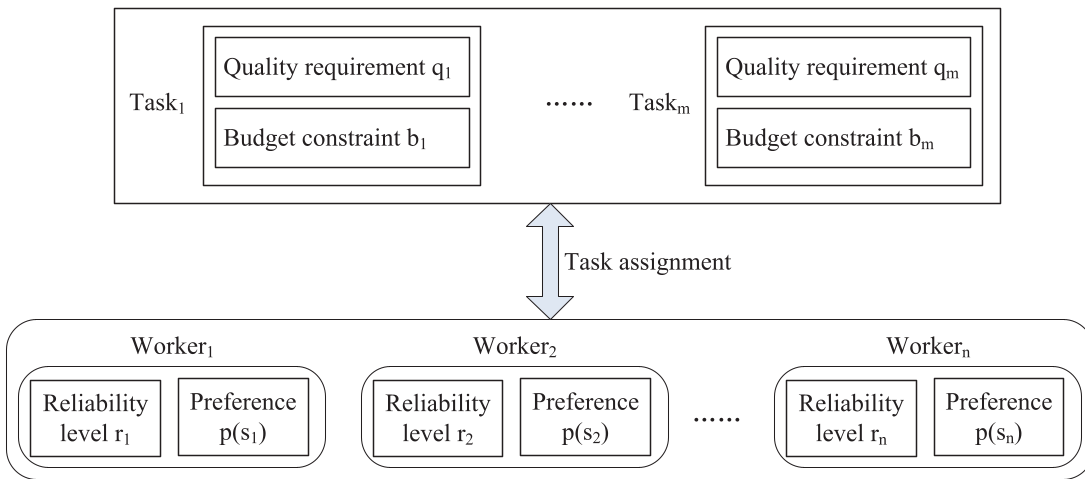 Figure 1: The heterogeneous crowdsourcing model where workers of various skill levels match with tasks having specific budget and quality demands.
Experiments: Quality vs. Efficiency
The authors compared TAQR against Anchor, a benchmark for matching heterogeneous agents that ignores lower bounds.
Key Findings:
- Success Ratio: TAQR achieved up to an 18% increase in the number of tasks successfully completed. This is because TAQR "saves" workers for tasks that are struggling to meet their quality minimums.
- Worker Happiness: Because the algorithm respects preferences and doesn't aggressively reject workers to simplify the matching math, worker satisfaction (rank percentile) improved by 11%.
- Trade-off: The primary cost is Running Time. Finding the "minimum quality subset" to displace is essentially a variation of the Knapsack Problem, making TAQR slower than naive greedy approaches but still linear in practice.
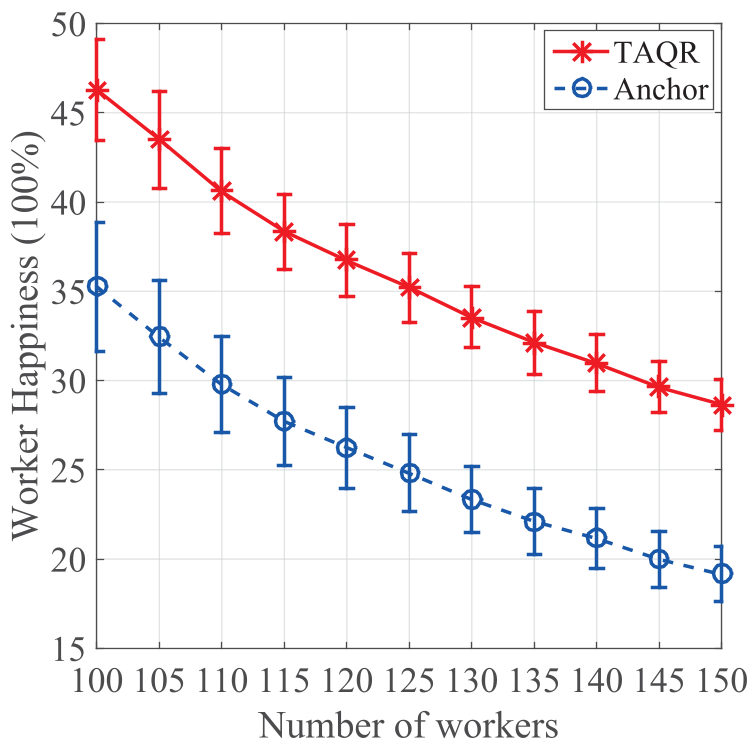 Figure 2: Performance comparison showing TAQR's superior success ratio as the number of tasks increases.
Critical Insight: Why it Works
The "magic" of TAQR lies in Theorem 2-5, where the authors prove the resulting assignment is Individually Rational, Fair, and Nonwasteful. By treating task quality as a "soft" lower bound, the algorithm prioritizes social welfare without forcing participants into assignments they despise.
Conclusion & Future Outlook
TAQR moves crowdsourcing from a "centralized command" model to a "market equilibrium" model. While the current model assumes worker quality is constant across all tasks, the next logical step—as the authors suggest—is handling task-specific skills, where a worker might be an expert in image labeling but a novice in data entry.
For platform architects, the takeaway is clear: Stability is the prerequisite for optimization. If your users aren't happy with their matches, your "optimal" algorithm is merely a theoretical exercise.