
SmartCrowd: Bridging the Gap in Knowledge-Intensive Crowdsourcing Optimization
Task assignment optimization in knowledge-intensive crowdsourcing
This paper introduces SmartCrowd, a framework for optimizing worker-to-task assignment in Knowledge-Intensive Crowdsourcing (KI-C). It formulates KI-C assignment as an optimization problem (C-DEX) and proposes adaptive algorithms to maximize quality while minimizing costs under human constraints.
TL;DR
Knowledge-Intensive Crowdsourcing (KI-C)—the collaborative creation of complex content like Wikipedia or news articles—has long lacked a formal optimization framework. SmartCrowd fills this void by treating worker-to-task assignment as a structured optimization problem. By pre-computing "Crowd Indexes" (C-DEX) and adaptively maintaining them, the framework achieves a 300% performance boost over traditional self-appointment and online greedy methods.
The Shift from Micro-Tasks to Knowledge Work
Most crowdsourcing research focuses on micro-tasks: atomic, independent units of work like labeling an image. In that world, "quality" is found through consensus (majority voting).
However, Knowledge-Intensive Crowdsourcing is different:
- Non-Decomposable: You cannot write a coherent news article by assigning independent sentences to 100 strangers.
- Continuous Quality: There isn't one "correct" version; quality is an aggregate of expertise.
- Collaborative: Workers must build upon each other’s contributions.
The authors argue that the current "passive" model—where workers pick their own tasks—leads to a "long tail" of low-quality content and inefficient budget burned on the wrong talent.
Methodology: The C-DEX Framework
The core innovation is the C-DEX (Crowd Index). Think of it as a database index for human capital. Instead of waiting for a worker to arrive and then figuring out where they fit, SmartCrowd proactively computes the best possible "teams" for a projected workload.
1. Modeling Human Factors
The framework moves beyond simple "accuracy" and models three physical realities:
- Expertise (): A worker's skill in a specific domain.
- Wage (): The cost to hire.
- Acceptance Ratio (): The probability a human actually says "yes" to a task.
2. The Optimization Logic
SmartCrowd uses Integer Linear Programming (ILP) to maximize a value function , which balances quality (sum of skills) and cost efficiency (remaining budget).
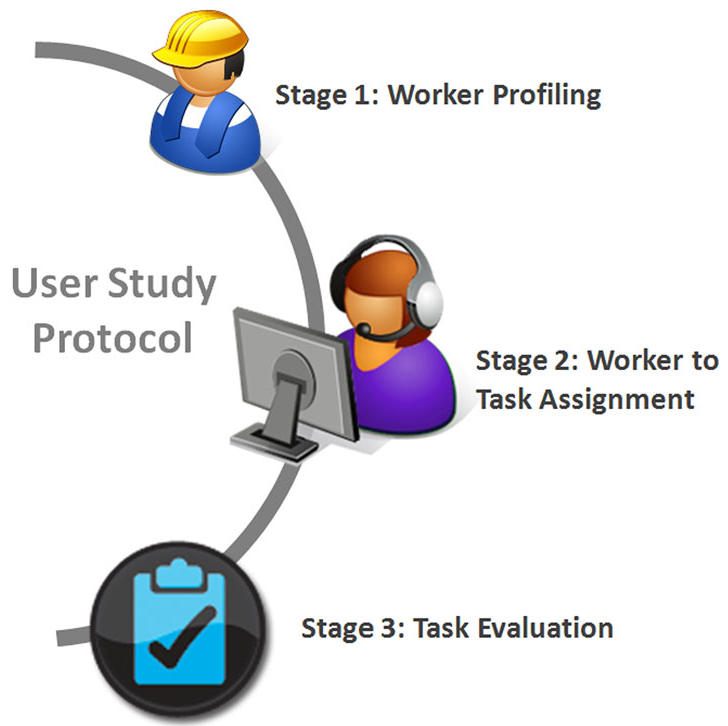 The SmartCrowd workflow: From profiling workers in Stage 1 to assigning them via C-DEX and evaluating the final collaborative outcome.
3. Scaling with C-DEX+
Because ILP is NP-Hard, the authors introduced C-DEX+, which uses multi-dimensional clustering to create Virtual Workers. By grouping similar workers, the number of variables in the optimization problem is drastically reduced, allowing the system to handle 50,000+ tasks with minimal loss in quality.
Experiments: Real-World Gains
The authors didn't just stay in simulation; they adapted Amazon Mechanical Turk to test news article composition on topics like "Egyptian Politics" and "NSA Leakage."
Quantitative Results
Compared to a Benchmark (self-appointment) and Online-Greedy (state-of-the-art), SmartCrowd's C-DEX yielded:
- 3x Efficiency Improvement: Better matching of specialists to complex requirements.
- Higher Continuous Quality: Articles produced via C-DEX received significantly higher marks from independent evaluators for completeness and language correctness.
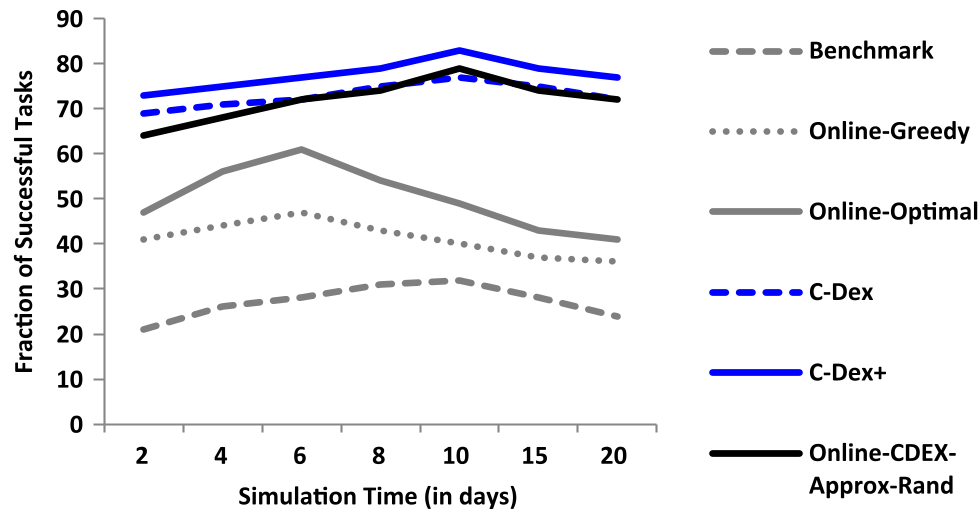 Figure: Performance over time. While other algorithms peak and then drop (due to myopic decisions), index-based strategies maintain high successful task ratios.
Critical Insights
The true power of this paper lies in its proof that offline knowledge is a prerequisite for online efficiency. By using a "workload" (a set of anticipated tasks), the system avoids the "greedy trap"—where early tasks consume all the best experts, leaving later tasks to fail.
Limitations: The current model assumes an additive skill aggregation (the more experts, the better). While this works for document editing (where users edit/improve each other), it may not capture "too many cooks in the kitchen" scenarios where coordination overhead outweighs individual skill.
Conclusion
As we move into an era of "Human-in-the-loop" AI training and complex creative crowdsourcing, the SmartCrowd framework provides the mathematical bedrock for turning a chaotic pool of workers into a high-performance knowledge factory. Its use of Virtual Workers and expected acceptance ratios makes it one of the few frameworks that feels robust enough for the unpredictability of actual human behavior.