
Collaborative Grouping: Solving the Small-Budget Dilemma in Mobile Crowdsourcing
Task Assignment for Simple Tasks with Small Budget in Mobile Crowdsourcing
This paper proposes a comprehensive task assignment mechanism for Mobile Crowdsourcing (MC) specifically designed for simple tasks with small budgets. It introduces a two-phase framework—Task Grouping (TGC, TGR, TGS) and Worker Selection (WSFP, WSCP)—to optimize recruitment and ensure participation from both requesters and workers.
TL;DR
Mobile Crowdsourcing (MC) often fails when tasks are too simple and budgets are too small to attract quality workers. This paper introduces a systematic framework that groups simple tasks based on cohesion, relevance, and similarity, then matches them with workers using optimized selection algorithms. This approach ensures that even low-budget tasks get completed while maintaining the platform's profitability and worker satisfaction.
Background: The Recruitment Bottleneck
In the current MC landscape, we see a gap. While complex tasks (requiring multiple skills) have mature assignment models, simple tasks like "taking a temperature reading" at a specific coordinate often go ignored. Why? Because the individual reward is too low to justify the worker's travel or effort. Requesters are trapped in a cycle of "small budget = no workers," and workers see no value in isolated, low-pay micro-tasks.
The Core Insight: Task Atomization to Group Synergy
The authors suggest that the solution lies in Task Grouping. By aggregating tasks based on location and intrinsic properties, we can create a "bulk" assignment that is worth a worker's time.
Phase 1: Task Grouping Strategies
The paper proposes three distinct methods to bundle tasks:
- Tasks Grouping with Cohesion (TGC): Focuses on the "Value-to-Cost" ratio. It adds tasks to a group only if they maintain or improve the overall economic cohesion of the set.
- Tasks Grouping with Relevance (TGR): Uses a Jaccard Similarity approach to link tasks that are contextually related (e.g., humidity and temperature in the same area).
- Tasks Grouping with Similarity (TGS): Employs a distance-based metric considering value, cost, and historical publication frequency to find "twin" tasks.
Phase 2: Intelligence in Worker Selection
Once grouped, how do we pick the right workers? The paper introduces two paradigms:
- WSFP (Fixed Price): Best for independent tasks where one job doesn't make the next any easier.
- WSCP (Changing Price): A sophisticated model accounting for a Price Decay Factor (). This recognizes that as a worker performs more similar tasks, their proficiency increases, and their marginal cost decreases.
 Above: The matching degree formula () integrates location, reputation, and price alignment.
Methodology & Architectural Flow
The system first performs Preliminary Aggregation of Tasks (PAT) to establish a clearing price for each location. It then flows into the grouping algorithms (TGC/TGR/TGS). Finally, it executes the worker selection, ensuring that the total wages () do not exceed the group budget ().
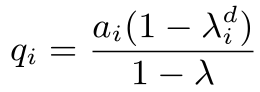 The price decay model (Eq. 4) allows the platform to capitalize on worker experience gains.
Experimental Results
The evaluation focused on the utility (profit/benefit) of the three main stakeholders.
- Stakeholder Win-Win: As more participants join the platform, the utility for Requesters, Workers, and the Platform scales positively. This indicates the system is budget-balanced and gain-efficient.
- Matching Weights: The study tested different weights for Location (), Reputation (), and Price (). Interestingly, the system remained robust regardless of the specific weight distribution, proving the underlying grouping logic is the primary driver of success.
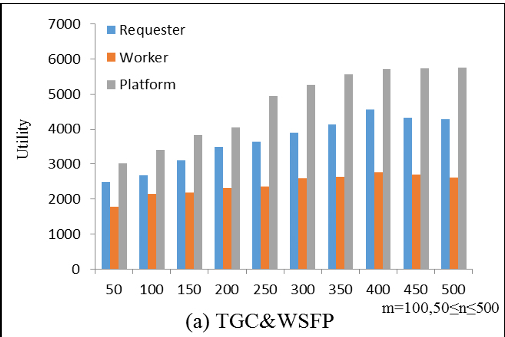 Figure: Utility increases linearly with the number of requesters, validating the scalability of the grouping approach.
Critical Analysis & Future Outlook
Strengths:
- Truthfulness: The mechanism is mathematically proven to discourage "shill bidding" or budget manipulation by requesters.
- Practicality: By addressing high-volume, low-budget tasks, it opens MC to a much wider array of IoT and urban sensing applications.
Limitations:
- The model assumes a "centralized platform" architecture. In the future, adapting this to decentralized/blockchain-based MC (where trust is trustless) would be a significant leap.
- The "Price Decay Factor" is a great theoretical addition, but real-world worker fatigue (which would increase costs) isn't fully balanced against the proficiency gain.
Conclusion
This research provides a vital blueprint for the "long tail" of Mobile Crowdsourcing. By transforming isolated, unappealing tasks into cohesive, high-value groups, we can build sensing networks that are both economically stable and highly efficient.