
Architecting Cognitive Skill Ladders: Solving the Complexity Gap in Crowdsourcing
Task Design for Crowdsourcing Complex Cognitive Skills
The paper presents a case study on designing crowdsourcing tasks for complex cognitive skills, specifically generating "Dimension/Values" (D/V) to categorize ideas. Through four design iterations, the authors developed a structured mini-tutorial strategy that significantly improved the quality of crowd-sourced results, achieving a final SOTA validity rate of 79.6%.
TL;DR
Crowdsourcing complex cognitive tasks like idea categorization often fails because workers misunderstand the high-level intent. This paper from Purdue University researchers solves this by decomposing cognitive processes into a "Skill Ladder"—a four-stage tutorial that trains and filters workers. The result? A massive jump in data validity from a meager 7% to 79.6%.
Problem & Motivation: The Vocabulary Trap
In crowdsourcing platforms like Amazon Mechanical Turk (AMT), simple labeling is easy. However, asking workers to generate a Dimension/Value (D/V) system—such as identifying "Location" (Dimension) with values like "Indoor/Outdoor" to categorize "Ways to use a brick"—is notoriously difficult.
The researchers identified two primary pain points:
- Vocabulary Overload: Terms like "attributes," "metrics," and "dimensions" are often conflated, leading to irrelevant submissions.
- Context Misalignment: Workers tend to classify existing items rather than creating a system that can handle future unseen items.
Without a feedback loop, typical "Plain Requirement" instructions resulted in a 93% failure rate.
Methodology: The Evolution of Task Design
The authors moved through four distinct iterations, shifting from "what we want" to "how to think."
Iterations 1-3: Context and Structure
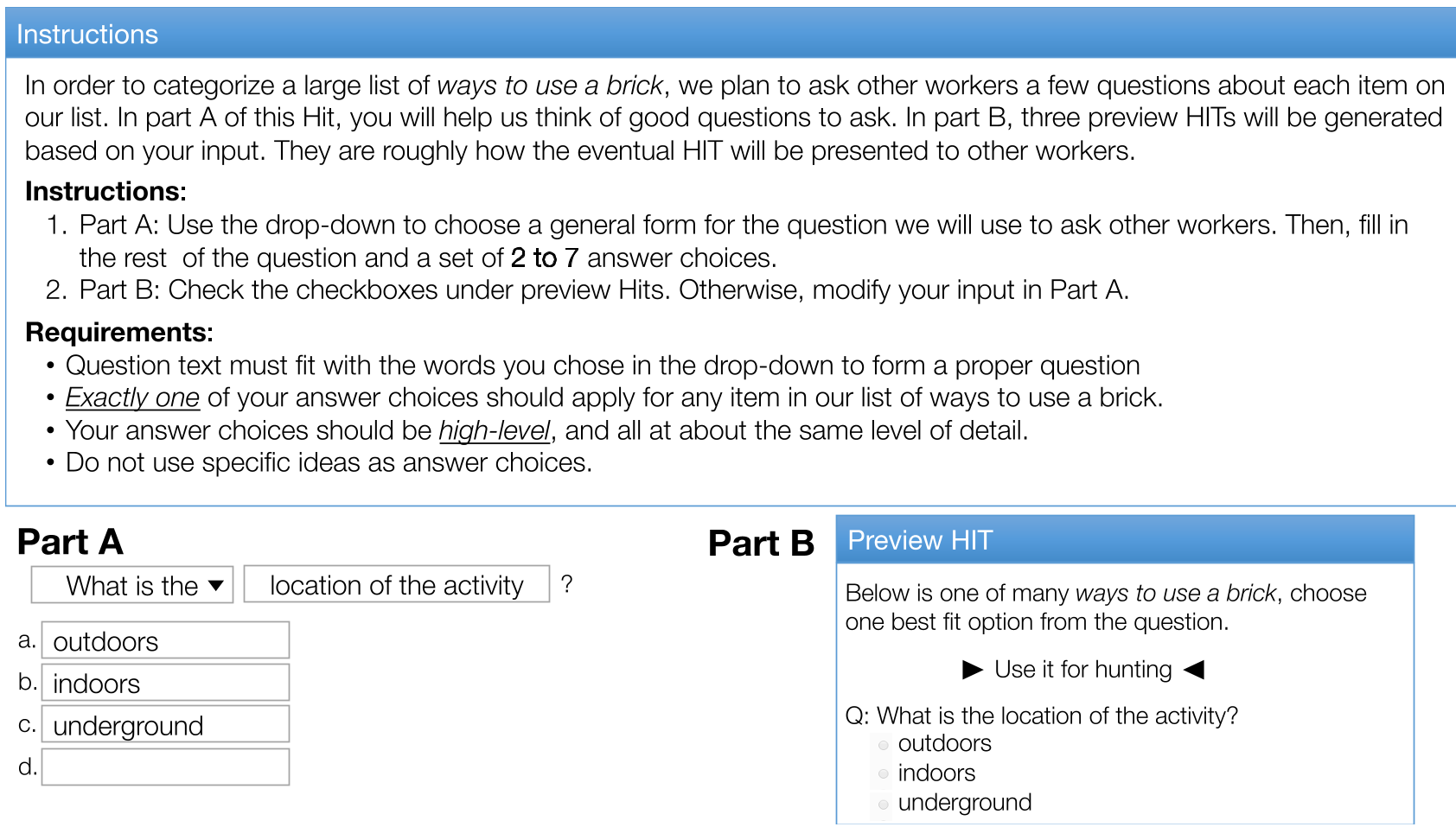
Initially, they tried providing sample ideas (S1) and decomposing tasks into simple sub-units (S2). They eventually moved to Contextual Enrichment (S3), where workers saw a preview of how their questions would be used by others. While this improved results, it wasn't enough to filter out low-cognitive-effort participants.
Iteration 4: The Skill Ladder (The Breakthrough)
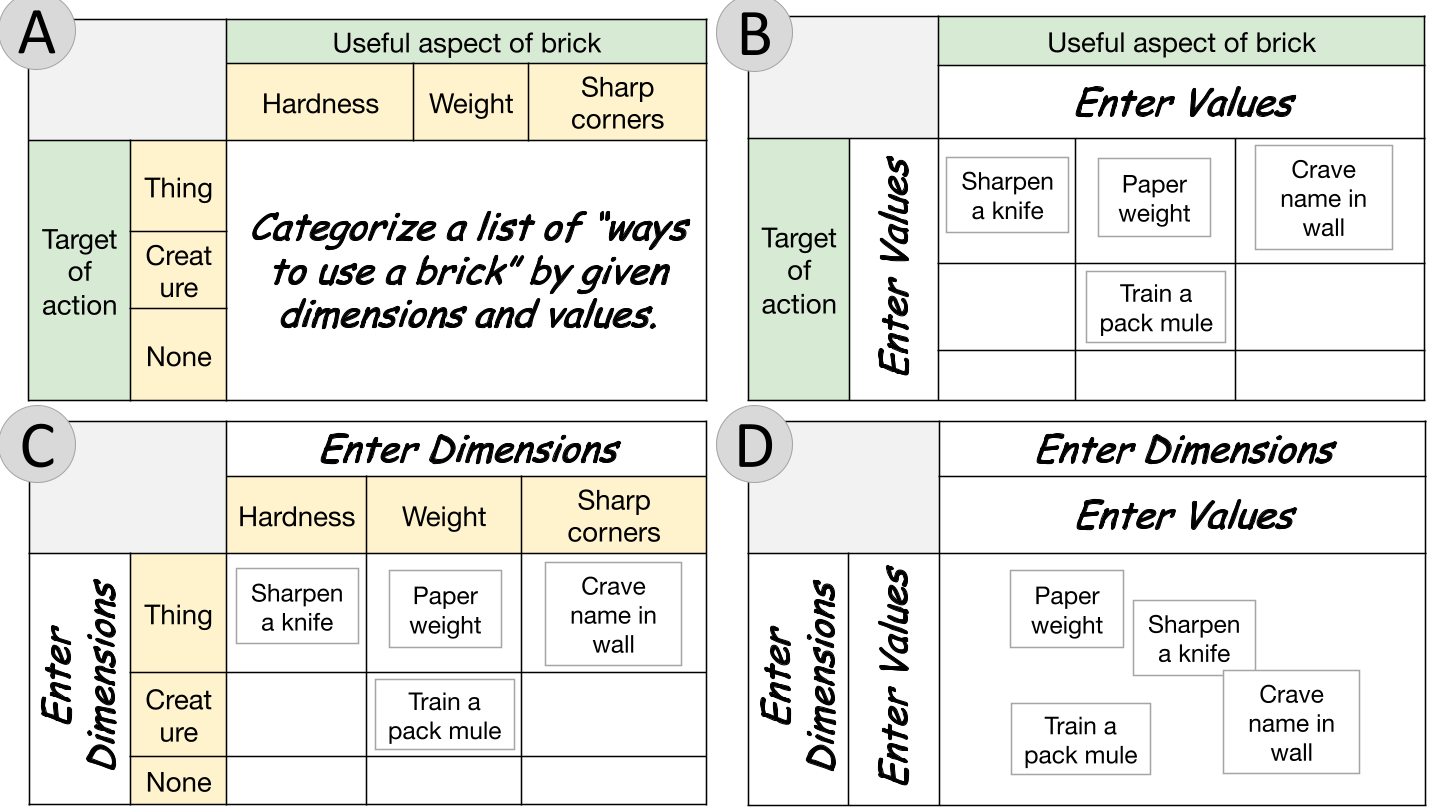
The final solution was a structured mini-tutorial that treated cognitive skill acquisition like a mathematics curriculum. Instead of just instructing, the system tested mastery of three sub-skills before allowing the actual task:
- Categorization: Sorting items using existing D/V.
- Value Generation: Filling in blanks for a given dimension.
- Dimension Generation: Reverse-engineering the label for given values.
Experiments & Results: Quantifying Success
The "Skill Ladder" approach transformed the output quality. By the fourth iteration, not only did the percentage of valid dimensions increase, but the Valid D/V (the alignment between the category and its sub-options) reached parity with dimension validity.
Performance Metrics Across Iterations
| Iteration | Valid Dimension (%) | Valid D/V (%) |
|---|---|---|
| #1: Plain Requirements | 9.3% | 7.0% |
| #2: Simple Decomposition | 42.9% | 28.6% |
| #3: Context Enrichment | 52.4% | 44.0% |
| #4: Training + Structure | 79.6% | 79.6% |
This 11x improvement over the baseline (Iteration 1) suggests that the combination of training and filtering is the "Silver Bullet" for high-complexity crowd tasks.
Critical Analysis & Conclusion
Takeaways
- Implicit Structure > Explicit Text: Using tables and multiple-choice questions conveys semantics (orthogonality, completeness) better than paragraphs of text.
- The "Big Picture" Matters: Contrary to the common practice of hiding the "why" to prevent bias, showing workers the context of the larger system (S3) significantly reduces irrelevant noise.
Limitations & Future Work
The study notes that this approach effectively filters workers. While efficient, it means a smaller pool of participants can complete the task. Future research could investigate whether these "Skill Ladders" can eventually train even lower-skilled workers to perform at expert levels, or if the "transferable skill" observed in this paper is limited to specific cognitive domains like categorization.
For developers of AI and human-in-the-loop systems, this paper provides a blueprint: Don't just give better instructions; build a better ladder.