
Scaling Local Genius: Efficient Task Matching and Scheduling in Spatial Crowdsourcing
Task matching and scheduling for multiple workers in spatial crowdsourcing
The paper introduces BisectionLALS, a scalable framework for spatial crowdsourcing that simultaneously optimizes task-matching and multi-worker scheduling. By combining bipartite matching with a bisection-based partitioning strategy, it achieves near-optimal task completion rates while being three orders of magnitude faster than global optimization methods.
TL;DR
Scaling platforms like Uber or TaskRabbit requires more than just matching a worker to a task; it requires optimizing the entire sequence of locations a worker visits. This paper tackles the Maximum Task Scheduling with Multiple Workers (MTSMW) problem. By introducing a bisection-based partitioning method, the authors enable real-time, high-quality scheduling for massive numbers of workers, outperforming traditional global methods in speed by a factor of 1,000.
The Core Conflict: Matching vs. Scheduling
In spatial crowdsourcing, the goals of the platform (maximize completed tasks) often clash with the constraints of the workers (limited time, travel cost, and sequence of movement).
- Prior Work in Matching: Treat it as a "Maximum Flow" problem. It’s great at finding pairs but terrible at pathing.
- Prior Work in Scheduling: Optimizes a single worker's route. It’s great at pathing but ignores the "global" competition where multiple workers vie for the same high-value tasks.
The authors argue that doing one after the other is insufficient. A worker might be "matched" to a task they can't actually reach in time due to their previous commitments.
Methodology: The 3-Phase GALS and the Bisection Breakthrough
1. The GALS Framework
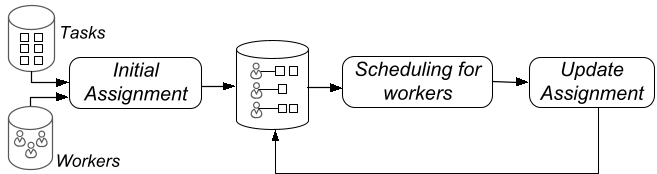
The researchers first propose GALS (Global Assignment and Local Scheduling). It iterates through:
- Initial Assignment: Max-flow bipartite matching.
- Local Scheduling: An insertion heuristic optimizes each worker's route.
- Update Phase: Re-inserts failed tasks back into the pool for other workers.
2. Solving the Scalability Wall (BisectionLALS)
While GALS is effective, global max-flow calculations are too slow for real-time systems. To fix this, the authors introduce BisectionLALS.
The intuition? A worker in New York doesn't affect the scheduling of a worker in Los Angeles. The algorithm recursively "bisects" the task-worker graph into smaller, balanced partitions until the workload is manageable.
Key Innovations:
- Task-Oriented Partitioning: Instead of simple grid-based splits, it "grows" partitions like balloons around seed tasks to ensure that connected tasks and workers stay together.
- Bottom-Up Merging: After local solving, it merges the "residual" (unmatched) workers and tasks from sibling partitions to try and find new matches at a higher level of the tree.

Evidence of Success
The researchers tested their approach against various baselines including K-Means partitioning and simple matching.
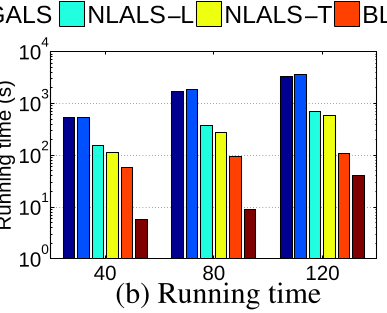
- Efficiency: BisectionLALS (BLALS-T) consistently showed flat or near-linear growth in execution time, whereas global GALS exploded exponentially as task numbers reached 100k.
- Quality: Despite cutting the world into pieces, the "Bottom-Up Merging" ensures only a ~4% drop in the total number of tasks completed compared to a global optimum.
- Real-World Data: On Yelp and Gowalla datasets, the system successfully handled the "skewed" nature of urban data (busy city centers vs. sparse suburbs).
Deep Insight: Why Bisection Wins
The brilliance of the Bisection-based Local Assignment and Local Scheduling (LALS) isn't just the "divide" part—it's the merging. Most partitioning schemes leave "border" tasks unassigned. By using the partitioning tree to merge neighboring residuals, the algorithm allows a task that couldn't fit in Worker A's local schedule to be picked up by Worker B in a neighboring partition during the bottom-up pass.
Conclusion & Future Outlook
This paper provides a robust blueprint for real-time spatial platforms. By treating task assignment and scheduling as a unified, partitioned problem, it overcomes the NP-hard complexity of global fleet management. Future research into multi-worker tasks (where a task requires 2+ people) and fully dynamic environments (where tasks appear and disappear in seconds) will likely build upon this bisection foundation.