
Dynamic Quality Control: Leveraging Task Ontologies to Solve the Crowdsourcing Paradox
A Task Ontology-based Model for Quality Control in Crowdsourcing Systems
The paper proposes a task ontology-based model designed to dynamically identify the most appropriate Quality Control Mechanism (QCM) for specific types of crowdsourcing tasks. By integrating an ontology with a reputation system, the model maps tasks to quality mechanisms based on historical performance and requester feedback, achieving a domain-independent approach to quality assurance.
TL;DR
Crowdsourcing is a cornerstone of big data operations, yet its biggest hurdle remains Quality Control (QC). This paper introduces a novel model that abandons the traditional "blanket approach" to QC. By using a Task Ontology-based Model, the system dynamically identifies the best Quality Control Mechanism (QCM) for any given task, using a reputation engine to learn from historical requester feedback.
Background Positioning: This work moves beyond simple worker-rating systems, establishing a domain-independent framework that treats the nature of the task as the primary variable in quality assurance.
The "One-Size-Fits-All" Problem
In current systems like Amazon Mechanical Turk (MTurk), requesters often have limited flexibility. Whether you are asking a worker to identify a cat in a photo or translate a technical manual, the system often defaults to simple Worker Ratings or Redundancy (Majority Voting).
The authors identify a fundamental insight: Task type is the single most significant factor affecting output quality. A mechanism that ensures high-quality image tagging might be completely useless for subjective sentiment analysis. Furthermore, worker reputations are non-transferable; a high rating in transcription does not guarantee accuracy in complex data validation.
Methodology: The Task-Centric Architecture
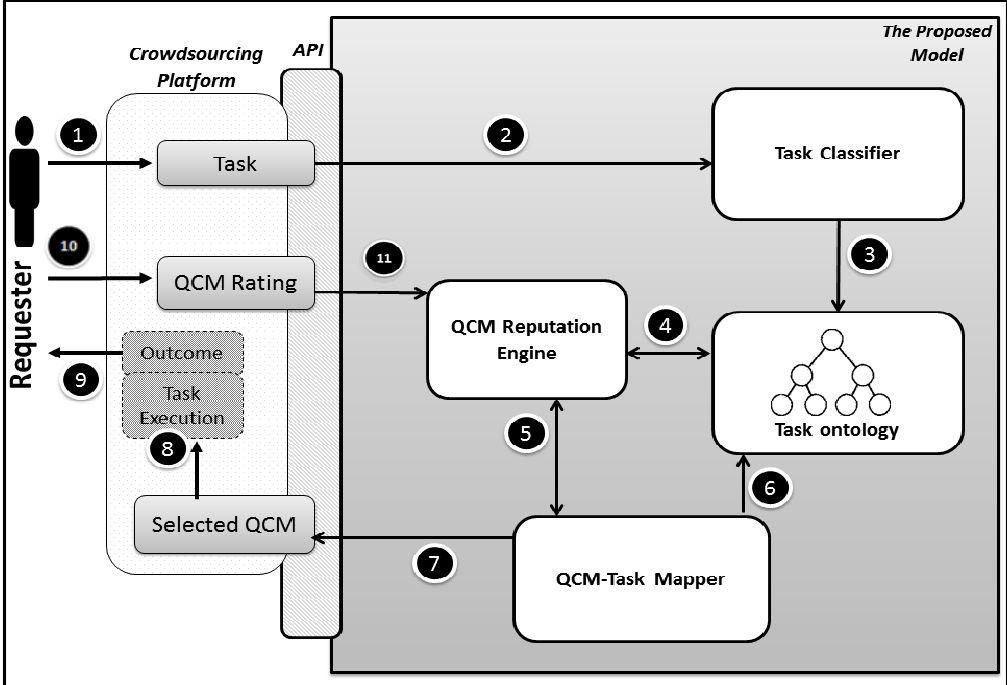
The proposed model shifts the focus from the human worker to the Task Type. The architecture is divided into four critical components:
- Task Classifier: Extracts features (title, description, keywords) to align new tasks with the ontology.
- Task Ontology: A structured repository that categorizes tasks (e.g., NLP, Image Processing) and linkable QCMs.
- QCM Reputation Engine: Calculates a "Success Score" for QCMs based on historical data.
- QCM-Task Mapper: The decision-making layer that selects the optimal mechanism, even dealing with "Cold Start" scenarios.
The Algorithm: Context-Aware Reputation
Unlike standard reputation systems that give a QCM a global score, this model uses Algorithm 1 to calculate reputation relative to the task. It sums only the ratings where Task Type == Target Task, ensuring that a QCM's failure in one domain doesn't unfairly penalize its use in another.
Experimental Validation
The paper validates the model through a comparative analysis. In a scenario with five tasks (T1-T5) and three mechanisms (q1-q3), a "Global Reputation" approach would have recommended mechanism q2 for a translation task (T1). However, the Task Ontology-based model correctly identified that q1 consistently outperformed others for T1, despite q1 having a lower overall global score.
| Quality Control Mechanism | Global Reputation | Task-Specific Reputation (T1) |
|---|---|---|
| q1 (Selected by model) | 3.0 | 4.5 |
| q2 (Standard choice) | 3.33 | 1.0 |
| q3 | 1.33 | 1.5 |
The data shows that for Task 1 (Translation), the proposed model successfully identified the superior mechanism that had been obscured by global averages.
Critical Insight & Future Outlook
The true value of this work lies in its Semantic Awareness. By using an ontology, the model solves the Sparsity Problem. If the system encounters a brand new task ("Summarize this text"), it can look at its neighbors in the ontology ("Translate this text") and borrow successful QCM strategies from those similar nodes.
Limitations & Challenges
- The Trust Loop: The model assumes requesters provide honest ratings for the QCMs. In practice, requesters might be biased or malicious.
- Ontology Maintenance: As new crowdsourcing domains emerge (e.g., training RLHF models for AI), the ontology must be manually or semi-automatically updated by experts.
Conclusion
By moving away from static reputation and toward a dynamic, ontology-driven mapping system, this research provides a roadmap for more reliable and efficient human-computation systems in the age of big data.