
TATM: Shielding Social Traders from Deception in Double Auctions
TATM: a trust mechanism for social traders in double auctions
This paper introduces the Trading Agent Trust Model (TATM), a reinforcement learning-based trust mechanism designed for traders in double-auction markets with multiple competing marketplaces. TATM enables agents to detect deceptive peers and mitigate the impact of false information shared over social networks, ultimately improving individual profits and market efficiency.
TL;DR
In the world of automated trading, information is power—but only if that information is true. This paper presents TATM (Trading Agent Trust Model), a mechanism designed to help agents navigate social networks where peers might lie about their profits to manipulate the market. By integrating a recency-weighted trust score with reinforcement learning, TATM allows traders to ignore deceptive signals and significantly improve their bottom line compared to "naive" peers.
Background: The Double-Edged Sword of Social Trading
Modern markets are often fragmented across multiple marketplaces. Traders must decide not only what price to shout (buy/sell) but where to do it. Sharing success stories over a social network helps "intra-marginal" traders find the best deals faster.
The Catch: Deceptive sellers might claim they secured high prices in a different market to lure competitors away, or buyers might under-report prices to drive the market lower. Without a way to verify these claims, a social network becomes a vector for manipulation rather than cooperation.
Methodology: Building a Digital "Lie Detector"
The authors propose TATM as a defense layer. It doesn't just look at whether a neighbor was successful; it looks at whether mimicking that neighbor led to success for the trader themselves.
1. The Interaction Trust Score (The "FIRE" logic)
TATM calculates the trustworthiness of a neighbor by weighting recent interactions more heavily than old ones. The trust value () decays over time, ensuring that an agent who used to be honest but turned "rogue" is quickly downgraded.
2. Preemptive Deceit Detection
One of the most elegant parts of the methodology is the use of Private Information. If a neighbor claims they sold goods at price in Market , but the trader itself offered a lower price in the same market and wasn't matched, the trader knows for a fact the neighbor is lying—without needing any third-party verification.
3. Smart Mimicry (Softmax Selection)
Instead of always following the "best" neighbor, TATM uses a Boltzmann distribution for action selection. This allows the agent to "test" different neighbors occasionally (exploration) while primarily following known honest winners (exploitation).
 Figure: The decision-making formula used to choose which neighbor to mimic based on both their claimed profit and their calculated trust score.
Experiments & Results: Does Trust Pay Off?
Using the JCAT double-auction simulator, the authors tested TATM against "Naive" agents (who believe everything they hear) across 90 different configurations of deceit.
- The Profit Gap: In a market full of liars, naive traders get fleeced. Deceptive agents typically outperform naive ones by up to 6%.
- The TATM Shield: When TATM is introduced, the advantage of the deceptive traders largely vanishes. In scenarios with high deceit levels (0.7 to 0.9), the truthful TATM traders actually outperformed the liars.
- Market Efficiency: TATM doesn't just help the individual; it helps the system. By filtering out false price signals, the "Global Allocative Efficiency" of the market stays higher, meaning more trades happen at the correct equilibrium price.
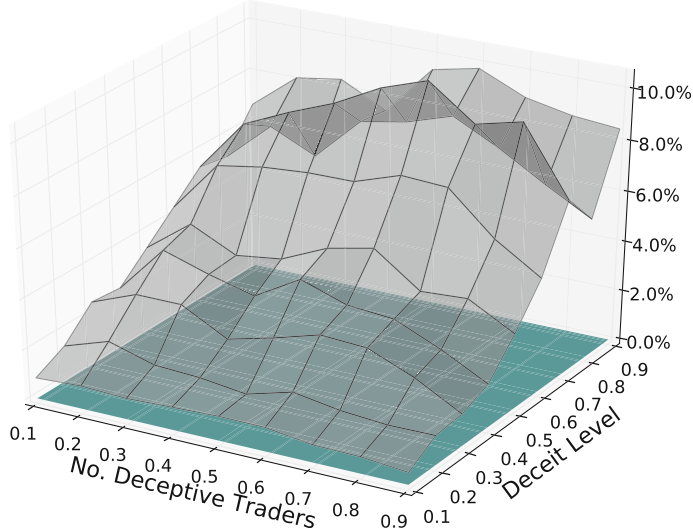 Figure 2: Analysis of the profit difference. Note how TATM (right graph) significantly flattens the advantage that deceptive traders hold in the No-Trust scenario (left graph).
Critical Insight: The "Hidden" Benefit
An interesting observation in the paper is that deceptive traders also benefit from using TATM to listen to each other. This suggests that in a competitive ecosystem, even "bad actors" gravitate toward trust models to avoid being fooled by their own kind.
Limitations & Future Outlook
While TATM is robust, it currently concentrates on direct sharing. In real-world social networks, information is often "third-hand" (reputations). The next frontier for this research is "Witness Reputation"—incorporating what Neighbor A says about Neighbor B.
Conclusion
The TATM model proves that you don't need complex, "all-knowing" central authorities to maintain market integrity. By applying simple reinforcement learning and recency-weighted trust, individual agents can protect themselves and the broader economy from the corrosive effects of misinformation.