
Decoding the TwitterSphere: A New Taxonomy for Online Political Discourse
A Taxonomy for Classifying User Group Activity in Online Political Discourse
The paper introduces a comprehensive taxonomy for classifying user group activity in online political discourse on Twitter. Using Social Media Signals (SMS)—origin, originality, and participation—the authors categorize users into distinct profiles and map them to "information patches" to optimize data preprocessing for sentiment analysis.
TL;DR
Researchers at Drexel University have developed a robust taxonomy to categorize Twitter users during major political events. By breaking down users into "Patches" based on their origin (Human vs. Bot) and participation intensity (Passive vs. Junkie), they've created a roadmap to filter through the noise of over 2.3 million tweets, revealing that a tiny fraction of "Junkies" controls nearly half of the conversation.
Contextual Positioning
In the landscape of social media analytics, most researchers focus on what is being said (NLP/Sentiment Analysis). This paper pivots to who is saying it and how they engage. It stands as a critical bridge between Information Foraging Theory—traditionally used for web browsing—and modern Social Media Pre-processing.
The Problem: The Cost of Information Foraging
Searching for genuine public opinion on Twitter is a high-cost activity. The "Information Scent" is often polluted by:
- Bots and Automation: Malicious actors spreading misinformation.
- Informational Cascades: Individuals being influenced by group behavior rather than private information.
- Data Volume: The sheer noise of millions of retweets that mask original human thought.
Current SOTA methods often normalize text (correcting typos) but fail to account for the contextual meta-data of the user.
Methodology: The SMS Taxonomy
The authors leverage Social Media Signals (SMS) to segment the audience. The architecture of their classification system is built on three pillars:
- Origin: Is the actor a Human, a News outlet, or a Bot?
- Originality: Is the post a Retweet (shared thought) or a Mention (unique thought)?
- Participation: How frequent are they?
- Passive: < 2 tweets
- Active: 2–5 tweets
- Junkies: > 5 tweets
User Classification Logic
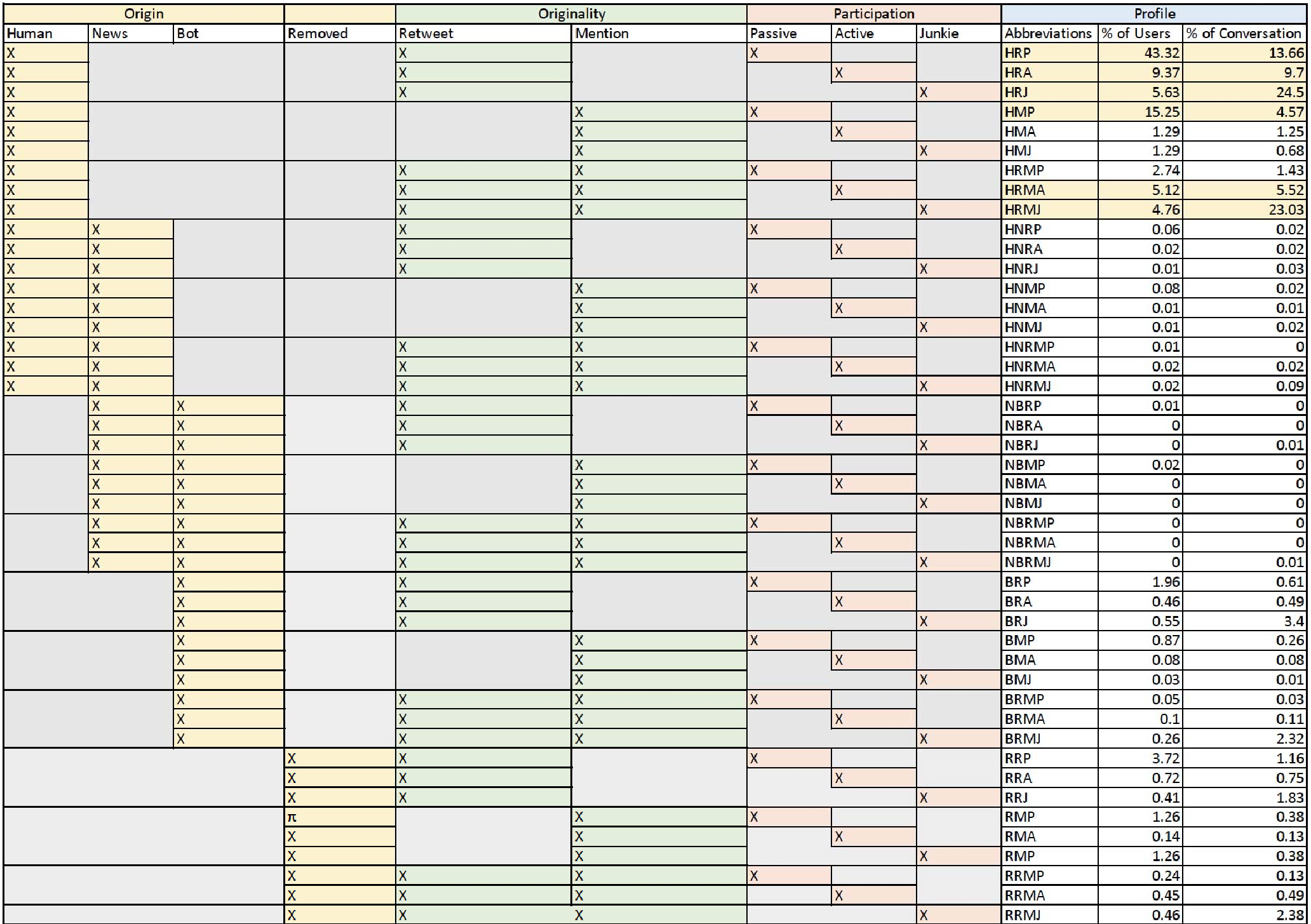 The taxonomy provides a binary checklist to categorize every user profile into a specific abbreviation (e.g., HRP: Human-Retweet-Passive).
Mapping Information Patches (Experimental Results)
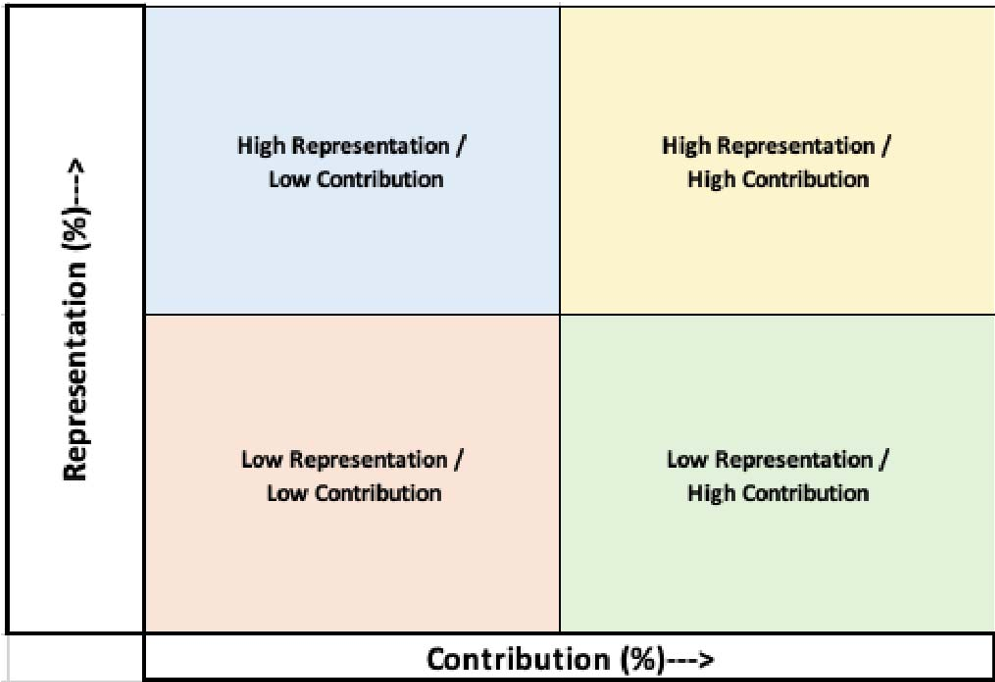
Using the 2019 State of the Union address as a case study, the researchers applied K-Means clustering to group these profiles into four quadrants (Patches):
- Cluster 1 (Upper Right): High representation, high impact. (The general public).
- Cluster 2 (Lower Left): Low representation, low impact. (Usually niche bots or news-bot hybrids).
- Cluster 3 (Lower Right): Small representation, Major Impact. This is where the "Junkies" live—human accounts that retweet incessantly, dominating nearly 48% of the discourse.
- Cluster 4 (Upper Left): Moderate representation and contribution.
Key Insight: The "Junkie" Effect
The data shows a massive imbalance. While 69% of the users are passive "voyeurs" who retweet once or twice, the conversation is effectively "hijacked" by a 10% minority of hyper-active users. If a sentiment analysis tool treats every tweet as equal, it will effectively be a report on the "Junkies'" opinions, not the general public's.
Critical Insight: Considerations for Sentiment Analysis
The paper concludes with a "Call to Action" for data scientists. To achieve accurate sentiment analysis, we should:
- Prune the Extremes: Remove tiny groups with negligible impact to save compute.
- Instance Diminishing: Don't count the 100th retweet of a message with the same weight as the 1st.
- Group-Weighted Sentiment: Assign higher weights to "Active Humans" (Cluster 4) who provide original thoughts (Mentions) rather than just "Junkie" amplifiers.
Conclusion & Future Work
This taxonomy provides a systematic way to transition from "Exploratory Search" (browsing the noise) to "Focused Search" (analyzing targeted patches). By identifying which users are merely echoing versus those leading the discourse, we can build more resilient AI models that aren't fooled by the volume of digital shouting. Future work will look to validate this taxonomy across other political cycles to ensure its universality.