
TCSC: Redefining Spatial Crowdsourcing for Continuous Monitoring
TCSC: A New Type Of Spatial Crowdsourcing
The paper introduces Time-Continuous Spatial Crowdsourcing (TCSC), a novel framework for long-duration tasks requiring time-sharing among multiple workers. It proposes an entropy-based quality metric and optimized assignment strategies for both single-task and multi-task scenarios to handle data deficiency through interpolation.
Executive Summary
TL;DR: The paper "TCSC: A New Type Of Spatial Crowdsourcing" tackles the challenge of long-term environmental and infrastructure monitoring (like air quality or traffic surveillance) using a crowd of mobile workers. It introduces Time-Continuous Spatial Crowdsourcing (TCSC), a framework that optimizes task assignments over continuous time intervals under strict budget constraints.
Positioning: This work moves beyond "instantaneous" tasks (like food delivery) into the realm of continuous sensing, filling a critical gap in the academic landscape regarding temporal data sparsity and interpolation in crowdsourcing.
The Pain Point: The Data Deficiency Problem
In real-world scenarios like pollution monitoring, we need data for every hour of the day. However, budgets are finite. We cannot pay workers to be present at every single time slot ().
Previous methods often ignored the gaps, leading to "sparse" and unreliable results. The authors identify two core difficulties:
- Temporal Dependency: The value of an unobserved time slot can be inferred from its neighbors.
- Assignment Complexity: Determining which slots to "probe" (assign to workers) to maximize total information gain is NP-hard.
Methodology: Entropy and Interpolation
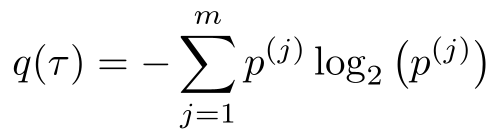
1. The Quality Metric: Beyond Binary Completion
Instead of just checking if a task is "done," the authors use Shannon Entropy to measure quality. If we don't probe a slot, its value is estimated via Inverse Distance Interpolation.
The "Finishing Probability" of a subtask decreases as the temporal distance to the nearest probed subtask increases:
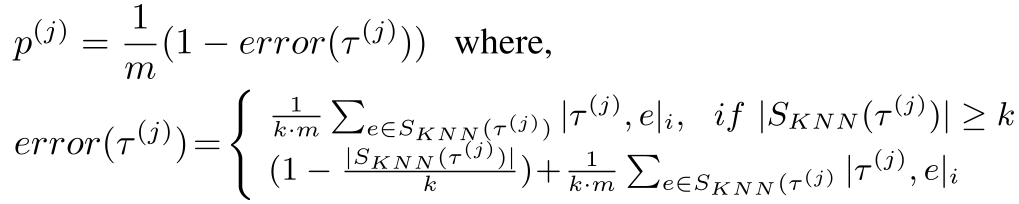
The total task quality is then defined as:
2. Optimization: Approximation*
To solve the NP-hard assignment problem, the authors propose Approximation*. This algorithm uses a local impact domain—since only nearby subtasks affect the interpolation error of a given slot (k-NN search), they can prune the search space and avoid recalculating the entire timeline for every iteration.
Multi-Task Scenarios & Parallelization
When multiple tasks arrive in batches, Worker Conflicts occur: two tasks might need the same nearby worker at the same time.
The paper proposes two parallel frameworks:
- Group-level: Clustering tasks that have no overlapping potential workers and running them on separate threads.
- Task-level: Using a locking mechanism on workers to allow asynchronous updates to task assignments while maintaining consistency.
Experimental Performance
The authors tested TCSC using the T-Drive dataset (Microsoft Research).
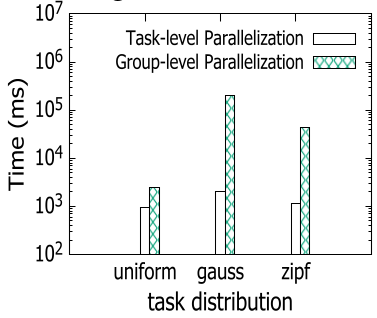 (a) Performance vs. Number of Tasks
Key Findings:
- Scalability: As the number of tasks increases, the parallelized approaches maintain a significantly lower runtime compared to the sequential baseline.
- Distribution Impact: The algorithm is slowest under a Gaussian distribution because worker density creates more conflicts, necessitating more complex locking/resolution steps.
Critical Insight & Future Outlook
TCSC provides a robust mathematical foundation for budget-aware sensor deployment. The core insight—that the value of a crowdsourced point is determined by its ability to help interpolate its neighbors—is a significant step toward "Smarter" Cities.
Limitations: The model assumes a fixed "finishing probability" formula. Future work could incorporate active learning, where the interpolation model (like a Gaussian Process) updates its uncertainty in real-time as workers submit data.
Final Takeaway: For anyone building platforms for environmental sensing or urban monitoring, the TCSC framework offers a blueprint for maximizing information density while minimizing worker costs.