
TEA-RNN: Unmasking Private User Attributes through Behavioral Fingerprinting
TEA-RNN: Topic-Enhanced Attentive RNN for Attribute Inference Attacks via User Behaviors
TEA-RNN is a hybrid deep learning framework designed for Attribute Inference Attacks (AIA) using discrete user behavioral sequences (e.g., browsing/shopping history). It integrates an Attentive RNN to capture local sequential dependencies with a Topic Model (LDA) for global preference modeling, achieving SOTA performance in predicting private demographics.
TL;DR
In the era of big data, your "digital wandering"—the movies you rate or the products you browse—is a goldmine for privacy-intruding algorithms. TEA-RNN (Topic-Enhanced Attentive RNN) is a new framework that treats these behavioral sequences as a window into your private life, combining sequential deep learning with classical topic modeling to infer demographics like gender, age, and income with alarming accuracy.
Background: The Shift from "Who You Know" to "What You Do"
Traditionally, Attribute Inference Attacks (AIA) focused on Social Networks (OSNs). If your friends are all software engineers in their 30s, the model assumes you are too. However, in e-commerce (Amazon, Alibaba), social links are often invisible. The real signal lies in the chronological sequence of behaviors.
Current solutions usually fall into two traps:
- Ignoring the Order: Treating behaviors as a "bag of items" (like Matrix Factorization).
- Missing the Big Picture: Focusing only on local transitions (RNNs) while ignoring the user's high-level topical interests (e.g., a "tech enthusiast" vs. a "home gardener").
TEA-RNN Methodology: Local Logic meets Global Context
The core philosophy of TEA-RNN is that a user's identity is reflected both in how they jump from one item to the next and the overall categories they frequent.
1. The A-RNN Module (Local Features)
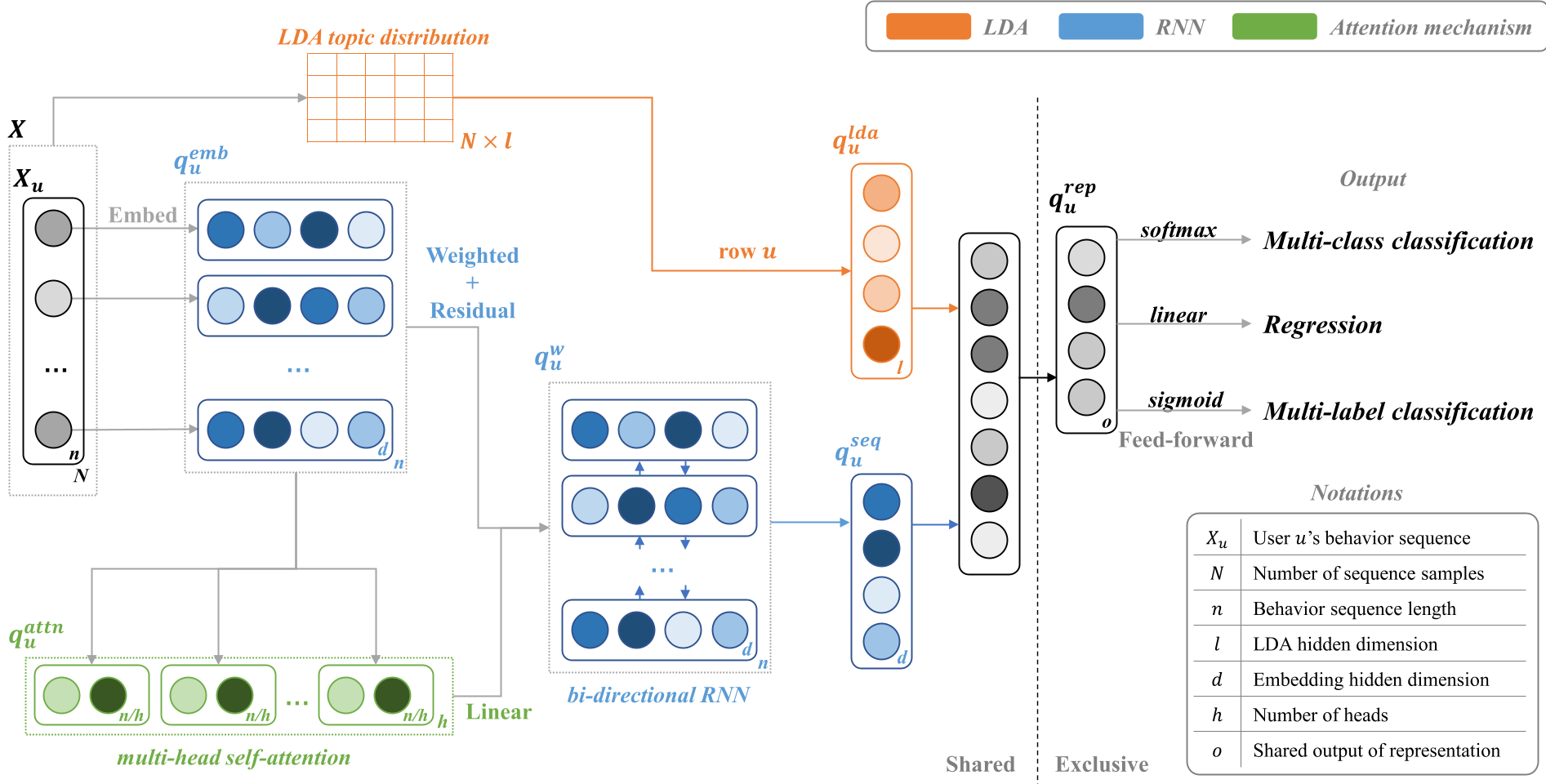
To capture the nuances of sequence, the model uses a Multi-head Self-Attention layer (inherited from Transformer architecture) followed by a Bidirectional GRU.
- The Intuition: Self-attention allows the model to weigh specific items (e.g., buying a baby stroller) more heavily than noise (e.g., buying a generic snack), regardless of when they occurred in the sequence.
2. The LDA Module (Global Features)
The researchers integrated Latent Dirichlet Allocation (LDA). By treating a user's history as a "document" and items as "words," LDA extracts a distribution over "topics."
- The Intuition: Even if the exact sequence varies, the underlying "interests" (topics) remain stable across long durations, providing a robust anchor for demographic prediction.
3. Multi-Task Learning (MTL) Head
Demographics aren't independent. Age often correlates with income; gender might correlate with occupation. TEA-RNN uses a shared representation layer that feeds into multiple specialized task heads. This Inductive Bias allows the model to use the training signal of one attribute to help predict another.
Experimental Validation
The authors tested the model on the MovieLens 1M (ML1M) and Alibaba (Ali) datasets.
- Heterogeneous Tasks: The model demonstrated its versatility by simultaneously handling Multi-class (Age, Occupation), Multi-label (Life Stage), and Regression (Income) tasks.
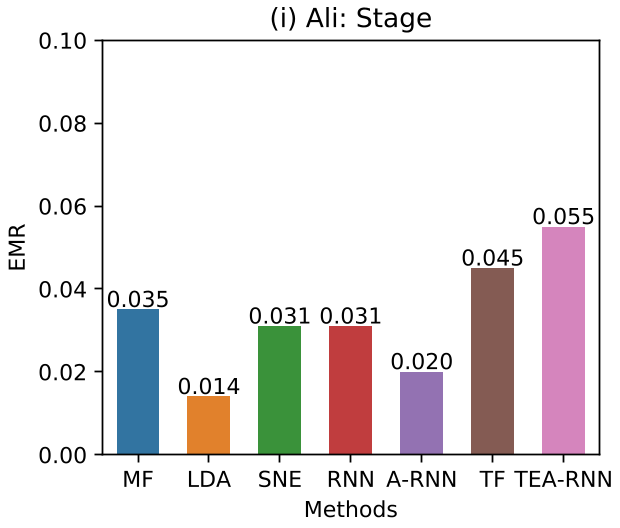
- SOTA Performance: As shown in the performance charts, TEA-RNN consistently outperformed pure RNNs and Transformers, particularly in the sparse Alibaba dataset where the "global topic" provided much-needed stability.
Critical Insight: Why the Hybrid Approach Wins
The most striking takeaway is the Ablation Study (comparing A-RNN vs. TEA-RNN). For attributes like "Education" and "Income," the addition of the Topic Model (LDA) provided a significant boost. This suggests that "Social Status" attributes are better captured by global consumption patterns than by the granular order of individual clicks.
Conclusion & Future Outlook
TEA-RNN represents a significant step in understanding the leakage of private information through routine behaviors. While it offers a powerful tool for marketers, it also serves as a stark warning for privacy researchers.
Future Directions:
- Defense Mechanisms: How can we inject "noise" into behavioral sequences to break these topical and sequential patterns without ruining user experience?
- Scalability: Integrating LDA (typically more computationally expensive) into an end-to-end neural pipeline at the scale of billions of users remains a practical challenge.
This work underlines a fundamental truth in the digital age: You are not just who you know, but every path you take in the digital labyrinth.