
Grouping-Based Team Formation: Optimizing Expertise and Synergy in Social Networks
On team formation with expertise query in collaborative social networks
This paper introduces the Generalized Team Formation problem, extending traditional models to specify a minimum number of experts for each required skill within a collaborative social network. The authors propose a Generalized Enhanced-Steiner algorithm and a novel Grouping-based approach to construct teams that balance skill sufficiency with low communication costs.
TL;DR
Finding the right team isn't just about picking the best individuals; it's about picking people who work well together. This paper tackles the Generalized Team Formation problem—finding multiple experts for specific skills while minimizing communication overhead. By introducing a Grouping-based approach and a Density-based seed strategy, the authors outperform traditional Steiner Tree-based methods in both team synergy and computational speed.
Problem & Motivation: The Complexity of Teamwork
In any collaborative environment, from open-source projects to research labs, a successful project relies on two pillars: Expertise and Communication. While previous algorithms could find a single expert for a set of skills, they stumbled when a task required multiple experts for a single skill (e.g., needing three backend developers and two UI designers).
Mathematically, this is an extension of the Group Steiner Tree (GST) problem, which is notoriously NP-hard. The challenge lies in the trade-off:
- Skill Satisfaction: You need enough people for every role.
- Communication Cost: You want people who have collaborated before (represented as low edge weights in a social graph) to avoid high "inter-mediator" costs—the overhead of including people who don't have the skills but are needed just to pass messages between experts.
Methodology: From Individuals to Group Graphs
The paper's core innovation is moving away from a node-by-node search towards a structural aggregation called the Group Graph.
1. Skill-Based Individual Grouping
Instead of viewing the network as 5,000+ individual authors, the algorithm clusters experts into "Groups" based on required skills. If person A and B both have "Machine Learning" skills and have worked together, they form a cohesive skill-group.
2. The Group Graph Construction
The system builds a super-level graph where each node is a skill-group. Edge weights between groups are derived from the Minimum Shortest Path (MSP) between any two individuals in those groups.
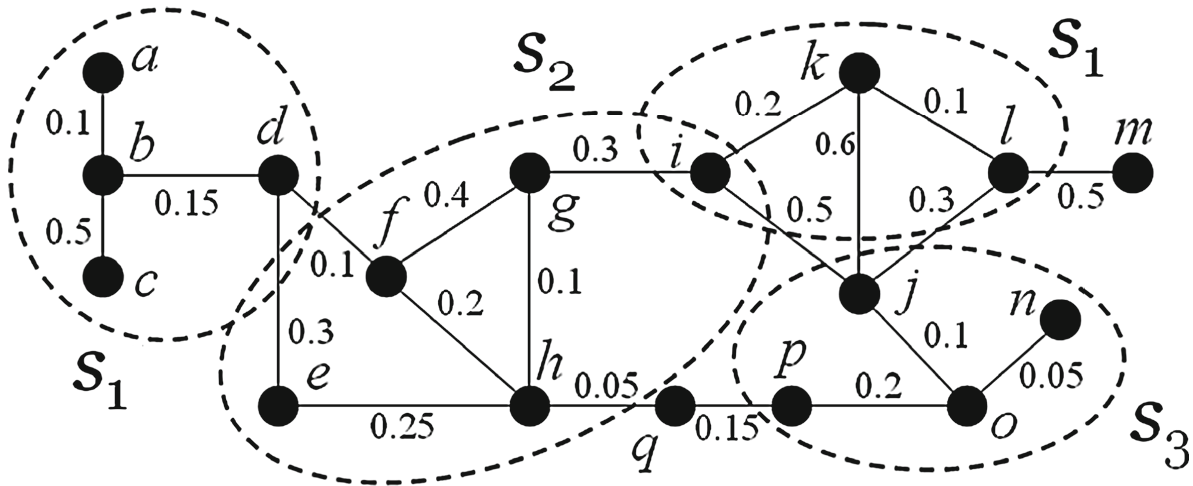 Figure: The process of skill-based individual grouping where overlapping nodes represent multi-talented experts.
3. Density-Based Seed Selection
Standard Steiner algorithms start with a random skill. This paper proposes a Density-based measure. By starting from a skill node that exists in a "dense" part of the network (highly connected ε-neighborhood), the algorithm is much more likely to find a low-cost connection to the next required skill.
4. Role Composition
Once the group-level path is found, the Role Composition Algorithm steps in to refine the team, designating members as Connectors, Inter-mediators, or Collaborators to meet the exact numerical requirements of the task.
Experimental Analysis: Efficiency meets Effectiveness
The authors tested their methods on the DBLP dataset, simulating the process of forming a research team based on paper keywords.
Performance Metrics:
- Communication Cost: The grouping method showed a lower increase in cost as the number of required skills grew.
- Inter-mediators: Crucially, the grouping approach kept the number of "unskilled" middlemen significantly lower than the standard Generalized Steiner algorithm.
- Scalability: While standard algorithms witnessed an exponential-like jump in execution time, the Grouping-based method scaled linearly.
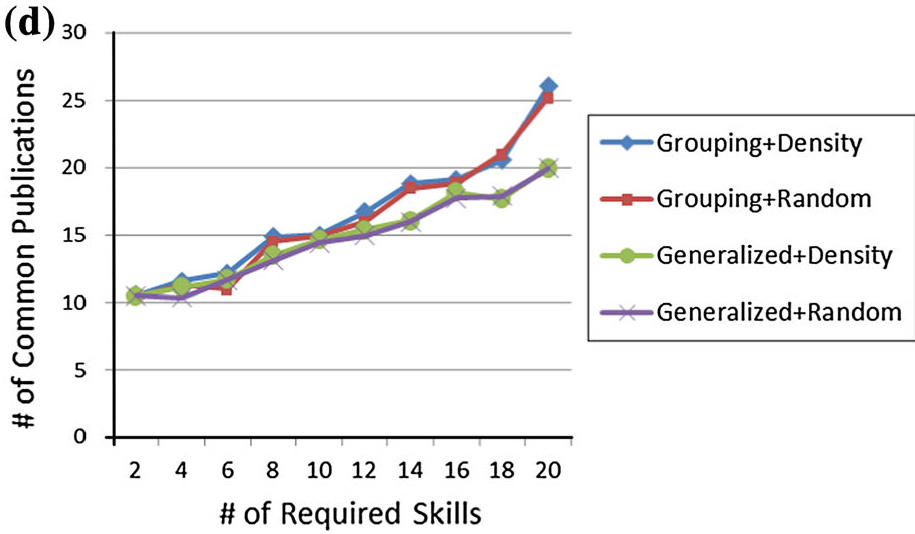 Figure: Performance across communication cost, team cardinality, and inter-mediators for generalized tasks.
Deep Insight & Conclusion
The true value of this paper lies in the Graph Abstraction. By transforming a massive social network into a condensed Group Graph, the authors significantly reduce the search space without losing the essential "collaboration signals."
Key Takeaway: For large-scale community systems, the "Group" is a more powerful unit of analysis than the "Individual." This methodology provides a blueprint for HR software, academic collaboration platforms, and even distributed autonomous organizations (DAOs) to form more cohesive, expert-heavy teams with minimal social friction.
Limitations: The study primarily uses co-authorship as a proxy for communication cost. In real-world companies, factors like geographic timezone, language, and hierarchy might require more complex edge-weighting models.