
ICA-TF: Optimizing Social Expert Teams through Socio-Political Evolution
Team Formation in Social Networks Using Imperialist Competitive Algorithm
This paper introduces a discrete version of the Imperialist Competitive Algorithm (ICA) to solve the Team Formation (TF) problem in social networks. By optimizing both skill coverage and communication costs (Diameter and Sum-Distances), the method achieves SOTA performance on DBLP datasets, outperforming traditional approximation algorithms like RareFirst and BEST-SD.
TL;DR
Finding the right team isn't just about collecting skills; it's about minimizing the friction of collaboration. This paper reimagines Team Formation (TF) as a competitive struggle between "empires." By adapting the Imperialist Competitive Algorithm (ICA) for discrete social networks, the authors provide a framework that finds higher-quality expert teams with lower communication overhead and smaller sizes than previous state-of-the-art approximation methods.
Background: The Cost of Connectivity
In modern online social networks like LinkedIn or GitHub, the bottleneck for project success is rarely a lack of talent—it is the communication cost. In academic terms, the TF problem asks: How can we pick a subset of nodes in a graph that covers all required skills while minimizing the "distance" (cost) between them?
Because this is an NP-hard problem, existing literature has focused on approximation algorithms (like RareFirst). However, these approximations are often "stiff"—they are tailored to specific cost definitions and fail to generalize or explore the global solution space effectively.
The Core Insight: Competition over Approximation
The authors shift the paradigm from greedy approximation to a meta-heuristic approach. They utilize the Imperialist Competitive Algorithm (ICA), which simulates the expansion, assimilation, and competition of imperial powers.
Why ICA?
Unlike Genetic Algorithms (GA) that rely solely on biological evolution, ICA introduces a unique Imperialistic Competition phase. Weak empires lose colonies to stronger ones, creating a powerful global search pressure that prevents the algorithm from getting stuck in "mediocre" local solutions.
Methodology: Discretizing the Empire
The original ICA was designed for continuous function optimization. To make it work for picking experts (discrete IDs), the authors introduced several key innovations:
- Country Representation: A "Country" is represented as an array where each index corresponds to a required skill and each value is an Expert ID.
- Discrete Assimilation: Instead of moving coordinates, "Colonies" (candidate teams) move toward "Imperialists" (better teams) using a Single Point Crossover. This allows the colony to inherit the "successful traits" (experts) of the imperialist.
- Similarity Detection: To prevent all empires from becoming identical (which would kill diversity), the authors added a check: if two imperialists are too similar, their empires are merged.
 Fig 1: Representation of a "Country" as a team of experts mapped to specific skills.
Experimental Battleground: DBLP Dataset
The authors tested their algorithm on the DBLP scientific collaboration network, where experts are authors and edges represent co-authorship.
Performance Metrics
They evaluated two primary costs:
- Diameter (Cc-D): The maximum shortest path between any two members.
- Sum-Distances (Cc-SD): The total distance between all pairs of required skill holders.
Results Analysis
The ICA approach consistently outperformed RareFirst and BEST-SD. For instance, in an 8-skill task, ICA achieved a mean diameter cost of 2.949, while the leading greedy alternative sat at 3.023.
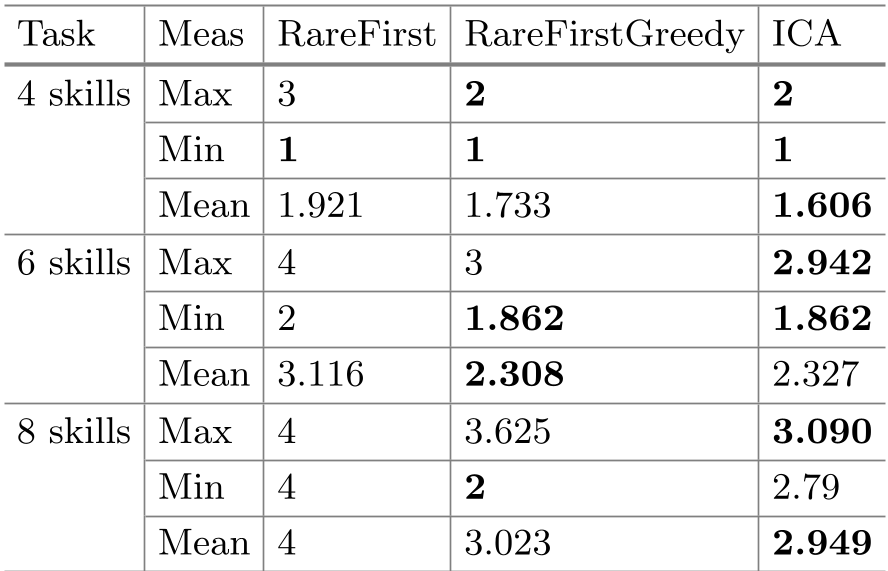 Table 1: Comparing Diameter cost across different algorithms. ICA consistently finds the global minimum.
More impressively, ICA solved the "overcrowding" problem. It found teams that were not only better connected but also smaller in size, which in the real world translates to lower personnel costs.
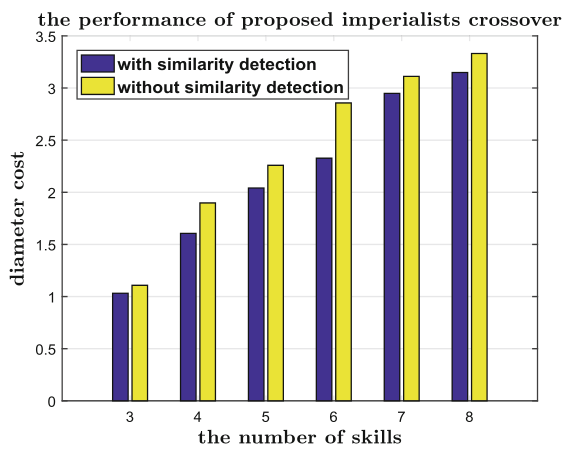 Fig 2: ICA (Blue) generates significantly smaller teams than RareFirst (Red) while maintaining lower costs.
Critical Insight: The Power of Crossover
The "secret sauce" revealed in the ablation study was the Imperialists Crossover. By allowing the "leaders" of different empires to exchange information with similarity detection, the algorithm maintained high Inductive Bias toward quality while preserving Population Diversity. This prevented the common evolutionary trap where the entire population converges to a single, sub-optimal "Imperialist" too early.
Conclusion & Future Outlook
This paper proves that social-inspired meta-heuristics are robust tools for complex network problems. Future Work: The authors aim to expand this into Multi-Objective TF, balancing not just communication and skills, but also individual workload and personnel costs—moving closer to a truly automated HR manager for the digital age.
Takeaway: If you are solving a discrete network problem that is too complex for simple greedy logic, look toward political competition—the Imperialist Competitive Algorithm might be the "optimizer" you need.