
Optimized Team Formation: Leveraging Local Distance Metrics for Efficient Social Collaboration
Team formation in social networks based on local distance metric
This paper introduces a novel algorithm for Team Formation in social networks by optimizing a bi-objective function of personnel and communication costs. The authors propose a unique local distance metric and a selection strategy that minimizes the distance between a candidate expert and any existing team member rather than the entire team.
TL;DR
Building the "dream team" isn't just about finding the best individuals—it's about finding the right people who can work together without excessive "friction" costs. This paper proposes a new algorithm that minimizes both personnel expenses and communication overhead in social networks by focusing on local connectivity rather than global team averages.
Background & Motivation: The Cost of Collaboration
In the context of social network analysis, team formation is modeled as finding a subset of nodes (experts) in a graph that covers a required set of skills. Traditionally, researchers focused on:
- Personnel Cost (PC): The individual fee or salary of an expert.
- Communication Cost (CC): The difficulty of experts working together, usually modeled as the "distance" between nodes in a graph.
The Problem: Prior SOTA methods often tried to minimize the distance from a candidate to every other member or to a single "leader." This results in overly restrictive teams and ignores the reality of modern collaborative workflows where a single "bridge" person is often sufficient for effective communication.
The Core Innovation: Local Distance and "One-to-Any" Matching
The authors introduce a refined distance metric and a new selection logic that shifts the paradigm from "One-to-All" to "One-to-Any."
1. The Local Distance Metric
The distance is not just the sum of edge weights. It incorporates the number of nodes in the path as a multiplier: This penalizes longer paths more heavily, reflecting the practical difficulty of relaying information through multiple intermediaries.
2. The Selection Strategy
Instead of adding an expert based on their total distance to the team, the algorithm uses: This ensures that as long as a new expert can communicate efficiently with at least one person already on the team, they are a viable candidate.
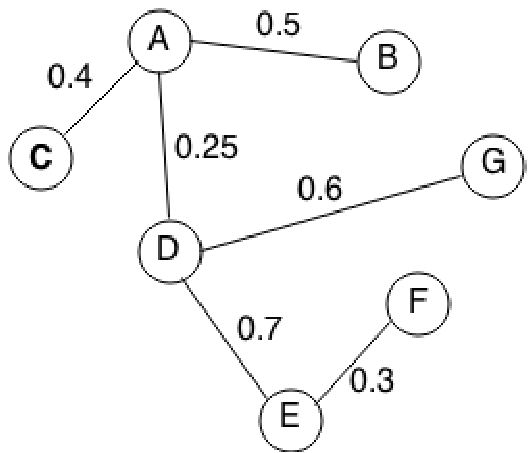 Figure 1: A sample expert graph showing how distances are calculated between nodes (e.g., A to F) using the proposed metric.
Experimental Validation: DBLP Study
The researchers used the DBLP dataset (a massive collaboration graph of computer science authors) to test the algorithm. Experts were defined as authors with papers, and edges were formed by co-authorship.
Performance Metrics
The study compared the proposed method against several baselines:
- MCC (Minimum Cost Contribution)
- Approximation Algorithm
- Swap Algorithm
- Random Selection
Key Findings
- Total Cost Efficiency: The proposed method outperformed all baselines. As the number of tasks (team size) increased, the cost gap widened significantly.
- Scalability: By simplifying the communication cost logic to a local search, the algorithm remains efficient even as the project complexity grows from 5 to 20 skills.
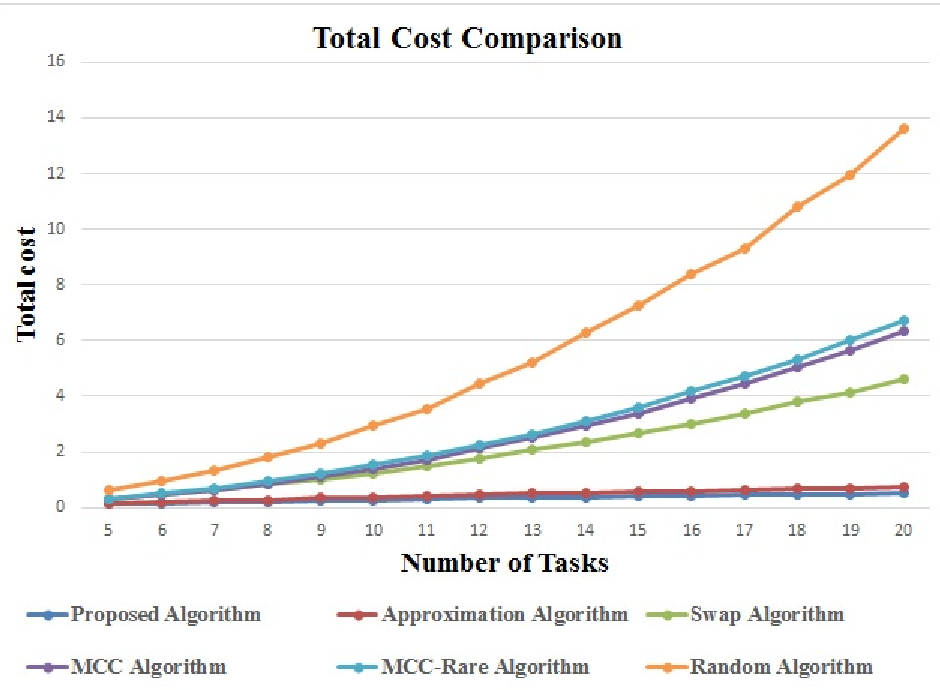 Figure 4: The Total Cost comparison highlights that the proposed algorithm maintains low overhead compared to MCC and Random methods.
Critical Insight & Future Outlook
The genius of this work lies in its Inductive Bias: the assumption that social collaboration is a "chain" or a "web" rather than a "star" topology.
Limitations: While the local distance metric is efficient, it might lead to "stringy" teams where experts at opposite ends of the communication chain are very far apart. Future work could introduce a "maximum diameter" constraint to ensure that while local connections are prioritized, the team doesn't become too fragmented.
Conclusion: This paper provides a robust framework for automated team composition. By balancing the "price" of an expert with their "proximity" to the existing group, it offers a pragmatic solution for organizations looking to optimize human capital in a connected world.