
TOTP: Bridging Skills and Space in Modern Crowdsourcing
Team-Oriented Task Planning in Spatial Crowdsourcing
The paper introduces TOTP (Team-Oriented Task Planning), a novel spatial crowdsourcing framework that optimizes worker schedules while ensuring tasks' multi-skill requirements are met. It proposes two heuristic algorithms, RSP and SCUP, to solve the NP-hard problem of maximizing total worker satisfaction under spatial, temporal, and skill constraints.
TL;DR
As spatial crowdsourcing platforms like Uber and Gigwalk evolve, the tasks they handle are becoming increasingly complex. In this paper, researchers from Beihang University and HKUST introduce TOTP (Team-Oriented Task Planning). Unlike previous models that assign one worker to one task, TOTP forms teams of workers to satisfy multi-skill task requirements while optimizing travel budgets and time windows.
The "Homogeneous Worker" Fallacy
Most existing spatial crowdsourcing (SC) research operates on a flawed assumption: that any worker can do any task as long as they are close enough. In reality, a task might require a specific skill set—like a domestic service requiring both "babysitting" and "cooking."
The problem is twofold:
- Skill Mismatch: A single worker rarely has every skill needed for complex tasks.
- Resource Constraints: Workers have limited "travel budgets" (time/distance) and tasks have strict "time intervals."
If a platform ignores skills, it might assign a task to a nearby worker who simply cannot complete it, leading to wasted time and zero utility.
Methodology: How to Build the Perfect Team?
The authors prove that finding the optimal set of plans for all workers is NP-hard via a reduction from the Knapsack Problem. To solve this efficiently, they propose two core heuristics:
1. Rarest Skill Priority (RSP)
This algorithm identifies "bottleneck" skills—skills that are required by many tasks but possessed by few workers. By prioritizing these rare matches, the system prevents a scenario where a specialized worker is "wasted" on a common task, leaving a specialized task unfinishable.
2. Skill Cover and Utility Priority (SCUP)
SCUP takes a "Task-First" approach. It sorts tasks chronologically and, for each task, performs a two-step optimization:
- Step 1: Find the smallest set of available workers needed to cover all required skills.
- Step 2: If there is remaining capacity (the task allows more workers), fill it with workers who provide the highest satisfaction/utility.
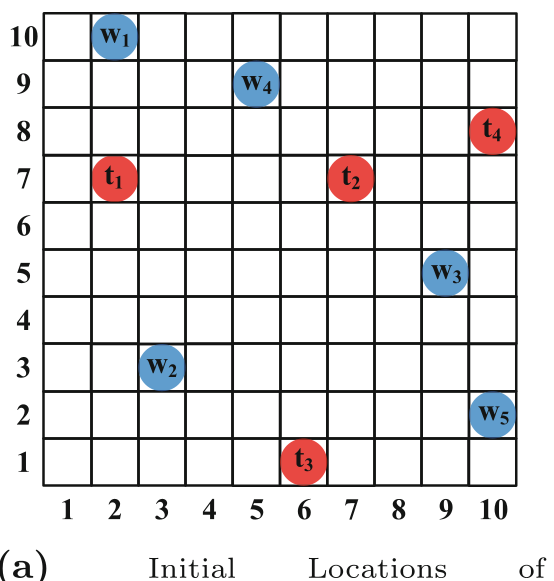 Fig 1: Illustrating the spatial distribution of workers (w) and tasks (t) within a 2D coordinate system.
Experimental Insights
The researchers tested their approach against the gMission real-world dataset. The findings were clear: SCUP is the superior strategy.
- Utility: SCUP consistently achieved higher total satisfaction because it ensures task completion by focusing on team coherence first.
- Efficiency: RSP relies on a complex heap structure that must be updated whenever a worker's plan changes, making it slower and more memory-intensive than the streamlined SCUP approach.
- Scalability: As the number of tasks () increases, SCUP’s utility gains remain stable, whereas RSP's utility grows much slower due to worker dispersion.
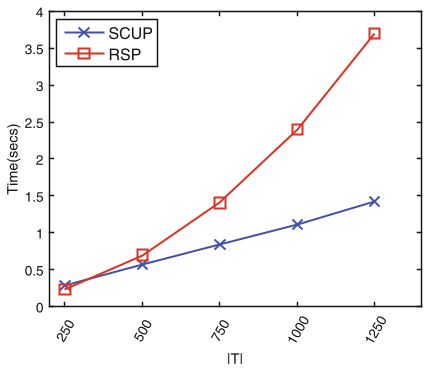 Fig 2: Utility trends showing SCUP's dominance over RSP as the number of tasks increases.
Critical Analysis & Conclusion
The TOTP framework is a significant step toward making crowdsourcing platforms more "intelligent" and "collaborative." By treating task assignment as a team formation problem over a spatial-temporal manifold, the authors provide a more realistic solution for gig-economy platforms.
Limitations: The model assumes that worker skills are static and fully known. In future iterations, incorporating a "learning" component—where workers gain skills or their proficiency is rated by the platform—would add another layer of robustness.
Future Outlook: We expect this "Team-Oriented" logic to spread beyond domestic services into fields like disaster relief or complex urban logistics, where no single "expert" can solve a problem alone.