
TING Engine: Democratizing Complex Modeling and Predictions via the Cloud
TECHNICAL ENGINE FOR DEMOCRATIZATION OF MODELING, SIMULATIONS, AND PREDICTIONS
The paper proposes TING (Technical Engine), a cloud-based online platform designed to democratize Modeling and Simulation (M&S) and predictive analytics. It integrates multi-paradigm technologies with crowd-sourcing and social networking to provide "M&S on demand" for both professional technologists and the general public.
TL;DR
The TING (Technical Engine) project aims to bridge the gap between high-end computational science and everyday decision-making. By moving Modeling & Simulation (M&S) to the cloud and integrating it with social networks and crowd-sourcing, the authors propose a framework where anyone—from scientists to "passionate citizens"—can query the future through data-driven and physics-based simulations.
Context: The Need for Computational Democratization
We live in an era of "Big Data," yet the ability to turn that data into reliable predictions remains locked behind proprietary tools and specialized expertise. The authors argue that while computing power has grown exponentially, our social processes for collaborative innovation have not kept pace. Existing platforms like Google Prediction API or InnoCentive focus on either pure data or pure crowdsourcing; TING attempts to unify these with dynamic behavioral models (physics-informed simulation).
The Core Innovation: TING Architecture
The TING engine is built upon two pillars: the Technology Management System (TMS) and the Knowledge Management System (KMS). This dual-system approach ensures that both the specialized software (solvers, IDEs) and the collective wisdom (models, data sets, social interactions) are managed seamlessly.
Multi-View Interface
To cater to diverse stakeholders, the engine provides several "Views":
- Simulation-Specific View: Where users manipulate models and execution traces.
- Big-Data-Specific View: For handling large-scale datasets used in extrapolated projections.
- Social View: A dedicated business network for technical exchange and collaborative problem-solving.
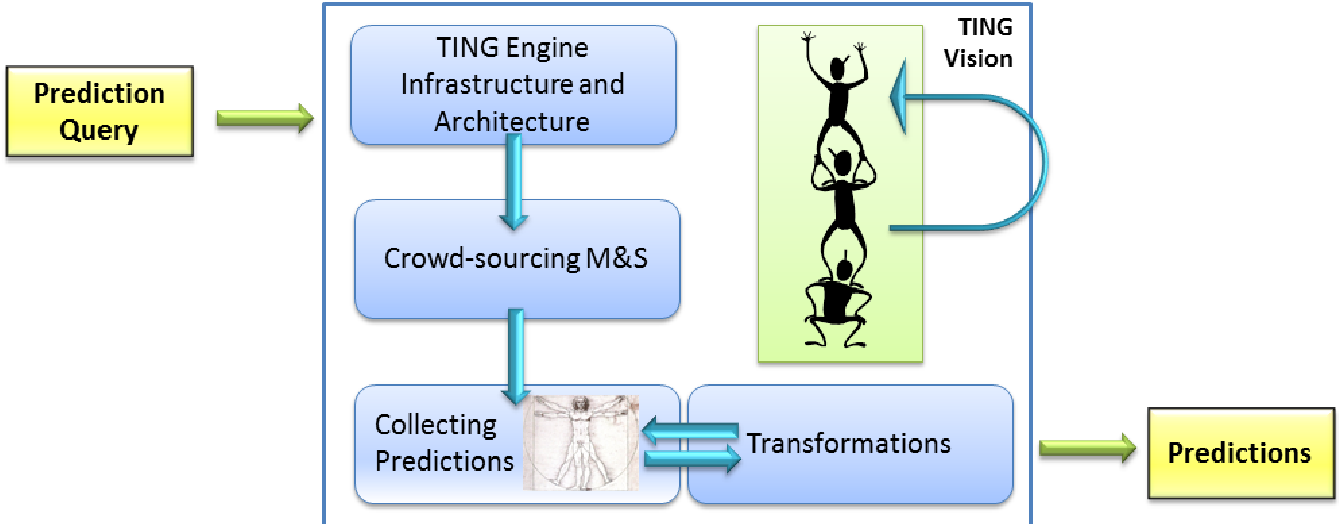 Figure 1: The vision of TING where "Prediction Queries" are transformed into "Prediction Responses" through a collaborative engine.
Methodology: From "Pick and Place" to Predictive Insight
The paper illustrates the framework using a Cyber-Physical System (CPS) example: a Pick and Place (PnP) machine interacting with "smart objects."
In traditional setups, changing the behavior of the system (e.g., solving the Tower of Hanoi puzzle) would require re-certifying the entire machine's control logic. Using TING’s Domain-Specific View, the complexity is shifted to the "local intelligence" of the blocks themselves. This Model-Based Design approach allows the engine to predict energy efficiency and operational frequency by simulating the interaction between physical sensors and software logic in the cloud.
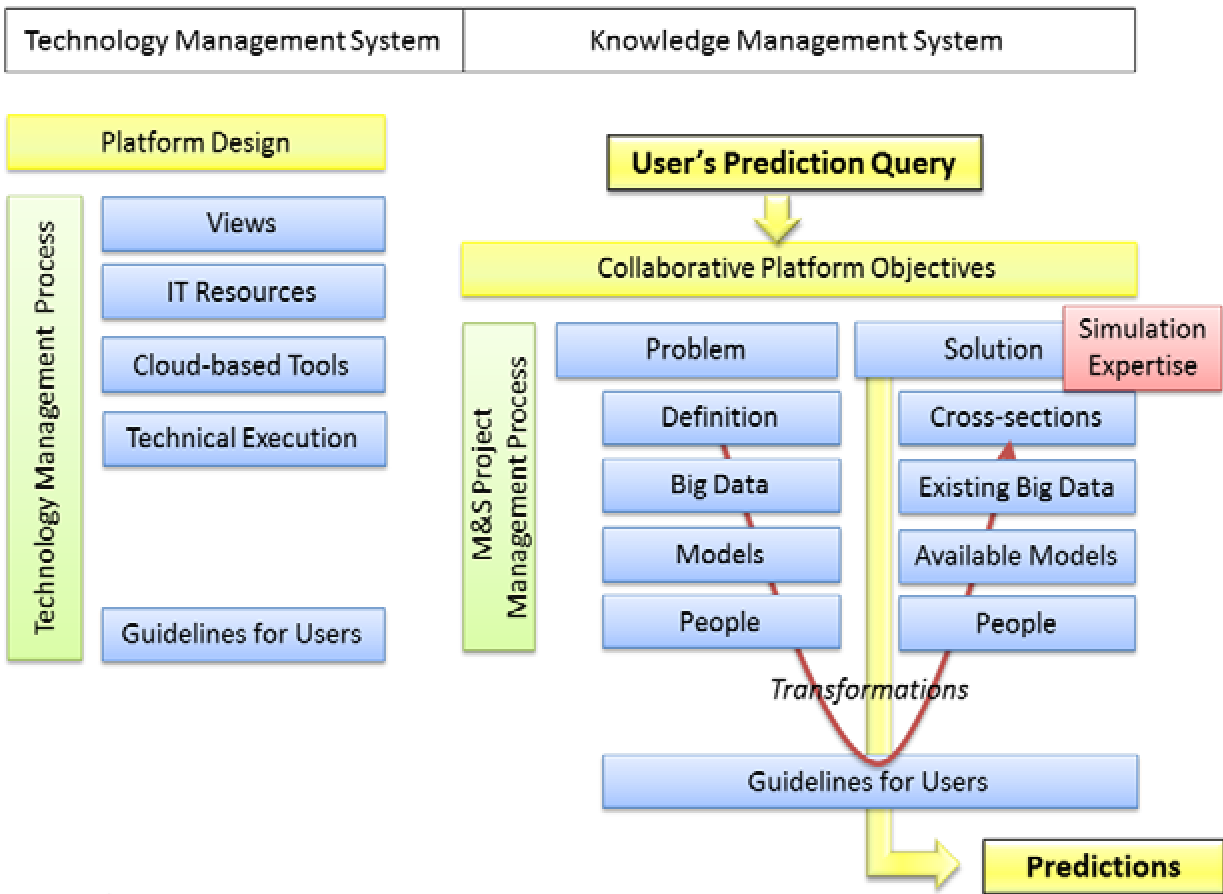 Figure 2: The detailed architecture showing the interplay between Cloud-based tools (TMS) and the community-driven Knowledge Management System (KMS).
SOTA Comparison & Critical Analysis
Unlike previous web-based simulation libraries (like those proposed by Iazeolla in the late 90s), TING focuses on Semantic-specific Views. It doesn't just store models; it analyzes the semantics of execution (e.g., discrete event vs. continuous time).
Key Advantages:
- Zero Installation: Users access heavy-duty tools like MATLAB/Simulink via a SaaS model.
- Human-in-the-loop: Integrates "Human Computation" to solve steps that algorithms cannot yet handle.
- Cross-pollination: A researcher in automotive dynamics might use a transformation pattern originally designed for aerospace, facilitated by the shared platform.
Limitations: The paper introduces a high-level conceptual framework and initial architecture. While the vision for "Computation of Things" (CoTh) is grand, the implementation of "Query Parsing" via machine learning remained a future objective at the time of writing. The complexity of resolving semantic inconsistencies between different solver types (e.g., merging different ODE solvers in the cloud) remains a significant technical hurdle.
Conclusion: A Vision for "Computation of Things"
TING is more than a tool; it is a proposal for a social business network for scientists. By lowering the barrier to entry for complex modeling, the authors envision a world where "citizen analysts" can use scientifically-founded extrapolations to solve societal challenges, from manufacturing efficiency to environmental sustainability.
Takeaway for Research
This work highlights that the future of SOTA M&S isn't just about faster solvers, but about accessible orchestration. For those working in Digital Twins or Smart Cities, the TING architecture provides a roadmap for integrating heterogeneous data and models into a unified, user-friendly prediction engine.